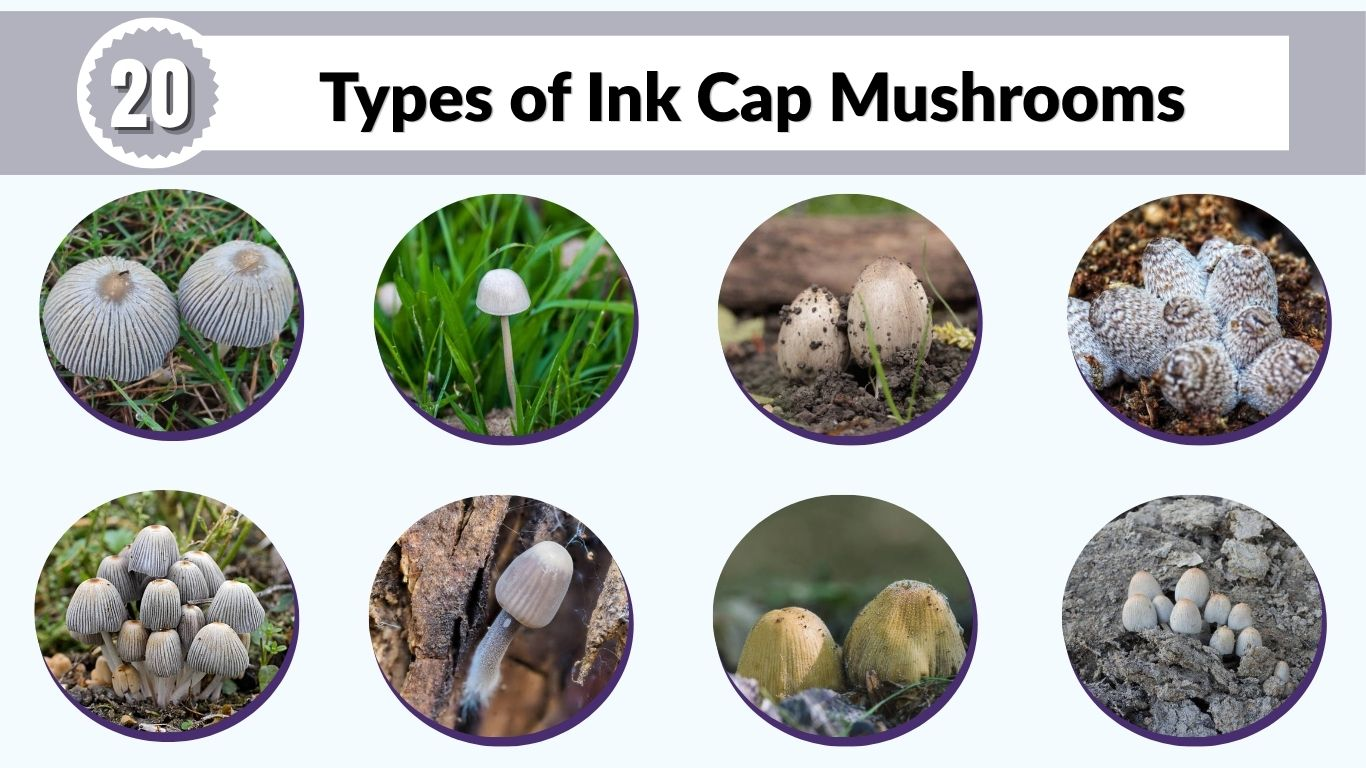
Ink cap mushrooms are a fascinating group of fungi known for their unusual life cycle and delicate appearance. These mushrooms are famous for turning into a black, ink-like liquid as they mature, a process that helps spread their spores. They can be found in a variety of environments, from forests and gardens to compost and grasslands. While some species are edible when young, others are best avoided. This guide explores 20 different types of ink cap mushrooms to help you identify and understand their unique characteristics in nature.
1. Coprinus comatus

A distinctive ink cap mushroom commonly known as the “shaggy mane” or “lawyer’s wig.” It is easily recognized by its tall, cylindrical cap covered in shaggy white scales. This species is popular among foragers due to its unique appearance and excellent edibility when young.
Identification
- Tall, cylindrical cap covered with shaggy white scales
- Cap starts white and gradually turns black as it matures
- Edges of the cap dissolve into a black, ink-like liquid (deliquescence)
- Slender, white stem with a movable ring
- Grows singly or in groups on soil, grass, or disturbed ground
Habitat and Distribution
Coprinus comatus is widely distributed across temperate regions worldwide. It commonly grows in grassy areas such as lawns, roadsides, and meadows, often appearing after rain. This species prefers nutrient-rich or disturbed soils and can frequently be found in urban environments. It typically fruits in clusters and may appear repeatedly in the same location under favorable conditions.
Edibility and Uses
This mushroom is considered highly edible when young and still white. It has a mild, pleasant flavor and is often used in sautéed dishes or soups. However, it must be consumed soon after harvesting because it quickly begins to dissolve into black liquid as it matures. Once this process starts, it is no longer suitable for eating.
Interesting Facts
Coprinus comatus is famous for its self-digesting process, where the cap turns into an inky substance to release spores. Historically, this black liquid was sometimes used as writing ink. Its rapid transformation makes timing important for those who wish to collect it for food.
2. Coprinopsis atramentaria

A well-known ink cap mushroom often called the “common ink cap.” It has a smooth, grayish cap and is famous for its unique chemical reaction with alcohol. This species is widely found and easily recognized, especially in urban and suburban environments.
Identification
- Smooth, bell-shaped cap that is gray to brown in color
- Cap surface may have fine radial lines or grooves
- Edges of the cap dissolve into black ink as it matures
- White stem, usually smooth and hollow
- Grows in dense clusters, often at the base of trees or on buried wood
Habitat and Distribution
Coprinopsis atramentaria is commonly found in temperate regions around the world. It grows on rich soil, lawns, roadsides, and near decaying wood. This species often appears in large clusters, especially after rainfall. It is frequently seen in urban areas, gardens, and parks, making it one of the most encountered ink cap mushrooms.
Edibility and Uses
This mushroom is considered edible when cooked, but it should never be consumed with alcohol. It contains a compound that can cause unpleasant reactions if alcohol is consumed within a few days of eating it. Due to this risk, it is generally not recommended for casual consumption.
Interesting Facts
Coprinopsis atramentaria is sometimes called the “tippler’s bane” because of its reaction with alcohol. The compound it contains interferes with alcohol metabolism, leading to symptoms like flushing and nausea. Like other ink caps, it undergoes deliquescence, turning into a black liquid to release its spores.
3. Coprinellus micaceus

A small, delicate ink cap mushroom commonly known as the “mica cap.” It gets its name from the tiny, glittering particles that often cover its cap when young. This species is frequently found in clusters and is one of the most common ink caps in urban and woodland areas.
Identification
- Small, bell-shaped cap with a honey-brown to amber color
- Covered with tiny, shiny granules when young (often washed away by rain)
- Cap has fine radial grooves and becomes more open with age
- Margins may partially dissolve into black ink, but less dramatically than larger ink caps
- Thin, pale stem, usually growing in dense clusters
Habitat and Distribution
Coprinellus micaceus is widely distributed across temperate regions worldwide. It typically grows in clusters on decaying wood, tree stumps, or buried roots. This mushroom is commonly found in gardens, parks, and forest edges. It thrives in moist conditions and often appears after rainfall, sometimes in large numbers.
Edibility and Uses
This species is considered edible when young, though it is not highly valued due to its small size and delicate nature. It has a mild flavor and is sometimes used in mixed mushroom dishes. However, like many ink caps, it deteriorates quickly and should be consumed soon after harvesting.
Interesting Facts
The sparkling granules on the cap resemble mica, giving the mushroom its common name. These particles can disappear quickly after rain, making identification slightly harder. Unlike some ink caps, it does not fully dissolve into liquid but may partially break down at the edges as it matures.
4. Coprinellus disseminatus

A small and fragile ink cap mushroom often called the “fairy ink cap.” It is known for appearing in large numbers, sometimes forming dense clusters that cover decaying wood. Its delicate structure and pale color make it a common but easily overlooked species.
Identification
- Very small, bell-shaped caps that are pale gray to whitish
- Thin, delicate structure with fine radial grooves
- Caps become slightly flattened as they mature
- Does not fully dissolve into black ink like many other ink caps
- Grows in large, dense clusters, often in hundreds
Habitat and Distribution
Coprinellus disseminatus is widely distributed in temperate regions around the world. It grows on decaying wood, tree stumps, and buried roots. This species thrives in moist, shaded environments and is often found in forests, gardens, and parks. It typically appears after rain and can form large colonies in a short time.
Edibility and Uses
This mushroom is generally considered inedible due to its very small size and fragile texture. It has little culinary value and is rarely collected for food. Most people encounter it as a natural curiosity rather than a useful edible species.
Interesting Facts
Coprinellus disseminatus is sometimes called the “fairy ink cap” because of its tendency to appear overnight in large numbers. Unlike many ink caps, it does not liquefy into ink as it matures. Its rapid growth and clustered appearance make it one of the most visually striking small fungi in woodland areas.
5. Coprinopsis lagopus

A delicate ink cap mushroom often known as the “hare’s foot ink cap.” It is named for its fuzzy, white covering when young, which resembles a rabbit’s foot. This species is short-lived and quickly transforms as it matures.
Identification
- Young caps covered with white, woolly or hairy fibers
- Cap starts egg-shaped, then expands into a bell shape
- Color changes from white to gray and eventually black
- Cap edges dissolve into black ink as it matures
- Slender, fragile stem, usually growing singly or in small groups
Habitat and Distribution
Coprinopsis lagopus is widely found in temperate regions across the world. It typically grows on decaying wood, wood chips, or rich organic debris. This mushroom prefers moist environments and often appears after rain. It is short-lived, sometimes emerging and disappearing within a day, especially in warm conditions.
Edibility and Uses
This species is generally considered inedible due to its small size, fragile structure, and rapid breakdown. It has no significant culinary value and is not commonly collected for food. Most observations of this fungus are for identification or study.
Interesting Facts
The name “hare’s foot” comes from its fuzzy appearance in early stages. As it matures, the hairy coating disappears, and the cap begins to liquefy. Like many ink caps, it undergoes deliquescence, turning into a black liquid to help disperse spores efficiently.
6. Coprinopsis picacea

A striking ink cap mushroom often called the “magpie ink cap” due to its black-and-white patterned cap. It has a tall, elegant form and is easily recognized by its contrasting colors. This species is more commonly found in woodland settings rather than urban areas.
Identification
- Tall, bell-shaped cap with black background and white patches
- Distinctive “magpie-like” pattern as the cap expands
- Cap surface becomes more exposed and darker with age
- Edges of the cap dissolve into black ink when mature
- Slender, white stem, often smooth and upright
Habitat and Distribution
Coprinopsis picacea is found in temperate regions, particularly in Europe. It typically grows in deciduous forests, especially under beech trees. This mushroom prefers rich, well-drained soil and shaded environments. It appears mainly during autumn and is usually found singly or in small scattered groups rather than large clusters.
Edibility and Uses
This species is generally considered inedible and may cause mild digestive discomfort if consumed. It is not used in cooking and is best avoided as a food source. Most people admire it for its unique appearance rather than collect it for consumption.
Interesting Facts
The common name “magpie ink cap” comes from its resemblance to the black-and-white plumage of a magpie bird. It is one of the more visually distinctive ink caps. Like others in its group, it undergoes deliquescence, where the cap breaks down into a black liquid to release spores.
7. Coprinellus radians

A small ink cap mushroom recognized for its delicate cap and distinctive orange, fuzzy growth at the base. It is less commonly noticed than other ink caps but can be identified by its unique substrate covering and clustered growth.
Identification
- Small, bell-shaped cap that is pale gray to light brown
- Fine radial grooves visible on the cap surface
- Cap edges may slightly dissolve with age
- Slender, fragile stem with a whitish color
- Orange, felt-like mat (ozonium) often present at the base
Habitat and Distribution
Coprinellus radians is found in temperate regions, particularly in Europe and North America. It grows on decaying wood, especially in damp, shaded environments such as forests, gardens, and parks. The species is often associated with buried wood or old stumps and tends to appear in small clusters rather than large groups.
Edibility and Uses
This mushroom is generally considered inedible due to its small size and lack of culinary value. It is not commonly collected for food and is mostly observed for identification purposes. There is little information suggesting any traditional or modern use.
Interesting Facts
Coprinellus radians is notable for the orange, fuzzy growth at its base, which helps distinguish it from similar species. This feature is actually a mass of fungal threads. Like many ink caps, it has a short lifespan and may quickly change in appearance as it matures.
8. Coprinellus domesticus

A small to medium-sized ink cap mushroom commonly known as the “firerug ink cap.” It is notable for the orange, carpet-like growth at its base, which makes it easier to identify among similar species. It often appears in clusters on decaying wood.
Identification
- Bell-shaped cap, pale brown to gray with fine grooves
- Cap surface smooth, becoming more open with age
- Margins may slightly dissolve but not as dramatically as larger ink caps
- Slender, whitish stem, fragile in structure
- Distinct orange, fuzzy mat (ozonium) at the base
Habitat and Distribution
Coprinellus domesticus is widely distributed in temperate regions. It grows on decaying hardwood, often on logs, stumps, or buried wood. This species is commonly found in forests, gardens, and even near buildings where wood is present. It prefers moist conditions and usually appears after rainfall, often in small to medium clusters.
Edibility and Uses
This species is generally considered inedible due to its small size and lack of desirable flavor or texture. It is not used in cooking and is rarely collected as a food source. Most encounters with this mushroom are for observation or identification.
Interesting Facts
The common name “firerug ink cap” comes from the bright orange mat at its base, which looks like a small carpet. This feature helps distinguish it from closely related species. Like many ink caps, it has a short lifespan and can quickly change appearance as it matures.
9. Coprinellus truncorum

A small to medium-sized ink cap mushroom that closely resembles Coprinellus micaceus but lacks the sparkling granules on the cap. It is commonly found in clusters and is often mistaken for similar species due to its subtle differences.
Identification
- Bell-shaped cap, light brown to grayish in color
- Smooth surface without shiny granules
- Fine radial grooves visible, especially as it matures
- Cap edges may partially dissolve into black ink
- Slender, pale stem, typically growing in clusters
Habitat and Distribution
Coprinellus truncorum is found in temperate regions, particularly in Europe and parts of North America. It grows on decaying wood, tree stumps, and buried roots. This species prefers moist environments such as forests, parks, and gardens. It often appears after rainfall and can grow in dense clusters, similar to other ink caps.
Edibility and Uses
This mushroom is considered edible when young, but it is not commonly used due to its small size and similarity to other species that are easier to identify. Proper identification is important before consumption, as it can be confused with less desirable species.
Interesting Facts
Coprinellus truncorum is frequently mistaken for Coprinellus micaceus, but it lacks the glitter-like particles on the cap. This similarity makes identification challenging without careful observation. Like many ink caps, it undergoes partial deliquescence, helping it release spores efficiently.
10. Coprinopsis nivea

A delicate white ink cap mushroom often called the “snowy ink cap.” It is easily recognized by its bright white, powdery appearance when young. This species is typically found in nutrient-rich environments and has a short lifespan.
Identification
- Small, white, bell-shaped cap covered with a powdery coating
- Cap surface smooth underneath the powder, becoming grayish with age
- Edges of the cap dissolve into black ink as it matures
- Thin, fragile white stem
- Often grows in small groups on rich organic material
Habitat and Distribution
Coprinopsis nivea is widely distributed in temperate regions around the world. It commonly grows on nutrient-rich substrates such as manure, compost, or heavily fertilized soil. This fungus prefers moist conditions and often appears after rainfall. It is typically found in open areas like fields, gardens, and pastures rather than deep forests.
Edibility and Uses
This species is generally considered inedible due to its small size, fragile structure, and growth on manure-rich substrates. It is not used in cooking and has no significant culinary value. Most people observe it in natural settings rather than collect it for consumption.
Interesting Facts
The name “nivea” refers to its snowy white appearance when young. As it matures, the bright coating fades and the cap begins to darken and dissolve. Like other ink caps, it undergoes deliquescence, turning into a black liquid to aid in spore dispersal.
11. Coprinopsis cinerea

A small to medium-sized ink cap mushroom often used in scientific research due to its simple life cycle. It has a grayish cap and a delicate structure, making it a typical example of ink cap fungi found on nutrient-rich substrates.
Identification
- Gray to light brown, bell-shaped cap
- Smooth surface with fine radial grooves
- Cap expands and darkens as it matures
- Edges dissolve into black ink during maturity
- Thin, fragile stem, usually pale in color
Habitat and Distribution
Coprinopsis cinerea is widely distributed across temperate regions worldwide. It commonly grows on nutrient-rich substrates such as manure, compost, and decaying organic matter. This species prefers moist environments and is often found in fields, gardens, and agricultural areas. It appears quickly after rainfall and has a short life cycle.
Edibility and Uses
This mushroom is generally considered inedible due to its small size and growth on manure-rich substrates. It has no significant culinary value and is not commonly collected for food. Instead, it is more important in scientific and educational contexts.
Interesting Facts
Coprinopsis cinerea is widely studied in laboratories because of its rapid growth and simple genetics. Scientists use it to understand fungal development and reproduction. Like other ink caps, it undergoes deliquescence, where the cap liquefies to release spores efficiently.
12. Coprinellus flocculosus

A small ink cap mushroom known for its soft, woolly covering when young. It has a delicate structure and quickly changes as it matures, making it somewhat difficult to identify at later stages. Its subtle appearance often causes it to be overlooked in natural settings.
Identification
- Small, bell-shaped cap with a whitish to pale gray color
- Covered with fine, woolly or floccose (hair-like) patches when young
- Cap surface becomes smoother as it ages
- Margins may begin to dissolve into black ink at maturity
- Thin, fragile stem, usually pale and slender
Habitat and Distribution
Coprinellus flocculosus is found in temperate regions, particularly in Europe and North America. It typically grows on decaying wood, wood chips, or rich organic debris. This species prefers moist, shaded environments such as forests, gardens, and parks. It often appears after rainfall and may grow in small groups or scattered clusters.
Edibility and Uses
This species is generally considered inedible due to its small size, fragile nature, and lack of culinary value. It is not commonly collected for food and is mostly observed for identification or study purposes.
Interesting Facts
The name “flocculosus” refers to the woolly texture seen on young caps. As the mushroom matures, these soft patches disappear, changing its appearance significantly. Like many ink caps, it has a short lifespan and may begin to break down into an inky substance as it ages.
13. Coprinopsis romagnesiana

A medium-sized ink cap mushroom often considered a close relative of Coprinopsis atramentaria. It has a grayish cap with subtle surface textures and is commonly found growing in clusters. Its overall appearance is less smooth than similar species, which helps in identification.
Identification
- Gray to gray-brown, bell-shaped cap
- Surface often has small, irregular scales or patches
- Cap expands and darkens with age
- Edges dissolve into black ink during maturity
- Slender, pale stem, usually growing in clusters
Habitat and Distribution
Coprinopsis romagnesiana is found in temperate regions, particularly in Europe and parts of North America. It grows on rich soil, compost, and decaying organic matter, often in gardens, parks, and forest edges. This species prefers moist conditions and typically appears after rainfall, sometimes forming dense clusters.
Edibility and Uses
This mushroom is considered edible when young, but like its close relative, it may cause reactions if consumed with alcohol. Due to this risk and its similarity to other species, it is generally not recommended for consumption without expert identification.
Interesting Facts
Coprinopsis romagnesiana is often confused with Coprinopsis atramentaria, but it usually has a more textured cap. It shares the same inky transformation process, where the cap dissolves to release spores. Its classification has been studied extensively due to its close relationship with similar ink cap species.
14. Coprinellus saccharinus

A small, delicate ink cap mushroom similar to Coprinellus micaceus but typically lacking the shiny, mica-like granules. It forms clustered groups and has a soft, fragile structure that changes quickly as it matures.
Identification
- Small, bell-shaped cap, pale brown to gray
- Smooth surface, usually without sparkling granules
- Fine radial grooves become more visible with age
- Cap edges may partially dissolve into black ink
- Thin, whitish stem, growing in clusters
Habitat and Distribution
Coprinellus saccharinus is found in temperate regions, especially in Europe and North America. It grows on decaying wood, stumps, and buried roots. This species prefers moist environments such as forests, parks, and gardens. It often appears after rainfall and can grow in dense clusters similar to related species.
Edibility and Uses
This mushroom is considered edible when young, but it is not commonly used due to its small size and similarity to other species. Accurate identification is important before consumption, as it can be confused with less desirable ink caps.
Interesting Facts
Coprinellus saccharinus is often mistaken for Coprinellus micaceus because of its similar size and color. However, it typically lacks the glittering particles on the cap. Like other ink caps, it has a short lifespan and may begin to break down as it matures, aiding in spore dispersal.
15. Coprinopsis sterquilina

A white to pale ink cap mushroom commonly found on dung and rich organic material. It resembles Coprinus comatus in shape but is typically smaller and more directly associated with nutrient-rich substrates. Its rapid growth and transformation make it a classic example of ink cap behavior.
Identification
- White to off-white, cylindrical to bell-shaped cap
- Smooth or slightly fibrous surface
- Cap darkens and dissolves into black ink as it matures
- Slender, hollow stem, usually pale
- Often grows directly on dung or heavily enriched soil
Habitat and Distribution
Coprinopsis sterquilina is widely distributed in temperate regions around the world. It is most commonly found on animal dung, compost heaps, or soil rich in organic waste. This species prefers moist conditions and often appears after rainfall. It is typically seen in open areas such as fields, farms, and pastures rather than dense forests.
Edibility and Uses
This species is generally considered inedible due to its habitat and lack of culinary appeal. Growing on dung makes it unsuitable for consumption, and it has no known use in cooking. Most encounters are for observation or study rather than harvesting.
Interesting Facts
The name “sterquilina” refers to its association with dung. Despite its unattractive habitat, it plays an important ecological role in breaking down organic waste. Like other ink caps, it undergoes deliquescence, turning into a black liquid to help disperse its spores efficiently.
16. Coprinellus impatiens

A small, fragile ink cap mushroom known for its delicate structure and quick development. It has a pale, grooved cap and often appears in small groups on decaying organic matter. Its subtle appearance makes it easy to overlook in natural environments.
Identification
- Small, bell-shaped cap, pale gray to light brown
- Fine radial grooves across the cap surface
- Smooth texture, becoming more open with age
- Cap edges may slightly dissolve but not heavily liquefy
- Thin, fragile, whitish stem
Habitat and Distribution
Coprinellus impatiens is commonly found in temperate regions across Europe and North America. It grows on decaying wood, leaf litter, and rich organic debris. This species prefers moist, shaded environments such as forests and woodland edges. It often appears after rainfall and typically grows in small scattered groups rather than dense clusters.
Edibility and Uses
This mushroom is generally considered inedible due to its small size, delicate texture, and lack of culinary value. It is not used in cooking and is rarely collected as a food source. Most encounters are for observation and identification.
Interesting Facts
The name “impatiens” refers to its quick and fragile nature, as it develops and deteriorates rapidly. Unlike some larger ink caps, it does not fully dissolve into ink but may show slight breakdown at the edges. Its short lifespan makes it a fleeting but interesting species to observe.
17. Coprinopsis narcotica

A rare and lesser-known ink cap mushroom with a pale to grayish appearance. It has a typical ink cap shape but is not commonly encountered in the wild. Its name suggests unusual properties, though it is mainly of scientific and identification interest.
Identification
- Pale gray to whitish, bell-shaped cap
- Smooth surface with slight radial lines
- Cap expands and darkens as it matures
- Edges dissolve into black ink at maturity
- Slender, fragile, pale-colored stem
Habitat and Distribution
Coprinopsis narcotica is found in temperate regions but is considered relatively uncommon. It typically grows on decaying wood, compost, or rich organic matter. Like other ink caps, it prefers moist environments and appears after rainfall. Due to its rarity, it is not frequently observed compared to more common species.
Edibility and Uses
This species is generally considered inedible, and there is little reliable information about its safety for consumption. It is not used in cooking and is mainly of interest for study and identification rather than as a food source.
Interesting Facts
Despite its name, there is no widely confirmed evidence that Coprinopsis narcotica has narcotic effects. The name likely comes from early observations or assumptions. Like other ink caps, it undergoes deliquescence, turning into a black liquid to disperse its spores.
18. Coprinellus heptemerus

A small and delicate ink cap mushroom that typically grows on dung and other nutrient-rich substrates. It has a short lifespan and a fragile structure, making it easy to miss unless observed soon after it appears.
Identification
- Small, bell-shaped cap, gray to pale brown in color
- Fine radial grooves visible on the cap surface
- Smooth texture, becoming more flattened with age
- Cap edges may slightly dissolve as it matures
- Thin, fragile stem, usually pale and slender
Habitat and Distribution
Coprinellus heptemerus is found in temperate regions across Europe and North America. It commonly grows on dung, compost, and other organic waste materials. This species prefers moist conditions and is often seen after rainfall. It typically appears in small groups rather than large clusters and has a very short fruiting period.
Edibility and Uses
This mushroom is generally considered inedible due to its small size, fragile nature, and growth on dung. It has no culinary value and is not collected for food. Most observations are made for study or identification purposes.
Interesting Facts
The name “heptemerus” suggests a short-lived nature, reflecting how quickly this mushroom appears and disappears. Like many ink caps, it has a rapid life cycle and may begin to break down soon after maturing. Its preference for dung-rich environments highlights its role in nutrient recycling.
19. Coprinopsis pseudonivea

A small, white ink cap mushroom that closely resembles Coprinopsis nivea but is typically more delicate and short-lived. It appears on nutrient-rich substrates and is often overlooked due to its subtle appearance.
Identification
- Small, white to pale gray, bell-shaped cap
- Powdery or slightly granular surface when young
- Cap becomes darker and smoother with age
- Edges dissolve into black ink at maturity
- Thin, fragile, whitish stem
Habitat and Distribution
Coprinopsis pseudonivea is found in temperate regions, particularly in Europe and North America. It commonly grows on dung, compost, and other organic-rich materials. This species prefers moist environments and is often seen after rainfall. It typically appears in open areas such as fields and pastures rather than dense forests.
Edibility and Uses
This species is generally considered inedible due to its small size, fragile structure, and habitat. It has no known culinary use and is not collected for food. Most encounters with this mushroom are for observation or scientific interest.
Interesting Facts
Coprinopsis pseudonivea is very similar in appearance to Coprinopsis nivea, making identification challenging without close examination. Like other ink caps, it undergoes deliquescence, where the cap turns into a black liquid to release spores. Its short lifespan makes it a fleeting but interesting species.
20. Coprinellus xanthothrix

A small, delicate ink cap mushroom known for its yellowish, fibrous covering when young. It has a fragile structure and is typically found growing on decaying wood. Its subtle color and quick life cycle make it less noticeable in natural settings.
Identification
- Small, bell-shaped cap with yellowish to light brown tones
- Covered with fine, yellowish fibers when young
- Cap surface becomes smoother and more grayish with age
- Margins may slightly dissolve as it matures
- Thin, fragile, pale stem, often growing in small clusters
Habitat and Distribution
Coprinellus xanthothrix is found in temperate regions, particularly in Europe and North America. It grows on decaying wood, wood chips, and organic debris. This species prefers moist, shaded environments such as forests, gardens, and parks. It often appears after rainfall and usually grows in small scattered groups.
Edibility and Uses
This mushroom is generally considered inedible due to its small size, delicate texture, and lack of culinary value. It is not used in cooking and is rarely collected as a food source. Most encounters are for observation and identification.
Interesting Facts
The name “xanthothrix” refers to the yellowish hair-like fibers seen on young caps. These fibers gradually disappear as the mushroom matures, changing its appearance. Like many ink caps, it has a short lifespan and may begin to break down soon after reaching maturity.
FAQs
What are ink cap mushrooms?
Ink cap mushrooms are a group of fungi known for their unique ability to dissolve into a black, ink-like liquid as they mature. This process, called deliquescence, helps disperse their spores. They are commonly found on soil, wood, or organic matter in moist environments.
Are all ink cap mushrooms edible?
Not all ink cap mushrooms are safe to eat. Some are edible when young, while others are inedible or may cause adverse reactions. Proper identification is essential before consumption, as certain species can interact negatively with alcohol or have little culinary value.
Why do ink cap mushrooms turn into liquid?
Ink cap mushrooms liquefy as part of their natural life cycle. This process helps release and spread spores efficiently. Instead of relying on wind alone, the dissolved “ink” carries spores away, increasing their chances of reproduction.
Where do ink cap mushrooms usually grow?
Ink cap mushrooms are commonly found in nutrient-rich environments such as lawns, gardens, forests, compost heaps, and decaying wood. Some species also grow on dung or organic waste. They typically appear after rainfall and thrive in moist conditions.
How can you identify ink cap mushrooms?
Ink cap mushrooms are usually identified by their bell-shaped caps, slender stems, and tendency to dissolve into black liquid. Many species also have fine grooves or unique textures on their caps. Observing their growth habitat and changes over time helps with accurate identification.