
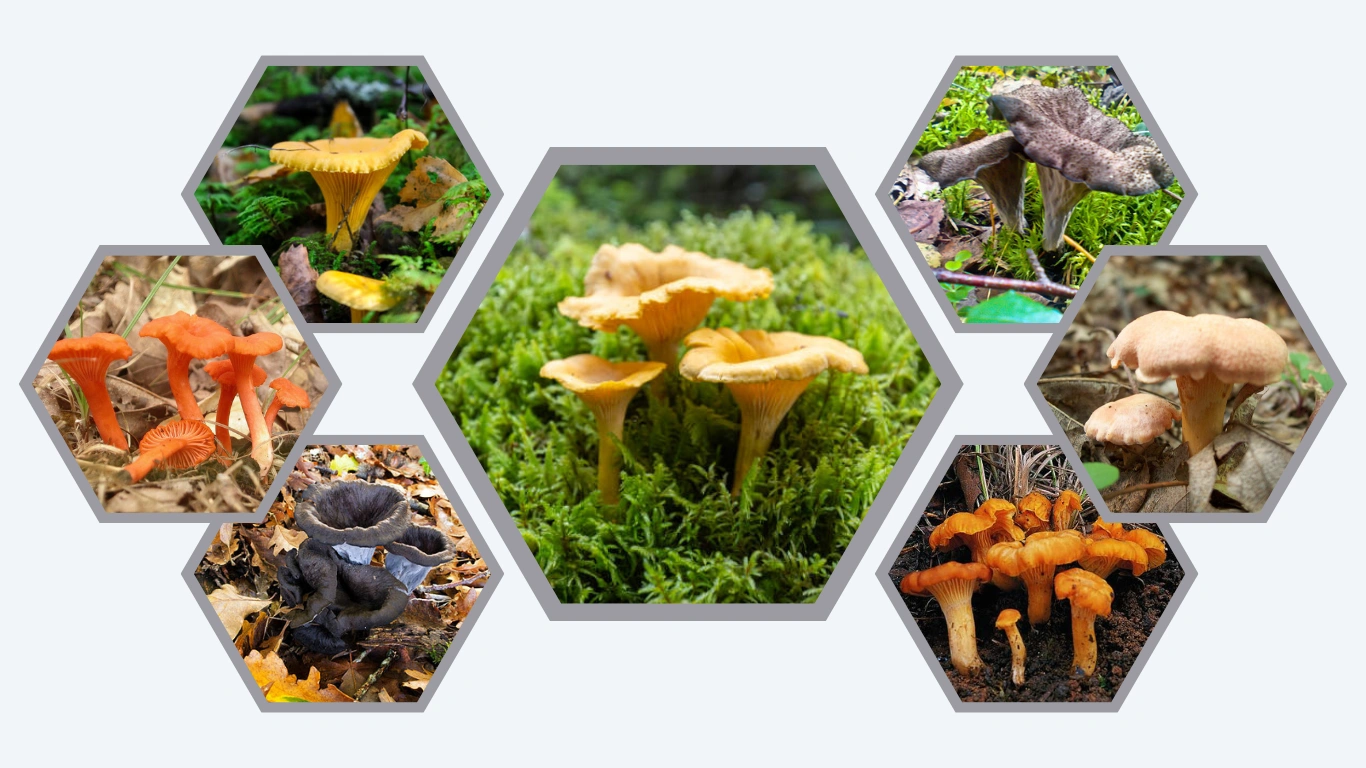
Chanterelle mushrooms are among the most popular and easily recognized wild edible mushrooms in the world. Known for their golden colors, fruity aroma, and rich flavor, chanterelles grow naturally in forests where they form close relationships with trees. There are many different types of chanterelles found across Europe, Asia, Africa, and the Americas, each with unique colors and shapes. This guide explores common chanterelle varieties, their identification features, habitats, and culinary value.
1. Golden Chanterelle (Cantharellus cibarius)

Golden chanterelle is the most famous and widely recognized chanterelle mushroom in the world. It is prized for its bright golden-yellow color, fruity apricot-like aroma, and rich, mildly peppery flavor. This mushroom naturally grows in forests and forms a symbiotic relationship with trees. Because of its excellent taste, firm texture, and nutritional value, the golden chanterelle is considered one of the finest edible wild mushrooms.
Identification
- Cap color: Golden yellow to deep egg-yolk yellow
- Cap shape: Funnel-shaped with wavy, irregular edges
- Surface: Smooth to slightly wrinkled
- Gills: False gills (blunt, forked ridges running down the stem)
- Stem: Solid, thick, and the same color as the cap
- Size: Cap usually 3–10 cm wide
- Smell: Fruity, often compared to apricots
- Spore print: Pale yellow to cream
Habitat
Golden chanterelles grow on the ground in mixed, coniferous, and deciduous forests. They are mycorrhizal, meaning they live in partnership with trees such as oak, beech, pine, and spruce. They usually appear scattered or in small groups, often hidden among moss, leaf litter, and forest debris.
Edibility and Taste
This mushroom is highly edible and considered a gourmet species. It has a mild, slightly peppery flavor with a fruity aroma. The flesh is firm and does not become slimy when cooked. Golden chanterelles are commonly sautéed, added to soups, sauces, pasta dishes, and omelets.
Season and Distribution
Golden chanterelles are widely distributed across Europe, Asia, North America, and parts of North Africa. They typically fruit from late spring through autumn, depending on rainfall and regional climate. In warmer regions, they may also appear during the monsoon season.
Look-Alikes and Safety
Although golden chanterelles are safe to eat, they are sometimes confused with false chanterelles (Hygrophoropsis aurantiaca) and jack-o’-lantern mushrooms (Omphalotus species), which can cause stomach upset. True chanterelles have blunt, forked ridges instead of sharp gills and a fruity smell, which helps in proper identification.
2. Smooth Chanterelle (Cantharellus lateritius)

Smooth chanterelle is a distinctive chanterelle species known for its nearly gill-less underside and soft, pale golden appearance. Unlike most chanterelles, its cap surface flows smoothly into the stem with very shallow or almost invisible false gills. This mushroom is edible and appreciated for its gentle flavor and tender texture, making it a favorite among foragers and mushroom cooks.
Identification
- Cap color: Pale yellow to light orange
- Cap shape: Convex when young, becoming shallowly funnel-shaped
- Surface: Smooth, often slightly velvety
- Gills: Nearly absent or extremely shallow ridges
- Stem: Thick, smooth, and usually paler than the cap
- Size: Cap about 3–8 cm wide
- Smell: Mild to slightly fruity
- Spore print: Cream to pale yellow
Habitat
Smooth chanterelles grow on the forest floor in hardwood and mixed woodlands. They form mycorrhizal relationships mainly with oak and beech trees. These mushrooms often appear scattered or in loose groups, sometimes partly hidden in leaf litter.
Edibility and Taste
This species is edible and considered good quality. Its flavor is mild and slightly sweet, without the strong peppery note of golden chanterelles. Smooth chanterelles cook well in butter, light sauces, soups, and mixed mushroom dishes.
Season and Distribution
Smooth chanterelles are found mainly in eastern North America, parts of Central America, and the Caribbean. They usually fruit from late spring through early autumn, especially after warm rains.
Look-Alikes and Safety
Because of their smooth underside, these chanterelles are less often confused with toxic species. However, careful observation is still important. True smooth chanterelles have blunt folds or almost no gills, solid stems, and never show sharp, knife-like gills found in poisonous look-alikes.
3. Red Chanterelle (Cantharellus cinnabarinus)

Red chanterelle is a small but striking chanterelle species known for its bright red to cinnabar-colored cap. It is one of the most colorful chanterelles and stands out clearly against green moss and dark forest floors. Despite its small size, it is edible and valued for adding color and a mild peppery flavor to wild mushroom dishes.
Identification
- Cap color: Bright red to pinkish-red
- Cap shape: Flat to shallowly depressed with wavy edges
- Surface: Smooth and dry
- Gills: Shallow, blunt false gills running down the stem
- Stem: Slender, red to pink, solid
- Size: Cap usually 1–4 cm wide
- Smell: Mild to slightly fruity
- Spore print: Pale pink to cream
Habitat
Red chanterelles grow on the ground in moist deciduous and mixed forests. They are often found among moss, leaf litter, and rotting wood. This species forms mycorrhizal relationships with hardwood trees and is commonly seen scattered or in small clusters.
Edibility and Taste
Red chanterelles are edible but small, so they are usually collected in quantity. Their flavor is mild with a gentle peppery note. They are best used as a colorful addition to sautéed mushroom mixes, soups, and garnishes rather than as a main ingredient.
Season and Distribution
This species is widely distributed in eastern North America, Central America, parts of South America, and Asia. It usually fruits from summer to early autumn, especially after periods of steady rainfall.
Look-Alikes and Safety
Because of their bright red color and chanterelle-like folds, red chanterelles are not commonly confused with dangerous mushrooms. However, some small red cup fungi may appear similar from a distance. True red chanterelles always have blunt, forked ridges instead of true gills and a solid stem.
4. White Chanterelle (Cantharellus subalbidus)

White chanterelle is a large, thick-fleshed chanterelle species recognized for its pale cream to whitish color and sturdy structure. It is closely related to the golden chanterelle but appears much lighter and often bruises slightly yellowish or brownish with age. This mushroom is edible and appreciated for its firm texture and mild, earthy flavor.
Identification
- Cap color: White to pale cream, sometimes yellowing with age
- Cap shape: Convex when young, becoming funnel-shaped with wavy margins
- Surface: Smooth to slightly wrinkled
- Gills: Thick, blunt false gills running down the stem
- Stem: Thick, solid, white to pale cream
- Size: Cap commonly 5–14 cm wide
- Smell: Mild, slightly fruity
- Spore print: Pale yellow to cream
Habitat
White chanterelles grow on the ground in coniferous forests, especially under pine, fir, and hemlock trees. They are mycorrhizal and usually appear scattered or in loose groups, often partly buried under needles and forest debris.
Edibility and Taste
This species is edible and considered very good. It has a mild, slightly nutty taste and a dense texture that holds up well in cooking. White chanterelles are commonly sautéed, grilled, or added to soups, rice dishes, and creamy sauces.
Season and Distribution
White chanterelles are mainly found in western North America, particularly along the Pacific Northwest. They usually fruit from late summer through autumn, especially after cool rains.
Look-Alikes and Safety
White chanterelles can sometimes be confused with pale forms of toxic jack-o’-lantern mushrooms. True white chanterelles always have blunt, forked ridges rather than sharp gills and grow on soil, not directly on wood. Checking these features helps prevent misidentification.
5. Yellowfoot Chanterelle (Craterellus tubaeformis)

Yellowfoot chanterelle, also known as the winter chanterelle, is a slender, hollow-stemmed relative of true chanterelles. It is recognized by its brownish cap, bright yellow to orange stem, and trumpet-like shape. Although smaller and thinner than golden chanterelles, it is edible and highly valued for its rich, earthy flavor.
Identification
- Cap color: Brown to grayish-brown
- Cap shape: Convex to funnel-shaped, often with wavy edges
- Surface: Smooth to slightly scaly
- Gills: Shallow, blunt, widely spaced ridges
- Stem: Hollow, yellow to orange, slender
- Size: Cap usually 2–6 cm wide
- Smell: Mild, earthy
- Spore print: Pale yellow to whitish
Habitat
Yellowfoot chanterelles grow in damp, mossy coniferous forests. They are often found near spruce, pine, and fir trees, growing scattered or in dense groups. This species prefers cool, moist environments and is commonly hidden among thick moss.
Edibility and Taste
This mushroom is edible and considered excellent. It has a deeper, more earthy flavor than golden chanterelles and a tender texture. Yellowfoot chanterelles are especially good in soups, stews, sauces, and dried for later use.
Season and Distribution
Yellowfoot chanterelles are widely distributed across Europe, Asia, and North America. They usually fruit from late autumn into winter and may continue growing even after light frosts.
Look-Alikes and Safety
Yellowfoot chanterelles are generally safe to identify due to their hollow stems, blunt ridges, and trumpet form. However, they can resemble some small brown mushrooms. True yellowfoot chanterelles always have forked ridges rather than sharp gills and a flexible, hollow stem.
6. Black Trumpet (Craterellus cornucopioides)

Black trumpet is a dark, trumpet-shaped chanterelle relative often called the “horn of plenty.” It is famous for its smoky aroma, rich flavor, and thin, hollow body. Its black to charcoal color makes it hard to spot in the forest, but it is one of the most highly prized wild edible mushrooms in the world.
Identification
- Cap color: Dark gray to black
- Cap shape: Deeply funnel-shaped, trumpet-like
- Surface: Smooth to slightly wrinkled
- Gills: Almost absent, with very shallow or no visible ridges
- Stem: Hollow, thin, same color as the cap
- Size: Cap usually 3–8 cm wide
- Smell: Smoky, fruity, or earthy
- Spore print: White to pale cream
Habitat
Black trumpets grow on the ground in moist hardwood forests. They are often associated with oak and beech trees and prefer shaded, mossy, or leaf-littered areas. They commonly appear scattered or in loose groups, blending into the dark forest floor.
Edibility and Taste
This mushroom is edible and considered a gourmet species. It has a deep, smoky, and slightly fruity flavor. Black trumpets are excellent dried and used as seasoning, or fresh in sauces, risottos, pasta, and egg dishes.
Season and Distribution
Black trumpets are found across Europe, Asia, and North America. They usually fruit from summer through autumn, especially after periods of warm rain.
Look-Alikes and Safety
Black trumpets have very few dangerous look-alikes. Their hollow, trumpet shape and dark color are distinctive. However, always check that the mushroom is hollow and fragile, and avoid confusing it with tough, woody black fungi.
7. Horn of Plenty (Craterellus fallax)

Horn of plenty is a close relative of the black trumpet and is often considered its North American counterpart. It has a thin, trumpet-shaped body and a dark brown to black coloration. This mushroom is highly valued for its rich aroma and strong, savory taste, making it a favorite among foragers and chefs.
Identification
- Cap color: Dark brown to black
- Cap shape: Deeply funnel-shaped, trumpet-like
- Surface: Smooth to finely wrinkled
- Gills: Nearly absent or with very shallow ridges
- Stem: Hollow, thin, merging with the cap
- Size: Cap about 3–7 cm wide
- Smell: Fruity to smoky
- Spore print: Pale cream to white
Habitat
Horn of plenty grows on the ground in moist deciduous forests, especially near oak and beech trees. It often appears in scattered groups, sometimes forming large flushes after heavy summer rains. These mushrooms blend well with dark soil and leaf litter.
Edibility and Taste
This species is edible and considered excellent. It has a strong, rich flavor that becomes even more intense when dried. Horn of plenty mushrooms are commonly used in sauces, soups, pasta dishes, and as a powdered seasoning.
Season and Distribution
Horn of plenty is mainly found in eastern North America. It typically fruits from mid-summer through early autumn, especially after warm and humid weather.
Look-Alikes and Safety
Horn of plenty has very few confusing or dangerous look-alikes. Its hollow body, thin flesh, and dark trumpet shape are key features. Always confirm the mushroom is hollow inside and not woody or tough.
8. Frosted Chanterelle (Cantharellus pruinosus)

Frosted chanterelle is a smaller chanterelle species known for its delicate appearance and pale, slightly “powdered” surface that can look frosted. It has a soft yellow to orange cap and fine, blunt ridges underneath. This mushroom is edible and appreciated for its gentle flavor and attractive form.
Identification
- Cap color: Pale yellow to light orange
- Cap shape: Convex to shallowly funnel-shaped
- Surface: Smooth with a frosted or powdery coating
- Gills: Fine, blunt false gills running down the stem
- Stem: Slender, smooth, pale yellow
- Size: Cap usually 2–5 cm wide
- Smell: Mild, slightly fruity
- Spore print: Pale yellow to cream
Habitat
Frosted chanterelles grow on the ground in hardwood and mixed forests. They are often associated with oak and other broadleaf trees. These mushrooms usually appear scattered in leaf litter, sometimes in small groups.
Edibility and Taste
This species is edible and considered good. It has a mild, slightly sweet taste and tender flesh. Frosted chanterelles are suitable for light sautéing, soups, and mixed wild mushroom dishes.
Season and Distribution
Frosted chanterelles are found mainly in parts of Europe and North America. They typically fruit from summer through early autumn, especially in warm, humid conditions.
Look-Alikes and Safety
Because of their small size, frosted chanterelles may be confused with other tiny yellow forest mushrooms. True chanterelles always have blunt, forked ridges instead of sharp gills and a solid, smooth stem.
9. Appalachian Chanterelle (Cantharellus appalachiensis)

Appalachian chanterelle is a North American chanterelle species closely related to the golden chanterelle. It is known for its bright yellow to orange coloration and slightly smaller, more delicate build. This mushroom is edible and commonly collected in eastern forests for its pleasant aroma and good cooking quality.
Identification
- Cap color: Bright yellow to orange
- Cap shape: Convex at first, becoming funnel-shaped with wavy margins
- Surface: Smooth to slightly wrinkled
- Gills: Blunt, forked false gills running down the stem
- Stem: Solid, yellow, slightly paler than the cap
- Size: Cap usually 3–9 cm wide
- Smell: Fruity, similar to apricot
- Spore print: Pale yellow to cream
Habitat
This species grows on the ground in hardwood and mixed forests, especially under oak, beech, and maple trees. It forms mycorrhizal relationships with trees and often appears scattered or in loose groups among leaf litter and moss.
Edibility and Taste
Appalachian chanterelles are edible and considered very good. They have a mild, slightly peppery flavor and firm texture. They are excellent sautéed, added to soups, pasta, and rice dishes.
Season and Distribution
Appalachian chanterelles are mainly found in the eastern United States, particularly in the Appalachian region. They typically fruit from late spring through early autumn, depending on rainfall and temperature.
Look-Alikes and Safety
They can sometimes be confused with false chanterelles or small jack-o’-lantern mushrooms. True Appalachian chanterelles always have blunt ridges instead of sharp gills and a fruity smell, and they grow from soil rather than directly from wood.
10. Pacific Golden Chanterelle (Cantharellus formosus)

Pacific golden chanterelle is a large, thick chanterelle species native to the forests of the western United States and Canada. It is known for its bright golden to deep yellow color, sturdy structure, and rich aroma. This mushroom is edible and highly valued both commercially and by wild foragers.
Identification
- Cap color: Deep yellow to golden orange
- Cap shape: Convex when young, becoming deeply funnel-shaped
- Surface: Smooth to finely wrinkled
- Gills: Thick, blunt, forked false gills running down the stem
- Stem: Solid, thick, yellow to pale yellow
- Size: Cap commonly 5–15 cm wide
- Smell: Fruity, often apricot-like
- Spore print: Pale yellow to cream
Habitat
Pacific golden chanterelles grow on the ground in coniferous forests. They are commonly associated with Douglas fir, spruce, and hemlock trees. These mushrooms often appear in scattered groups or large flushes, especially in moist, mossy forest areas.
Edibility and Taste
This species is edible and considered excellent. It has a rich, mildly peppery flavor and firm flesh that holds its shape well when cooked. Pacific golden chanterelles are widely used in sautéed dishes, soups, sauces, and gourmet recipes.
Season and Distribution
They are mainly found along the Pacific Northwest coast of North America. The fruiting season typically runs from late summer through autumn, with peak growth after heavy rainfall.
Look-Alikes and Safety
Pacific golden chanterelles may be confused with jack-o’-lantern mushrooms. True chanterelles have blunt ridges rather than sharp gills and grow on soil, not directly on wood. Always verify these features before consumption.
11. Texas Chanterelle (Cantharellus texensis)

Texas chanterelle is a warm-climate chanterelle species native to the southern United States. It is smaller and more slender than many golden chanterelles but shares the same bright yellow to orange coloring and fruity aroma. This mushroom is edible and appreciated for its good flavor and frequent appearance after heavy rains.
Identification
- Cap color: Yellow to yellow-orange
- Cap shape: Convex to shallowly funnel-shaped with wavy margins
- Surface: Smooth, sometimes slightly wrinkled
- Gills: Blunt, forked false gills running down the stem
- Stem: Solid, slender, yellow, often paler than the cap
- Size: Cap usually 2–7 cm wide
- Smell: Fruity to mildly sweet
- Spore print: Pale yellow to cream
Habitat
Texas chanterelles grow on the ground in hardwood and mixed forests. They are commonly associated with oak trees and are often found scattered or in loose groups among leaf litter and grass.
Edibility and Taste
This species is edible and considered good quality. It has a mild, slightly peppery taste and tender texture. Texas chanterelles are suitable for sautéing, soups, egg dishes, and mixed mushroom recipes.
Season and Distribution
Texas chanterelles are found mainly in Texas and surrounding southern states, as well as parts of Mexico. They usually fruit from late spring through early autumn, especially after warm rains.
Look-Alikes and Safety
They can resemble small false chanterelles or young jack-o’-lantern mushrooms. True Texas chanterelles always show blunt, forked ridges instead of sharp gills and grow from soil, not directly from wood.
12. Rainbow Chanterelle (Cantharellus persicinus)

Rainbow chanterelle is a colorful chanterelle species recognized for its soft peach to pinkish tones, often blended with yellow and orange shades. It is smaller and more delicate than the golden chanterelle but is edible and admired for both its appearance and gentle flavor.
Identification
- Cap color: Peach, pinkish, to light orange
- Cap shape: Flat to shallowly funnel-shaped with wavy margins
- Surface: Smooth and dry
- Gills: Blunt, forked false gills running down the stem
- Stem: Slender, pale pink to yellowish
- Size: Cap usually 2–6 cm wide
- Smell: Mild to slightly fruity
- Spore print: Pale yellow to cream
Habitat
Rainbow chanterelles grow on the ground in moist hardwood forests. They are often found near oak and beech trees, scattered among leaf litter and moss.
Edibility and Taste
This mushroom is edible and considered good. It has a mild, slightly sweet taste and tender flesh. Rainbow chanterelles are best used in light sautés, soups, or as a colorful addition to mixed mushroom dishes.
Season and Distribution
Rainbow chanterelles are mainly found in eastern North America. They usually fruit from summer through early autumn, especially after periods of rain.
Look-Alikes and Safety
Their soft coloring makes them less likely to be confused with toxic species. However, always confirm the presence of blunt ridges instead of sharp gills and a solid stem before collecting.
13. Scarlet Chanterelle (Cantharellus coccolobae)

Scarlet chanterelle is a rare and visually striking chanterelle species known for its vivid red to scarlet coloring. It is smaller than most golden chanterelles but stands out clearly against green and brown forest floors. This mushroom is edible and valued mainly for its beauty and mild flavor.
Identification
- Cap color: Scarlet red to deep pink
- Cap shape: Flat to shallowly depressed with wavy edges
- Surface: Smooth and dry
- Gills: Blunt, forked false gills running down the stem
- Stem: Slender, red to pink, solid
- Size: Cap usually 1–4 cm wide
- Smell: Mild, sometimes slightly fruity
- Spore print: Pale cream to light pink
Habitat
Scarlet chanterelles grow on the ground in tropical and subtropical forests. They are often found in moist leaf litter and mossy areas, usually scattered rather than in large groups.
Edibility and Taste
This species is edible but small, so it is usually collected in quantity. Its flavor is mild and delicate. Scarlet chanterelles are best used as a colorful addition to salads, light sautés, and gourmet mushroom mixes.
Season and Distribution
Scarlet chanterelles are found in the Caribbean, parts of Central America, northern South America, and southern North America. They usually fruit during warm, wet seasons.
Look-Alikes and Safety
Their bright red color makes them easy to recognize. Still, collectors should ensure the mushroom has blunt, forked ridges and not true gills, which helps distinguish it from unrelated red fungi.
14. Blue Chanterelle (Polyozellus multiplex)

Blue chanterelle, also known as the blue-black chanterelle, is a unique chanterelle-like mushroom recognized for its dark bluish to purplish-black color and clustered growth. Unlike typical chanterelles, it often forms rosettes of fused caps. It is edible and highly valued for its deep, rich flavor and striking appearance.
Identification
- Cap color: Dark blue, purple-black to black
- Cap shape: Funnel-shaped to irregular, often fused in clusters
- Surface: Smooth to slightly velvety
- Gills: Thick, blunt, forked ridges running down the stem
- Stem: Short, thick, often fused at the base
- Size: Individual caps 3–8 cm wide
- Smell: Mild to earthy
- Spore print: White
Habitat
Blue chanterelles grow on the ground in coniferous forests, especially under spruce and fir trees. They are usually found in cool, moist mountain regions, growing in dense clusters.
Edibility and Taste
This mushroom is edible and considered excellent. It has a rich, savory, almost smoky flavor and firm flesh. Blue chanterelles are well suited for sautéing, drying, and use in sauces, soups, and rice dishes.
Season and Distribution
Blue chanterelles are mainly found in western North America and parts of East Asia. They typically fruit from late summer through autumn.
Look-Alikes and Safety
Blue chanterelles have few dangerous look-alikes. Their dark color and rosette growth form are distinctive. Always confirm the presence of blunt ridges and solid flesh before consumption.
15. Amethyst Chanterelle (Cantharellus amethysteus)

Amethyst chanterelle is a European chanterelle species known for the fine purple to violet scales or tones that often appear on its yellow cap. It closely resembles the golden chanterelle but can be distinguished by its subtle amethyst coloring, especially near the center of the cap. This mushroom is edible and appreciated for its pleasant aroma and good culinary quality.
Identification
- Cap color: Yellow with purple or violet scales, especially when young
- Cap shape: Convex at first, becoming funnel-shaped with wavy margins
- Surface: Slightly scaly to smooth
- Gills: Blunt, forked false gills running down the stem
- Stem: Solid, pale yellow to whitish
- Size: Cap usually 3–10 cm wide
- Smell: Fruity, apricot-like
- Spore print: Pale yellow to cream
Habitat
Amethyst chanterelles grow on the ground in deciduous and mixed forests. They are often associated with beech and oak trees and appear scattered or in loose groups.
Edibility and Taste
This species is edible and considered very good. It has a mild, slightly peppery taste similar to golden chanterelles. Amethyst chanterelles are excellent sautéed, in creamy sauces, soups, and pasta dishes.
Season and Distribution
Amethyst chanterelles are mainly found in Europe. They typically fruit from summer through autumn, especially after warm rainfall.
Look-Alikes and Safety
They can resemble golden chanterelles, but the purple scaling helps with identification. Always check for blunt ridges instead of sharp gills and a fruity aroma to confirm a true chanterelle.
16. Small Chanterelle (Cantharellus minor)

Small chanterelle is a delicate, miniature chanterelle species known for its bright yellow to orange color and slender form. It looks like a tiny version of the golden chanterelle and is often found growing in large numbers. Although small, it is edible and appreciated for its mild, pleasant flavor.
Identification
- Cap color: Bright yellow to orange
- Cap shape: Flat to shallowly funnel-shaped with wavy margins
- Surface: Smooth and dry
- Gills: Fine, blunt, forked false gills running down the stem
- Stem: Thin, solid, yellow
- Size: Cap usually 1–3 cm wide
- Smell: Mild, slightly fruity
- Spore print: Pale yellow to cream
Habitat
Small chanterelles grow on the ground in hardwood and mixed forests. They are often associated with oak trees and commonly appear scattered or in large troops among leaf litter and moss.
Edibility and Taste
This species is edible and considered good. It has a mild, slightly peppery taste and tender texture. Because of their small size, they are often used whole in soups, sautés, and mixed wild mushroom dishes.
Season and Distribution
Small chanterelles are found in eastern North America, Central America, and parts of South America. They usually fruit from summer through early autumn.
Look-Alikes and Safety
Small chanterelles may be confused with tiny orange mushrooms. True chanterelles always have blunt, forked ridges rather than sharp gills and a solid stem. Carefully checking these traits helps avoid mistakes.
17. Orange Chanterelle (Cantharellus friesii)

Orange chanterelle is a European chanterelle species known for its bright orange cap and delicate structure. It is smaller and more thin-fleshed than the golden chanterelle but shares the same wavy cap edges and blunt false gills. This mushroom is edible and appreciated for its pleasant aroma and light, peppery flavor.
Identification
- Cap color: Bright orange to yellow-orange
- Cap shape: Convex at first, becoming funnel-shaped with wavy margins
- Surface: Smooth to slightly wrinkled
- Gills: Blunt, forked false gills running down the stem
- Stem: Slender, yellow-orange to pale orange
- Size: Cap usually 2–6 cm wide
- Smell: Mildly fruity
- Spore print: Pale yellow to cream
Habitat
Orange chanterelles grow on the ground in deciduous and mixed forests. They are commonly associated with beech, oak, and birch trees and appear scattered or in small groups.
Edibility and Taste
This species is edible and considered good. It has a mild, slightly peppery taste and tender flesh. Orange chanterelles are suitable for sautéing, soups, sauces, and light mushroom dishes.
Season and Distribution
Orange chanterelles are mainly found in Europe. They typically fruit from summer through autumn, especially after warm rains.
Look-Alikes and Safety
They can resemble false chanterelles, which have sharp gills and softer flesh. True orange chanterelles always show blunt ridges and a solid, firm stem, which helps distinguish them safely.
18. European Chanterelle (Cantharellus pallens)

European chanterelle is a pale-colored chanterelle species closely related to the golden chanterelle. It is known for its creamy yellow to almost whitish cap and thick, sturdy body. This mushroom is edible and widely collected across Europe for its excellent flavor and firm texture.
Identification
- Cap color: Pale yellow to creamy white
- Cap shape: Convex when young, becoming funnel-shaped with wavy margins
- Surface: Smooth to slightly wrinkled
- Gills: Thick, blunt, forked false gills running down the stem
- Stem: Solid, thick, pale cream to yellow
- Size: Cap usually 4–12 cm wide
- Smell: Fruity, apricot-like
- Spore print: Pale yellow to cream
Habitat
European chanterelles grow on the ground in deciduous and mixed forests. They are often associated with oak, beech, and hornbeam trees. They usually appear scattered or in loose groups in leaf litter.
Edibility and Taste
This species is edible and considered excellent. It has a mild, slightly peppery flavor and dense flesh that holds up well in cooking. European chanterelles are popular in sautés, soups, sauces, and traditional European dishes.
Season and Distribution
European chanterelles are widely distributed across Europe. They typically fruit from late spring through autumn, depending on rainfall and climate.
Look-Alikes and Safety
European chanterelles may be confused with pale forms of toxic jack-o’-lantern mushrooms. True chanterelles have blunt ridges instead of sharp gills and grow on soil rather than directly on wood.
19. Alpine Chanterelle (Cantharellus alpinus)

Alpine chanterelle is a smaller chanterelle species adapted to cool, mountainous environments. It resembles a compact version of the golden chanterelle, with bright yellow coloring and a firm body. This mushroom is edible and valued for its pleasant aroma and ability to thrive in colder regions.
Identification
- Cap color: Bright yellow to yellow-orange
- Cap shape: Convex to shallowly funnel-shaped with wavy edges
- Surface: Smooth to slightly wrinkled
- Gills: Blunt, forked false gills running down the stem
- Stem: Solid, short, yellow
- Size: Cap usually 2–6 cm wide
- Smell: Fruity to mild
- Spore print: Pale yellow to cream
Habitat
Alpine chanterelles grow on the ground in subalpine and alpine forests. They are often associated with spruce, pine, and fir trees. These mushrooms appear scattered or in small groups among moss and forest litter in cool, moist areas.
Edibility and Taste
This species is edible and considered good. It has a mild, slightly peppery flavor and firm texture. Alpine chanterelles are suitable for sautéing, soups, and mixed wild mushroom dishes.
Season and Distribution
Alpine chanterelles are found mainly in mountainous regions of Europe and parts of Asia. They typically fruit from summer through early autumn.
Look-Alikes and Safety
They can resemble other small yellow mushrooms. True alpine chanterelles always show blunt ridges rather than sharp gills and a solid, firm stem, which are key identification features.
20. Asian Chanterelle (Cantharellus anzutake)

Asian chanterelle, often called anzutake in Japan, is a brightly colored chanterelle species known for its yellow to orange tones and pleasant fruity aroma. It is edible and commonly collected in parts of East Asia, where it is used in traditional cooking.
Identification
- Cap color: Yellow to orange-yellow
- Cap shape: Convex at first, becoming funnel-shaped with wavy margins
- Surface: Smooth to slightly wrinkled
- Gills: Blunt, forked false gills running down the stem
- Stem: Solid, yellow, often paler than the cap
- Size: Cap usually 3–9 cm wide
- Smell: Fruity, apricot-like
- Spore print: Pale yellow to cream
Habitat
Asian chanterelles grow on the ground in mixed and coniferous forests. They are often associated with pine, oak, and other native trees. They appear scattered or in small groups among moss and forest litter.
Edibility and Taste
This species is edible and considered very good. It has a mild, slightly peppery taste and firm flesh. Asian chanterelles are widely used in stir-fries, soups, noodle dishes, and light sautés.
Season and Distribution
Asian chanterelles are found mainly in Japan, China, and parts of Korea and Southeast Asia. They usually fruit from summer through autumn during warm, rainy periods.
Look-Alikes and Safety
They may resemble other yellow forest mushrooms. Always check for blunt, forked ridges instead of sharp gills and a solid stem to confirm a true chanterelle.
21. Himalayan Chanterelle (Cantharellus himalayensis)

Himalayan chanterelle is a mountain-dwelling chanterelle species adapted to cool, high-altitude forests. It resembles the golden chanterelle but often has a paler yellow tone and a slightly more slender form. This mushroom is edible and locally collected for food in Himalayan regions.
Identification
- Cap color: Pale yellow to yellow-orange
- Cap shape: Convex when young, becoming funnel-shaped with wavy margins
- Surface: Smooth to slightly wrinkled
- Gills: Blunt, forked false gills running down the stem
- Stem: Solid, slender, pale yellow
- Size: Cap usually 3–8 cm wide
- Smell: Mild to slightly fruity
- Spore print: Pale yellow to cream
Habitat
Himalayan chanterelles grow on the ground in high-altitude mixed and coniferous forests. They are often associated with pine, fir, and oak trees and appear scattered among moss, leaf litter, and forest soil.
Edibility and Taste
This species is edible and considered good. It has a mild, slightly peppery flavor and tender to firm texture. Himalayan chanterelles are used in local dishes, stir-fries, soups, and dried preparations.
Season and Distribution
Himalayan chanterelles are found mainly in the Himalayan regions of Nepal, India, Bhutan, and Tibet. They usually fruit during the summer monsoon and early autumn.
Look-Alikes and Safety
They can resemble other yellow chanterelles and forest mushrooms. Confirming blunt ridges instead of sharp gills and a solid stem helps ensure correct identification.
22. Japanese Chanterelle (Cantharellus ianthinoxanthus)

Japanese chanterelle is an East Asian chanterelle species known for its bright yellow to orange cap often mixed with subtle violet or purplish tones. It is edible and appreciated locally for its aroma and pleasant flavor, making it a valued wild mushroom in regional cuisine.
Identification
- Cap color: Yellow to orange with faint purplish shades
- Cap shape: Convex to funnel-shaped with wavy margins
- Surface: Smooth to slightly wrinkled
- Gills: Blunt, forked false gills running down the stem
- Stem: Solid, yellow, slightly paler than the cap
- Size: Cap usually 3–8 cm wide
- Smell: Mildly fruity
- Spore print: Pale yellow to cream
Habitat
Japanese chanterelles grow on the ground in mixed and deciduous forests. They are often associated with oak and conifer trees and appear scattered among moss and leaf litter.
Edibility and Taste
This species is edible and considered good. It has a mild, slightly peppery taste and firm texture. Japanese chanterelles are used in stir-fries, soups, hot pots, and traditional mushroom dishes.
Season and Distribution
Japanese chanterelles are mainly found in Japan and parts of East Asia. They usually fruit from summer through early autumn during humid weather.
Look-Alikes and Safety
They resemble other yellow chanterelles, so correct identification depends on checking for blunt ridges instead of sharp gills and a fruity aroma typical of chanterelles.
23. African Golden Chanterelle (Cantharellus miomboensis)

African golden chanterelle is a tropical chanterelle species found in African woodlands, especially in miombo forests. It is known for its bright yellow to golden-orange color and firm body. This mushroom is edible and plays an important role as a local food source in many regions.
Identification
- Cap color: Bright yellow to golden orange
- Cap shape: Convex to funnel-shaped with wavy edges
- Surface: Smooth to slightly wrinkled
- Gills: Blunt, forked false gills running down the stem
- Stem: Solid, yellow, thick and firm
- Size: Cap usually 4–12 cm wide
- Smell: Mild to slightly fruity
- Spore print: Pale yellow to cream
Habitat
African golden chanterelles grow on the ground in tropical woodland forests, particularly miombo ecosystems dominated by Brachystegia and Julbernardia trees. They appear scattered or in loose groups after seasonal rains.
Edibility and Taste
This species is edible and widely consumed. It has a mild, slightly nutty flavor and firm texture. African golden chanterelles are commonly dried or cooked fresh in stews, sauces, and traditional dishes.
Season and Distribution
They are found in southern and central Africa, including countries such as Zambia, Tanzania, Zimbabwe, and the Democratic Republic of Congo. Fruiting occurs mainly during the rainy season.
Look-Alikes and Safety
They resemble other yellow chanterelles. Always confirm blunt, forked ridges instead of sharp gills and avoid mushrooms growing directly from wood.
24. Costa Rican Chanterelle (Cantharellus costaricensis)

Costa Rican chanterelle is a tropical chanterelle species found in Central American forests. It is known for its bright yellow to orange coloration and relatively small to medium size. This mushroom is edible and locally collected, adding flavor and color to regional dishes.
Identification
- Cap color: Yellow to orange
- Cap shape: Convex at first, becoming funnel-shaped with wavy margins
- Surface: Smooth and dry
- Gills: Blunt, forked false gills running down the stem
- Stem: Solid, yellow, slightly paler than the cap
- Size: Cap usually 3–9 cm wide
- Smell: Mild to slightly fruity
- Spore print: Pale yellow to cream
Habitat
Costa Rican chanterelles grow on the ground in tropical and subtropical forests. They are often associated with native hardwood trees and appear scattered among leaf litter during the rainy season.
Edibility and Taste
This species is edible and considered good. It has a mild, slightly peppery taste and firm flesh. Costa Rican chanterelles are used in sautés, soups, and traditional Central American recipes.
Season and Distribution
They are mainly found in Costa Rica and surrounding parts of Central America. Fruiting usually occurs during the wet season, when humidity is high.
Look-Alikes and Safety
They can resemble other yellow chanterelles. Correct identification depends on confirming blunt ridges rather than sharp gills and a solid stem structure.
25. Cuban Chanterelle (Cantharellus cubensis)

Cuban chanterelle is a tropical chanterelle species native to the Caribbean region. It is recognized by its bright yellow to orange cap, small to medium size, and typical chanterelle shape. This mushroom is edible and locally collected, mainly during the rainy season.
Identification
- Cap color: Yellow to orange-yellow
- Cap shape: Convex to funnel-shaped with wavy margins
- Surface: Smooth and dry
- Gills: Blunt, forked false gills running down the stem
- Stem: Solid, slender, yellow
- Size: Cap usually 2–7 cm wide
- Smell: Mild to slightly fruity
- Spore print: Pale yellow to cream
Habitat
Cuban chanterelles grow on the ground in tropical forests and woodlands. They are often found among leaf litter and moss, forming mycorrhizal relationships with native trees.
Edibility and Taste
This species is edible and considered good. It has a mild, pleasant flavor and tender flesh. Cuban chanterelles are used in local cooking, including sautés, stews, and mixed mushroom dishes.
Season and Distribution
They are found mainly in Cuba and other Caribbean islands. Fruiting usually occurs during warm, rainy months.
Look-Alikes and Safety
They resemble other small yellow chanterelles. Always confirm blunt, forked ridges instead of sharp gills and avoid mushrooms growing directly on wood.
26. Australian Chanterelle (Cantharellus austrosinensis)

Australian chanterelle is a Southern Hemisphere chanterelle species associated with forested regions of Australia. It is known for its yellow to golden-orange cap and sturdy structure. This mushroom is edible and locally foraged, though less commonly known than European and American chanterelles.
Identification
- Cap color: Yellow to golden orange
- Cap shape: Convex at first, becoming funnel-shaped with wavy margins
- Surface: Smooth to slightly wrinkled
- Gills: Blunt, forked false gills running down the stem
- Stem: Solid, yellow, thick
- Size: Cap usually 4–10 cm wide
- Smell: Mild to slightly fruity
- Spore print: Pale yellow to cream
Habitat
Australian chanterelles grow on the ground in eucalyptus forests and mixed woodlands. They form mycorrhizal relationships with native trees and often appear scattered among leaf litter after seasonal rains.
Edibility and Taste
This species is edible and considered good. It has a mild, slightly peppery flavor and firm flesh. Australian chanterelles are suitable for sautéing, soups, and light mushroom dishes.
Season and Distribution
They are found mainly in parts of Australia. Fruiting generally occurs during the cooler, wetter months.
Look-Alikes and Safety
They resemble other yellow chanterelles. Correct identification depends on confirming blunt ridges rather than sharp gills and a solid stem structure.
27. Chinese Chanterelle (Cantharellus sinensis)

Chinese chanterelle is an East Asian chanterelle species known for its yellow to orange coloration and classic chanterelle shape. It is edible and commonly collected in parts of China, where it is used in both traditional and modern cooking.
Identification
- Cap color: Yellow to yellow-orange
- Cap shape: Convex when young, becoming funnel-shaped with wavy margins
- Surface: Smooth to slightly wrinkled
- Gills: Blunt, forked false gills running down the stem
- Stem: Solid, yellow, slightly paler than the cap
- Size: Cap usually 3–9 cm wide
- Smell: Mild to slightly fruity
- Spore print: Pale yellow to cream
Habitat
Chinese chanterelles grow on the ground in mixed and coniferous forests. They are often associated with pine, oak, and other native trees and appear scattered among leaf litter and moss.
Edibility and Taste
This species is edible and considered good. It has a mild, slightly peppery flavor and firm texture. Chinese chanterelles are used in stir-fries, soups, hot pots, and dried mushroom blends.
Season and Distribution
They are mainly found in different regions of China and neighboring areas of East Asia. Fruiting usually occurs from summer through autumn during warm, humid conditions.
Look-Alikes and Safety
They resemble other yellow chanterelles. Always confirm blunt, forked ridges instead of sharp gills and a solid stem before collecting.
FAQs
Are chanterelle mushrooms safe to eat?
Chanterelle mushrooms are generally safe to eat and are considered some of the best edible wild mushrooms. However, they must be correctly identified before consumption. True chanterelles have blunt, forked ridges instead of sharp gills and usually smell fruity. Some toxic mushrooms look similar, so beginners should forage with experienced guides.
What is the best way to identify a true chanterelle?
A true chanterelle has false gills that look like wrinkles or folds rather than sharp, blade-like gills. These ridges often fork and run down the stem. Chanterelles also have a fruity, apricot-like smell and solid flesh. They grow from soil, not directly from wood.
When is chanterelle season?
Chanterelles usually appear from late spring through autumn, depending on climate and rainfall. In tropical regions, they often grow during the rainy season, while in temperate zones, they are most common in summer and fall. Yellowfoot chanterelles may even appear in late autumn and winter.
Where do chanterelle mushrooms grow?
Chanterelles grow on the ground in forests and form symbiotic relationships with trees. They are commonly found near oak, beech, pine, spruce, and fir trees. They prefer moist, well-drained forest soils and are often hidden among moss and leaf litter.
How should chanterelles be cooked?
Chanterelles are best cooked rather than eaten raw. They are commonly sautéed in butter, added to soups, sauces, pasta, and rice dishes. Cooking enhances their flavor, removes excess moisture, and improves their texture, making them firm and aromatic.