
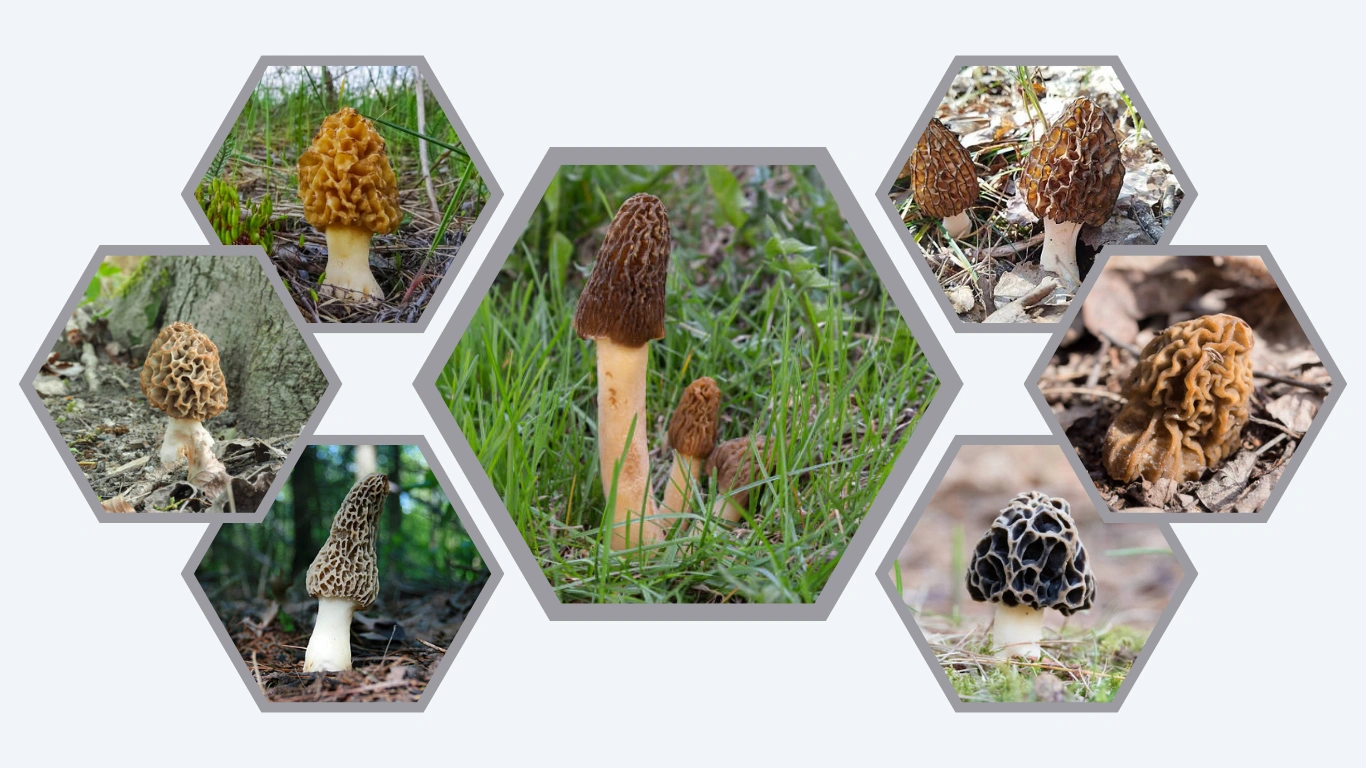
Morel mushrooms are among the most famous and highly valued wild mushrooms in the world. Recognized by their unique honeycomb-shaped caps and hollow bodies, morels are prized for both their appearance and their rich, earthy flavor. They emerge mainly in spring and are closely associated with forests, riverbanks, and even burned areas. From black and yellow morels to rare mountain varieties, morels attract chefs, foragers, and nature lovers who appreciate their short season and gourmet quality.
1. Black Morel Mushroom (Morchella elata group)

Black morels are one of the most prized and recognizable types of morel mushrooms. They are best known for their dark, honeycomb-patterned caps and rich, earthy flavor. These morels usually appear in spring, especially in forested areas, burn sites, and near hardwood trees. Because of their deep taste and firm texture, black morels are highly valued by chefs and wild mushroom foragers around the world.
Identification
- Dark brown to black, cone-shaped cap
- Deep, elongated pits with sharp ridges
- Cap fully attached to the stem
- Stem pale cream to whitish, hollow inside
- Height usually 5–15 cm
- Entire mushroom is hollow from tip to base
Habitat
Black morels commonly grow in hardwood and mixed forests, especially near elm, ash, poplar, and oak trees. They are also famous for appearing in large numbers in recently burned forest areas. These mushrooms prefer moist soil and are most often found in spring.
Flavor and Culinary Use
Black morels have a strong, nutty, and earthy flavor that becomes richer when cooked. They are popular in gourmet dishes such as creamy sauces, pasta, risottos, and stuffed morels. Black morels should always be cooked before eating, as raw morels can cause stomach upset.
Season and Growth Pattern
Black morels are early-season morels, usually fruiting from early to mid-spring depending on climate. They often grow singly or in scattered groups rather than in tight clusters. Their appearance is strongly linked to soil temperature, moisture, and recent environmental disturbance.
2. Yellow Morel Mushroom (Morchella esculenta group)

Yellow morels are among the most popular and widely recognized morel mushrooms. They are known for their golden-yellow to light brown caps and classic honeycomb texture. Compared to black morels, yellow morels usually have a milder, slightly sweet, and nutty flavor. They commonly appear a bit later in spring and are often found in rich woodland soils, old orchards, and along forest edges.
Identification
- Yellow to light brown, rounded or oval cap
- Honeycomb-like pits with smooth, pale ridges
- Cap fully attached to the stem
- Stem thick, white to creamy, and hollow
- Height usually 6–18 cm
- Entire mushroom hollow from cap tip to stem base
Habitat
Yellow morels typically grow in hardwood forests, old apple orchards, grassy woodland edges, and river bottoms. They are often associated with elm, ash, maple, poplar, and apple trees. These morels prefer well-drained but moist soil and areas with good sunlight.
Flavor and Culinary Use
Yellow morels have a delicate, nutty, and slightly buttery flavor. Their tender texture makes them excellent for sautéing, soups, sauces, omelets, and pasta dishes. Like all true morels, they must always be thoroughly cooked before consumption.
Season and Growth Pattern
Yellow morels usually appear from mid to late spring, often after black morels have started fruiting. They can grow singly, in small groups, or scattered across forest floors. Warm days, cool nights, and recent rainfall strongly influence their growth.
3. Common Morel Mushroom (Morchella esculenta)

The common morel is one of the best-known and most widely distributed morel mushrooms in the world. It is prized for its classic sponge-like cap, pleasant aroma, and excellent culinary value. This species is often what people imagine when they think of a “true morel.” It is frequently found in spring woodlands and is a favorite target for both beginner and experienced mushroom hunters.
Identification
- Light yellow to brown, oval or rounded cap
- Deep honeycomb pits with blunt ridges
- Cap completely attached to the stem
- Stem white to cream-colored and hollow
- Height usually 5–16 cm
- Entire mushroom hollow inside
Habitat
Common morels typically grow in deciduous forests, woodland edges, riverbanks, and old orchards. They are often associated with elm, ash, maple, apple, and poplar trees. These mushrooms prefer moist, well-drained soil and areas that receive filtered sunlight.
Flavor and Culinary Use
Common morels have a mild, nutty, and slightly meaty flavor. They are widely used in gourmet cooking for sautéed dishes, creamy sauces, soups, and stuffing recipes. Their porous caps absorb flavors easily, making them ideal for rich and buttery preparations.
Season and Growth Pattern
Common morels fruit mainly in mid to late spring. They may grow singly, in scattered groups, or sometimes in small clusters. Their emergence is influenced by soil warmth, rainfall, and the flowering stages of certain trees.
4. Half-Free Morel Mushroom (Morchella punctipes / Morchella semilibera)

Half-free morels are unique among true morels because only the upper portion of the cap is attached to the stem, leaving the lower half hanging freely. This gives them a distinct “skirted” appearance that makes them easy to recognize in the wild. They are edible like other true morels and are often found in large numbers, making them popular with spring mushroom hunters.
Identification
- Brown to dark brown, elongated cone-shaped cap
- Lower half of cap hangs free from the stem
- Deep pits with narrow, sharp ridges
- Stem white to pale yellow and hollow
- Height usually 6–15 cm
- Entire mushroom hollow
Habitat
Half-free morels usually grow in moist hardwood forests, floodplains, and along streams. They are commonly associated with elm, ash, cottonwood, and sycamore trees. They prefer rich soils and often appear in large scattered groups.
Flavor and Culinary Use
Half-free morels have a mild, earthy, and slightly nutty taste. Their thinner flesh makes them lighter in texture than other morels, but they are excellent for sautéing, drying, and adding to soups or egg dishes. Always cook thoroughly before eating.
Season and Growth Pattern
Half-free morels are early to mid-spring mushrooms and often appear slightly before or alongside black morels. They grow singly or in loose colonies, sometimes carpeting suitable forest floors after warm rains.
5. Thick-Stem Morel Mushroom (Morchella crassipes)

Thick-stem morels are known for their stout, heavy stems and relatively shorter, broad caps. This makes them look more robust than many other morel types. They are highly valued by foragers because their dense flesh holds up well during cooking. These morels are true morels and share the same hollow interior and rich springtime appeal.
Identification
- Yellow-brown to tan, rounded or slightly conical cap
- Large, irregular honeycomb pits
- Cap fully attached to the stem
- Stem very thick, white to pale cream, and hollow
- Shorter, stockier appearance than most morels
- Entire mushroom hollow from top to bottom
Habitat
Thick-stem morels usually grow in deciduous forests, especially in rich soils near ash, elm, maple, and poplar trees. They are often found on forest edges, old orchards, and well-drained woodland floors with good organic matter.
Flavor and Culinary Use
These morels have a rich, earthy, and nutty flavor with a firm, meaty texture. Their thick flesh makes them excellent for stuffing, pan-frying, grilling, and creamy sauces. They also dry well and retain a strong aroma after rehydration.
Season and Growth Pattern
Thick-stem morels typically appear in mid to late spring. They grow singly or in small scattered groups. Warm days following spring rains strongly encourage their emergence, especially when soil temperatures rise steadily.
6. White Morel Mushroom (Morchella deliciosa / pale forms)

White morels are lighter-colored morels that range from creamy white to very pale yellow. They are sometimes considered a pale form of yellow morels but are often called “white morels” by foragers because of their bright appearance. These mushrooms are prized for their tender texture, pleasant aroma, and excellent culinary qualities.
Identification
- Creamy white to very pale yellow cap
- Rounded to oval, honeycomb-patterned pits
- Cap fully attached to the stem
- Stem white, thick, and hollow
- Overall lighter color than most morels
- Entire mushroom hollow inside
Habitat
White morels typically grow in hardwood forests, river bottoms, and old orchard areas. They are commonly found near elm, ash, maple, poplar, and apple trees. Moist, well-drained soil and filtered sunlight create ideal growing conditions.
Flavor and Culinary Use
White morels have a mild, buttery, and slightly nutty flavor. Their delicate flesh makes them excellent for light sautés, cream sauces, soups, and egg-based dishes. As with all true morels, they must always be cooked before eating.
Season and Growth Pattern
White morels usually appear in mid to late spring, often overlapping with yellow morel season. They grow singly or scattered across woodland floors, sometimes appearing suddenly after warm rains followed by mild nights.
7. Gray Morel Mushroom (Morchella sp.)

Gray morels are transitional-colored morels that range from silvery gray to smoky brown. They often appear between the black and yellow morel seasons and can change color as they mature. These mushrooms are true morels and share the same hollow interior, honeycomb cap, and excellent edible qualities valued by foragers.
Identification
- Gray to gray-brown cap with honeycomb pits
- Ridges lighter or darker than the pits
- Cap fully attached to the stem
- Stem white to pale gray and hollow
- Medium to large size
- Entire mushroom hollow from tip to base
Habitat
Gray morels typically grow in mixed and hardwood forests, woodland edges, and moist river valleys. They are often associated with elm, ash, poplar, and maple trees. They prefer rich, damp soils and areas that warm gradually in spring.
Flavor and Culinary Use
Gray morels have a mild, earthy, and nutty flavor similar to yellow morels. Their soft but slightly meaty texture makes them excellent for sautéing, soups, sauces, and pasta dishes. They are also good for drying and long-term storage.
Season and Growth Pattern
Gray morels usually fruit in mid-spring and may appear as black morels decline and yellow morels begin to emerge. They grow singly or in scattered groups, often influenced by soil temperature and consistent moisture.
8. Burn Morel Mushroom (Morchella exuberans / fire morel types)

Burn morels, often called fire morels, are famous for appearing in large numbers in areas affected by recent wildfires. They can fruit by the thousands in burned forests, making them one of the most productive morel types. These mushrooms are true morels with classic honeycomb caps and are highly prized by commercial and recreational foragers.
Identification
- Dark brown to black, sometimes grayish cap
- Deep, sharply defined honeycomb pits
- Cap fully attached to the stem
- Stem white to pale cream and hollow
- Medium to large size
- Entire mushroom hollow from top to base
Habitat
Burn morels grow primarily in recently burned conifer and mixed forests, often one year after a wildfire. They are commonly found in disturbed soil, ash-covered ground, and on slopes where fire has removed vegetation. Burn sites in mountains and forested regions are especially productive.
Flavor and Culinary Use
Burn morels have a rich, smoky, nutty flavor that many people consider stronger than typical forest morels. They are excellent for sautéing, drying, soups, sauces, and commercial mushroom products. Their firm texture holds up well in cooking.
Season and Growth Pattern
Burn morels usually appear in spring to early summer, depending on elevation and snowmelt. They often grow in massive flushes, scattered widely across burn zones. Their emergence is closely linked to fire disturbance, soil moisture, and warming temperatures.
9. Landscape Morel Mushroom (Morchella importuna)

Landscape morels are a type of black morel commonly found in urban and suburban environments rather than deep forests. They often appear in wood-chip beds, gardens, parks, and landscaped areas, which is why they are called “landscape morels.” These mushrooms are true morels and are well known for suddenly popping up in large numbers after spring rains.
Identification
- Dark brown to black, elongated cone-shaped cap
- Long vertical pits with sharp ridges
- Cap fully attached to the stem
- Stem white to pale yellow and hollow
- Often tall and narrow in shape
- Entire mushroom hollow
Habitat
Landscape morels grow in disturbed soils, wood-chip mulch, flower beds, playgrounds, and roadside landscaping. They are especially common in newly mulched areas with hardwood chips. Unlike many morels, they are frequently found in cities and residential areas.
Flavor and Culinary Use
Landscape morels have a rich, earthy, and nutty flavor similar to black morels. They are widely used for sautéing, stuffing, sauces, and drying. Because they often grow in public areas, careful harvesting from clean, chemical-free sites is important.
Season and Growth Pattern
Landscape morels usually appear in mid to late spring. They often fruit in clusters or scattered groups and can return year after year in the same landscaped locations, especially where fresh mulch is added.
10. Natural Morel Mushroom (wild Morchella species)

Natural morels is a general name often used for wild-growing true morels that appear in forests, meadows, and undisturbed landscapes rather than gardens or burn sites. These morels can vary in color from pale yellow to dark brown or gray, but they all share the classic honeycomb cap and hollow body that define true morel mushrooms.
Identification
- Honeycomb-patterned cap with deep pits
- Color ranges from yellowish to dark brown or gray
- Cap fully attached to the stem
- Stem white to cream and hollow
- Shape varies from rounded to conical
- Entire mushroom hollow inside
Habitat
Natural morels grow in hardwood and mixed forests, riverbanks, woodland edges, and grassy forest openings. They are commonly associated with elm, ash, poplar, oak, maple, and old apple trees. Moist, well-drained soil and partial sunlight create ideal conditions.
Flavor and Culinary Use
Natural morels have a rich, earthy, nutty flavor that intensifies when cooked. They are excellent for sautéing, soups, cream sauces, pasta, and meat dishes. Their spongy caps absorb flavors well, making them highly valued in gourmet cooking.
Season and Growth Pattern
Natural morels typically appear from early to late spring, depending on climate and elevation. They grow singly or scattered in small groups, often emerging after warm days followed by cool, damp nights.
11. Eastern Black Morel Mushroom (Morchella angusticeps)

Eastern black morels are a well-known black morel species native to eastern North America. They are prized for their dark, sharply ridged caps and rich, earthy flavor. These morels are among the earliest true morels to appear in spring and are a favorite target for experienced mushroom hunters.
Identification
- Dark brown to nearly black, narrow conical cap
- Long vertical pits with sharp ridges
- Cap fully attached to the stem
- Stem pale cream to whitish and hollow
- Usually slender and elongated
- Entire mushroom hollow
Habitat
Eastern black morels grow in hardwood forests, especially near dead or dying elm trees, ash, poplar, and tulip poplar. They are often found on south-facing slopes, forest edges, and moist woodland soils.
Flavor and Culinary Use
They have a strong, nutty, and earthy flavor that holds up well in cooking. Eastern black morels are excellent for sautéing, drying, stuffing, and adding to sauces, soups, and risottos. Their firm texture makes them popular with chefs.
Season and Growth Pattern
Eastern black morels usually appear in early to mid-spring. They often grow singly or scattered in small groups. Their emergence closely follows warming soil temperatures and early spring rainfall.
12. Western Black Morel Mushroom (Morchella snyderi / Morchella importuna group)

Western black morels are dark-colored true morels commonly found in western North America. They are closely associated with mountainous regions and are especially famous for appearing in burn areas after wildfires. These mushrooms are highly valued for their firm texture, classic morel flavor, and commercial importance.
Identification
- Dark brown to black, tall conical cap
- Deep vertical pits with sharp ridges
- Cap fully attached to the stem
- Stem white to pale cream and hollow
- Often larger and thicker than eastern black morels
- Entire mushroom hollow
Habitat
Western black morels grow in conifer and mixed forests, river valleys, and especially in recently burned forest areas. They are often associated with pine, fir, spruce, and Douglas fir. Burn scars in mountainous regions are prime locations.
Flavor and Culinary Use
Western black morels have a rich, earthy, and nutty flavor. They are excellent for sautéing, drying, soups, sauces, and commercial mushroom products. Their sturdy structure allows them to hold shape well during cooking.
Season and Growth Pattern
Western black morels usually fruit from spring to early summer, depending on elevation and snowmelt. They can appear in huge numbers in burn zones and often grow scattered widely across suitable habitats.
13. Northern Yellow Morel Mushroom (Morchella americana)

Northern yellow morels are a well-known yellow morel species found mainly in northern regions of North America. They are appreciated for their large size, pale yellow to golden caps, and mild, nutty flavor. These morels are among the most commonly collected edible mushrooms in spring.
Identification
- Pale yellow to golden-brown, rounded or oval cap
- Large honeycomb pits with smooth, light ridges
- Cap fully attached to the stem
- Stem thick, white to cream-colored and hollow
- Often larger than many black morels
- Entire mushroom hollow
Habitat
Northern yellow morels grow in hardwood forests, river bottoms, floodplains, and old orchards. They are commonly associated with elm, ash, maple, poplar, and apple trees. They prefer cool spring temperatures and moist, nutrient-rich soils.
Flavor and Culinary Use
They have a mild, nutty, slightly buttery flavor and a tender texture. Northern yellow morels are excellent for sautéing, soups, cream sauces, pasta dishes, and drying for later use.
Season and Growth Pattern
Northern yellow morels usually appear from mid to late spring. They often fruit after black morels decline. They grow singly or scattered in small groups, sometimes producing impressive flushes in good years.
14. Southern Yellow Morel Mushroom (Morchella esculentoides)

Southern yellow morels are a warm-climate yellow morel species commonly found in the southern and central regions of North America. They are known for their golden to yellow-brown caps, broad shape, and pleasant aroma. These morels are highly sought after by spring foragers and are considered excellent edible mushrooms.
Identification
- Yellow to yellow-brown, rounded or slightly conical cap
- Wide honeycomb pits with smooth ridges
- Cap fully attached to the stem
- Stem white to pale cream, thick, and hollow
- Medium to large size
- Entire mushroom hollow inside
Habitat
Southern yellow morels typically grow in hardwood forests, river bottoms, floodplains, and woodland edges. They are often associated with elm, ash, sycamore, cottonwood, and old apple trees. Warm, moist soils and partially sunny areas favor their growth.
Flavor and Culinary Use
These morels have a mild, nutty, and slightly sweet flavor. Their tender but meaty texture makes them excellent for sautéing, frying, stuffing, and adding to soups, sauces, and pasta dishes. They also dry well for long-term storage.
Season and Growth Pattern
Southern yellow morels usually appear from early to mid-spring, often earlier than northern yellow morels. They grow singly or scattered in loose groups, emerging after warm rains and steady increases in soil temperature.
15. Himalayan Morel Mushroom (Morchella esculenta / Morchella conica complex)

Himalayan morels are highly prized wild mushrooms found in mountainous regions of South and Central Asia. Often called “Gucchi” in local markets, they are famous for their strong aroma, wrinkled honeycomb caps, and high economic value. These morels are traditionally harvested, dried, and sold as luxury edible mushrooms.
Identification
- Brown to dark brown, conical to oval cap
- Deep, irregular honeycomb pits
- Cap fully attached to the stem
- Stem pale cream to light brown and hollow
- Medium size, lightweight when fresh
- Entire mushroom hollow
Habitat
Himalayan morels grow in conifer and mixed mountain forests, alpine meadows, and disturbed soils. They are often associated with pine, cedar, fir, and oak trees. They prefer cool climates, high elevations, and moist spring conditions.
Flavor and Culinary Use
They have a rich, smoky, nutty flavor that becomes more intense when dried. Himalayan morels are widely used in traditional dishes, rice preparations, gravies, and gourmet cooking. They are usually sold dried and rehydrated before use.
Season and Growth Pattern
Himalayan morels appear mainly in spring, shortly after snowmelt. They grow scattered across forest floors and mountain slopes, often emerging after rain and sudden warming periods.
16. Chinese Black Morel Mushroom (Morchella sextelata / Morchella importuna types)

Chinese black morels are dark-colored true morels commonly found in various regions of China and East Asia. They are also among the most widely cultivated morel types in the world today. These morels are valued for their tall conical caps, deep pits, and strong earthy flavor.
Identification
- Dark brown to nearly black, elongated conical cap
- Deep vertical pits with sharp ridges
- Cap fully attached to the stem
- Stem white to pale cream and hollow
- Medium to large size
- Entire mushroom hollow
Habitat
Chinese black morels grow in mixed forests, mountainous regions, and cultivated mushroom farms. In the wild, they are associated with pine, fir, spruce, and hardwood trees. They prefer cool spring temperatures and moist, well-aerated soils.
Flavor and Culinary Use
They have a rich, earthy, nutty flavor and firm texture. Chinese black morels are commonly used in stir-fries, soups, sauces, and dried mushroom products. Cultivated morels are increasingly popular in international gourmet markets.
Season and Growth Pattern
In the wild, Chinese black morels appear in spring, especially after rainfall. In cultivation, they are produced under controlled conditions. They grow singly or scattered and can form large flushes in favorable environments.
17. European Black Morel Mushroom (Morchella elata group)

European black morels are dark, sharply ridged morels native to many parts of Europe. They are among the earliest morels to appear in spring and are highly valued for their intense aroma and firm texture. These mushrooms are classic representatives of the black morel group.
Identification
- Dark brown to black, narrow conical cap
- Deep pits with sharp, vertical ridges
- Cap fully attached to the stem
- Stem white to pale cream and hollow
- Slender, elongated appearance
- Entire mushroom hollow
Habitat
European black morels grow in deciduous and mixed forests, old orchards, forest edges, and sometimes burn sites. They are often associated with ash, elm, poplar, oak, and beech trees. They prefer moist soils and mild spring climates.
Flavor and Culinary Use
They have a strong, earthy, nutty, and slightly smoky flavor. European black morels are widely used in classic European cuisine, especially in cream sauces, meat dishes, risottos, and gourmet preparations.
Season and Growth Pattern
European black morels typically fruit in early to mid-spring. They grow singly or scattered in small groups, often emerging after periods of rain followed by warming temperatures.
18. Blonde Morel Mushroom (Morchella esculenta var. blond forms)

Blonde morels are light-colored morels with pale yellow to creamy caps, giving them a “blonde” appearance. They are often considered a color form of yellow morels and are especially popular with foragers because they are easy to spot against dark forest soil. These mushrooms are prized for their delicate flavor and attractive look.
Identification
- Pale yellow to cream-colored, rounded or oval cap
- Honeycomb pits with soft, light ridges
- Cap fully attached to the stem
- Stem thick, white to creamy, and hollow
- Overall lighter tone than typical yellow morels
- Entire mushroom hollow
Habitat
Blonde morels typically grow in hardwood forests, river bottoms, grassy woodland edges, and old orchards. They are commonly associated with elm, ash, maple, poplar, and apple trees. Moist soils and partial sunlight support their growth.
Flavor and Culinary Use
They have a mild, buttery, and slightly nutty flavor. Blonde morels are excellent for light sautés, creamy dishes, soups, and decorative gourmet recipes where color matters. They are also suitable for drying.
Season and Growth Pattern
Blonde morels usually appear in mid to late spring. They grow singly or scattered and often show up after warm rains followed by gentle cooling periods.
19. Round Morel Mushroom (Morchella rotunda)

Round morels are named for their short, rounded, and sometimes almost ball-shaped caps. They differ from the typical tall, cone-shaped morels and are considered part of the yellow morel complex. Their unusual shape makes them especially interesting to mushroom collectors and foragers.
Identification
- Rounded to egg-shaped cap, yellow to yellow-brown
- Large, irregular honeycomb pits
- Cap fully attached to the stem
- Stem thick, white to cream, and hollow
- Shorter and rounder appearance
- Entire mushroom hollow
Habitat
Round morels usually grow in hardwood forests, woodland edges, river bottoms, and old orchards. They are often associated with elm, ash, maple, poplar, and fruit trees. They prefer moist, nutrient-rich soils.
Flavor and Culinary Use
They have a mild, nutty, and earthy flavor similar to other yellow morels. Their thick flesh makes them excellent for stuffing, sautéing, and baking. They also absorb sauces well, making them good for rich recipes.
Season and Growth Pattern
Round morels appear mainly in mid to late spring. They grow singly or scattered in small groups, often after warm rains and steady spring temperatures.
20. Conical Morel Mushroom (Morchella conica group)

Conical morels are named for their tall, pointed, cone-shaped caps. They are often included within the black morel group and are admired for their dramatic appearance and strong, earthy flavor. These morels are classic spring mushrooms found in forests and mountainous regions.
Identification
- Tall, narrow, cone-shaped dark brown to black cap
- Deep, vertical honeycomb pits with sharp ridges
- Cap fully attached to the stem
- Stem pale cream to white and hollow
- Slender and elongated shape
- Entire mushroom hollow
Habitat
Conical morels grow in mixed and coniferous forests, mountain slopes, and sometimes in burned areas. They are commonly associated with pine, fir, spruce, and hardwood trees. Cool, moist spring conditions favor their development.
Flavor and Culinary Use
They have a rich, earthy, nutty, and slightly smoky flavor. Conical morels are excellent for sautéing, drying, sauces, soups, and stuffing. Their firm structure holds up well in cooking.
Season and Growth Pattern
Conical morels typically appear in early to mid-spring, sometimes extending into early summer at higher elevations. They grow singly or scattered and often fruit after rainfall followed by warming days.
21. Ridge Morel Mushroom (Morchella rufobrunnea / ridged morel types)

Ridge morels are named for the prominent raised ridges that separate the deep pits on their caps. They are often lighter brown to reddish-brown and are well known for growing in disturbed soils, gardens, and landscaped areas. These mushrooms are true morels and are among the first morels ever successfully cultivated.
Identification
- Light brown to reddish-brown cap with strong raised ridges
- Deep, irregular honeycomb pits
- Cap fully attached to the stem
- Stem white to pale cream and hollow
- Often smaller to medium-sized
- Entire mushroom hollow
Habitat
Ridge morels commonly grow in disturbed ground, gardens, greenhouse beds, wood-chip mulch, and forest edges. In the wild, they are found in hardwood forests and warm-climate regions. They are often associated with landscaping soils rather than deep forests.
Flavor and Culinary Use
Ridge morels have a mild, nutty, and slightly earthy flavor. They are suitable for sautéing, soups, sauces, and light dishes. Their softer texture makes them especially good for quick-cooking recipes.
Season and Growth Pattern
Ridge morels usually appear from late winter to early spring in warm regions and mid-spring in cooler climates. They grow singly or scattered, sometimes forming dense flushes in favorable disturbed habitats.
22. Fire Morel Mushroom (Morchella exuberans / Morchella sextelata group)

Fire morels are a famous type of morel that appear after forest fires, often covering burned ground in impressive numbers. They are one of the most productive morel types and are highly sought after by commercial harvesters. These are true morels with classic honeycomb caps and a strong, earthy aroma.
Identification
- Dark brown to black or grayish cap
- Deep honeycomb pits with sharp, well-defined ridges
- Cap fully attached to the stem
- Stem white to pale cream and hollow
- Medium to large size
- Entire mushroom hollow from top to base
Habitat
Fire morels grow almost exclusively in recently burned forests, especially in conifer-dominated areas. They are commonly found on ash-covered soil, hillsides, and disturbed forest floors one year after wildfires.
Flavor and Culinary Use
Fire morels have a rich, earthy, nutty flavor that many people find stronger than typical forest morels. They are excellent for drying, sautéing, soups, sauces, and commercial mushroom products.
Season and Growth Pattern
Fire morels usually appear in spring to early summer, depending on elevation and snowmelt. They often grow in massive flushes across burn zones, sometimes producing thousands of mushrooms in a single area.
23. Bigfoot Morel Mushroom (Morchella americana / large yellow morel types)

Bigfoot morels is a popular forager’s name used for unusually large morels, especially oversized yellow morels. They are famous for their thick stems, wide caps, and impressive height. These giant morels are highly prized because a single mushroom can weigh as much as several normal morels combined.
Identification
- Large yellow to yellow-brown, wide or elongated cap
- Big honeycomb pits with rounded ridges
- Cap fully attached to the stem
- Very thick, white to cream-colored hollow stem
- Much larger than average morels
- Entire mushroom hollow inside
Habitat
Bigfoot morels usually grow in rich hardwood forests, river bottoms, floodplains, and old orchards. They are often associated with elm, ash, cottonwood, maple, and apple trees. Deep, moist, nutrient-rich soil supports their large size.
Flavor and Culinary Use
They have a mild, nutty, and buttery flavor with a thick, meaty texture. Bigfoot morels are excellent for stuffing, grilling, slicing into steaks, sautéing, and making creamy sauces because their large bodies hold shape well.
Season and Growth Pattern
Bigfoot morels typically appear in mid to late spring, often toward the peak of morel season. They grow singly or scattered and develop especially well after steady rainfall followed by warm spring days.
24. Snowbank Morel Mushroom (Morchella tomentosa)

Snowbank morels are unique dark morels that grow near melting snowbanks in high-elevation mountain regions. They are known for their fuzzy young caps, dark color, and association with conifer forests. These rare morels are highly prized by mountain foragers.
Identification
- Dark brown to black, tall conical cap
- Young specimens often covered with fine hairs
- Deep vertical honeycomb pits
- Cap fully attached to the stem
- Stem pale cream to white and hollow
- Entire mushroom hollow
Habitat
Snowbank morels grow in high-elevation conifer forests, often near melting snow, mountain streams, and late snowfields. They are commonly associated with fir, spruce, pine, and hemlock. Cool temperatures and late snowmelt are key factors.
Flavor and Culinary Use
They have a rich, earthy, nutty flavor similar to other black morels. Snowbank morels are excellent for sautéing, drying, soups, and creamy sauces. Their firm texture holds up well in cooking.
Season and Growth Pattern
Snowbank morels usually appear from late spring to early summer as snow retreats. They grow scattered or in loose groups, often in freshly exposed moist soil along receding snow lines.
25. Riverbank Morel Mushroom (Morchella esculenta complex)

Riverbank morels are true morels commonly found along rivers, streams, floodplains, and moist lowland forests. They are well known for appearing in rich, silty soils after seasonal flooding. Because of the moisture and nutrients in these areas, riverbank morels often grow larger and in higher numbers than forest morels.
Identification
- Yellow to yellow-brown, rounded or oval cap
- Deep honeycomb pits with smooth ridges
- Cap fully attached to the stem
- Stem white to cream-colored and hollow
- Medium to large size
- Entire mushroom hollow inside
Habitat
Riverbank morels grow along river edges, stream banks, floodplains, and damp woodland bottoms. They are often associated with cottonwood, elm, ash, poplar, and willow trees. Moist, well-drained soils with seasonal flooding create ideal conditions.
Flavor and Culinary Use
They have a mild, nutty, slightly buttery flavor. Riverbank morels are excellent for sautéing, soups, sauces, pasta, and stuffing. Their tender but meaty texture makes them very popular in spring cooking.
Season and Growth Pattern
Riverbank morels usually appear in mid to late spring, often after floodwaters recede and temperatures rise. They grow singly or scattered in groups, sometimes producing strong flushes in favorable wet years.
26. Garden Morel Mushroom (Morchella rufobrunnea / landscape morel types)

Garden morels are true morels that commonly appear in home gardens, flower beds, greenhouses, and landscaped areas. They are often associated with disturbed soils and wood-chip mulch. These morels are well known because they were among the first morels successfully cultivated.
Identification
- Light brown to tan, rounded or slightly conical cap
- Honeycomb pits with pale, raised ridges
- Cap fully attached to the stem
- Stem white to pale cream and hollow
- Medium size, smooth overall appearance
- Entire mushroom hollow
Habitat
Garden morels grow in gardens, potted plants, flower beds, compost areas, and mulched landscapes. They are also found in hardwood forests in warm regions. They favor nutrient-rich, disturbed soil and areas with frequent watering.
Flavor and Culinary Use
Garden morels have a mild, nutty, and pleasant flavor. They are suitable for sautéing, soups, egg dishes, and light sauces. Their softer texture makes them especially good for quick recipes.
Season and Growth Pattern
Garden morels usually appear from late winter to mid-spring in warm climates and mid-spring in cooler regions. They grow singly or scattered and may return year after year in the same garden locations.
27. Black Veined Morel Mushroom (Morchella septentrionalis / dark-veined morel types)

Black veined morels are named for their strongly darkened ridges that contrast sharply with the lighter pits of the cap. This gives them a bold, high-contrast honeycomb pattern. They are part of the black morel complex and are highly prized for both appearance and flavor.
Identification
- Dark brown to black ridges with lighter gray or brown pits
- Deep honeycomb pits with strong contrast
- Cap fully attached to the stem
- Stem pale cream to whitish and hollow
- Medium to large size
- Entire mushroom hollow
Habitat
Black veined morels grow in hardwood and mixed forests, woodland edges, and sometimes in burned areas. They are often associated with elm, ash, poplar, maple, and conifer trees. Moist soils and mild spring temperatures favor their growth.
Flavor and Culinary Use
They have a rich, earthy, nutty flavor similar to other black morels. Black veined morels are excellent for sautéing, drying, soups, sauces, and gourmet dishes where appearance matters.
Season and Growth Pattern
Black veined morels usually appear in early to mid-spring. They grow singly or scattered in small groups, often emerging after rainfall followed by warming daytime temperatures.
FAQs
What makes morel mushrooms different from other mushrooms?
Morel mushrooms are easily recognized by their honeycomb-like caps and completely hollow bodies. Unlike most common mushrooms, their sponge-shaped structure traps flavor and aroma when cooked. True morels always have caps attached to the stem and must be cooked before eating to be safe.
When is the best time to find morel mushrooms?
Morels usually appear in spring, when daytime temperatures warm and nights stay cool. Their season often begins with black morels in early spring and ends with yellow morels in late spring. Rainfall, soil temperature, and tree growth stages strongly influence when they fruit.
Where do morel mushrooms commonly grow?
Morels grow in hardwood and mixed forests, riverbanks, old orchards, burned forest areas, and even landscaped gardens. They are often associated with elm, ash, poplar, apple, and pine trees. Moist, well-drained soil and partial sunlight create ideal growing conditions.
Are all morel mushrooms edible?
True morels are edible and highly prized, but they must always be cooked before eating. Raw morels can cause stomach upset. It is also important to avoid false morels, which look similar but can be toxic. Proper identification is essential before consuming any wild mushroom.
Why are morel mushrooms so expensive?
Morels are difficult to cultivate and grow unpredictably in the wild. Their short season, high demand, rich flavor, and labor-intensive harvesting make them valuable. Dried morels are especially costly because large amounts of fresh mushrooms are needed to produce small dried quantities.