
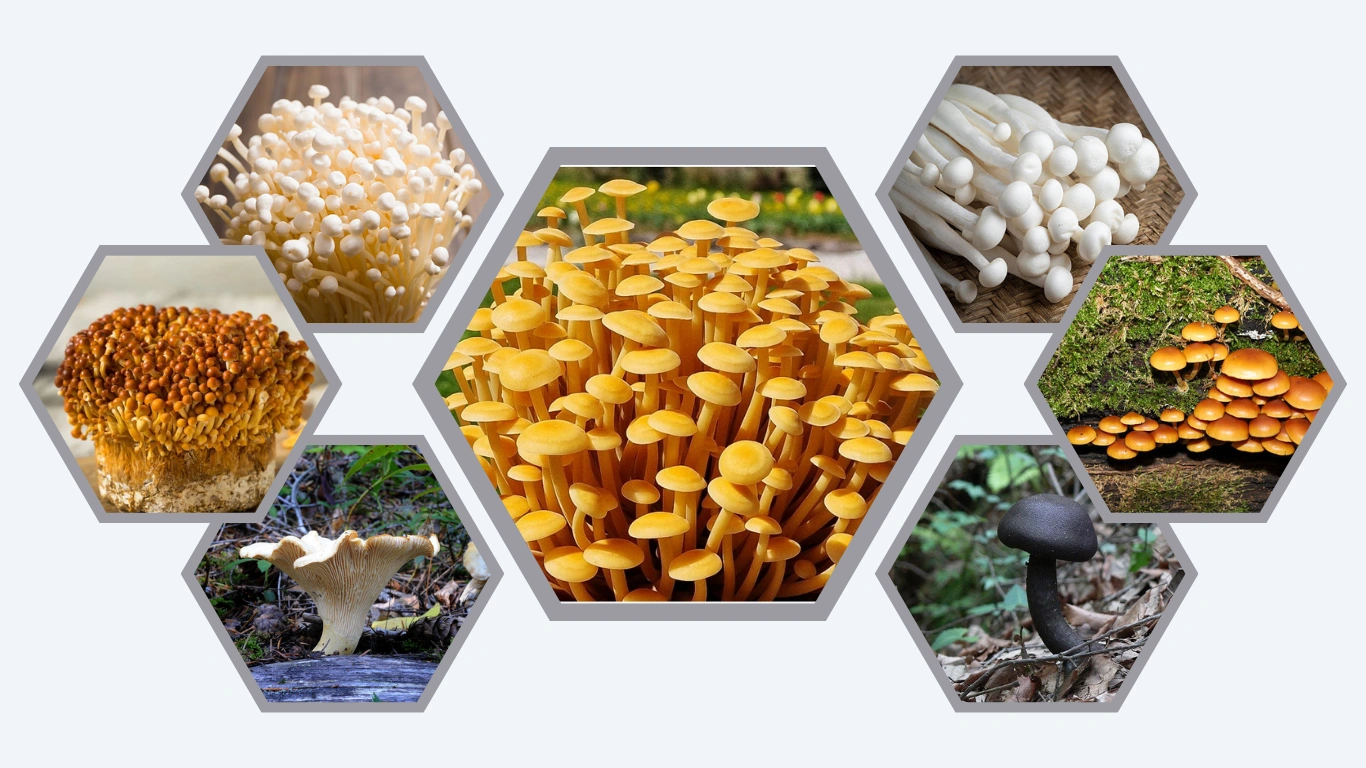
Enoki mushrooms are slender, delicate mushrooms best known for their long stems, tiny caps, and mild, slightly sweet flavor. They are popular in Asian cooking and widely used in soups, hot pots, stir-fries, and salads. While most people recognize the cultivated white form sold in markets, enoki mushrooms also exist in several wild and naturally pigmented types. Each type differs slightly in color, texture, growing environment, and flavor intensity, making enoki mushrooms both diverse and fascinating.
1. Golden Enoki Mushroom

Golden enoki mushroom is the wild, naturally pigmented form of enoki that grows in forests rather than farms. Unlike the thin, snowy-white enoki sold in supermarkets, golden enoki develops richer colors, stronger structure, and a more pronounced mushroom aroma. It is commonly found growing in tight clusters on decaying hardwood and is especially well known for its ability to fruit in cold weather. Because of this, it is sometimes called a “winter mushroom” in many regions.
Identification
- Cap: Small, rounded to slightly flattened, golden-yellow to orange-brown
- Stem: Long, slender, firm, darker and velvety toward the base
- Gills: Pale yellow to whitish, closely spaced, attached to the stem
- Spore print: White
- Growth pattern: Dense clusters emerging from wood
Habitat
Golden enoki mushrooms grow mainly on dead or dying hardwood trees such as elm, oak, beech, and maple. They prefer cool, moist environments and are often seen from late autumn through early spring. In many temperate regions, they continue growing even after light snowfall, making them one of the few mushrooms commonly found in winter forests.
Appearance and Growth Behavior
This type forms glossy caps when young, which gradually flatten as they mature. The stems are noticeably tougher than cultivated enoki, helping them withstand cold temperatures and outdoor exposure. Clusters often arise from cracks in bark or rotting stumps, creating eye-catching bunches of golden to amber-colored mushrooms.
Flavor and Culinary Use
Golden enoki has a mild, slightly sweet, and earthy taste with a firmer, chewier texture compared to white enoki. Because the stems are tougher, they are usually best cooked rather than eaten raw. They work well in soups, hot pots, stir-fries, and sautéed dishes, where they absorb flavors while still keeping a pleasant bite.
Ecological Importance
In nature, golden enoki plays an important role as a decomposer. By breaking down dead wood, it helps return nutrients to the soil and supports forest health. This recycling process contributes to soil formation and provides habitats for many small organisms, making golden enoki valuable not only in the kitchen but also in woodland ecosystems.
2. White Enoki Mushroom

White enoki mushroom is the most widely known and commercially cultivated form of enoki. It is instantly recognizable by its long, thin white stems and tiny rounded caps. This appearance is created by growing the mushroom in low-light, high-carbon-dioxide conditions, which prevents pigmentation and keeps the caps small. Because of its mild flavor, crunchy texture, and clean look, white enoki is extremely popular in Asian cuisine and is now common in supermarkets worldwide.
Identification
- Cap: Very small, smooth, round, pure white
- Stem: Long, thin, crisp, bright white
- Gills: White, closely packed, running slightly down the stem
- Spore print: White
- Growth pattern: Tight, bundled clusters from a single base
Cultivation and Growth
White enoki is usually grown indoors on sterilized bottles or bags filled with sawdust and nutrients. The controlled environment allows farmers to produce uniform clusters year-round. Lack of light keeps the mushrooms white, while limited airflow encourages long stem development. This cultivation method makes white enoki more delicate and tender than its wild relatives.
Texture and Flavor Profile
This type has a very mild, slightly sweet flavor with almost no bitterness. Its biggest attraction is texture. The stems are crisp and slightly crunchy when fresh, becoming tender but still springy after cooking. Because of its neutral taste, white enoki easily absorbs flavors from broth, sauces, and seasonings.
Culinary Uses
White enoki is commonly used in soups, hot pots, ramen, stir-fries, salads, omelets, and spring rolls. It cooks quickly and can be separated into individual strands, making it ideal for light dishes and garnishing. The base is usually trimmed off before use, and the rest of the cluster can be added whole or broken apart.
Nutritional and Practical Value
White enoki is low in calories and valued for its fiber content and lightness in meals. Its long shelf life under refrigeration and its clean, soil-free cultivation make it convenient for home kitchens. These qualities have helped it become one of the most commercially important enoki varieties worldwide.
3. Wild Enoki Mushroom

Wild enoki mushroom refers to naturally growing enoki found in forests, rather than cultivated environments. It is closely related to golden enoki but shows greater variation in color, size, and shape depending on climate, host tree, and growing conditions. Wild enoki is typically darker, tougher, and more strongly flavored than the cultivated white type, making it especially valued by experienced foragers and mushroom enthusiasts.
Identification
- Cap: Small to medium, convex to flat, yellow-brown to deep orange-brown
- Stem: Slender, firm, often darker and velvety near the base
- Gills: Pale cream to yellowish, crowded, attached to the stem
- Spore print: White
- Growth pattern: Dense to loose clusters on wood
Natural Habitat
Wild enoki grows on dead or dying hardwood trees, including elm, poplar, oak, and beech. It is most commonly found in late autumn, winter, and early spring. One of its unique features is its cold tolerance; it can survive frost and even continue growing at temperatures close to freezing, making it a notable winter-fruiting mushroom.
Appearance and Seasonal Behavior
Compared to cultivated enoki, wild forms have wider caps, shorter stems, and deeper pigmentation due to exposure to light and fresh air. The surface of the stem often becomes velvety or fuzzy near the base, which is a key field characteristic. Clusters frequently emerge from cracks in bark, fallen logs, or decaying stumps.
Flavor and Culinary Potential
Wild enoki has a richer, more complex flavor than white enoki, with mild sweetness and earthy undertones. The texture is firmer and slightly chewy, especially in the stem. It is best cooked thoroughly and works well in soups, broths, stir-fries, and slow-simmered dishes where its flavor can develop.
Ecological Role
In forest ecosystems, wild enoki acts as a decomposer, breaking down tough hardwood fibers. This process releases nutrients back into the soil, supporting plant growth and microbial life. Its presence is often a sign of healthy woodland decay processes, making it ecologically as well as culinarily important.
4. Velvet Shank Enoki Mushroom

Velvet shank enoki is the traditional wild form of enoki, scientifically known as Flammulina velutipes. It is named after the distinctive dark, velvety texture at the base of its stem. This type is widely distributed across Asia, Europe, and North America and is especially famous for fruiting in very cold conditions, sometimes even emerging through snow. Velvet shank is considered the true wild ancestor of cultivated enoki.
Identification
- Cap: Small to medium, convex to flat, honey-yellow to orange-brown, often sticky when moist
- Stem: Long, slender, pale near the top, dark brown to black and velvety at the base
- Gills: Pale cream to yellowish, closely spaced, attached to the stem
- Spore print: White
- Growth pattern: Clusters growing from wood
Habitat and Distribution
Velvet shank enoki grows mainly on dead hardwood such as elm, willow, poplar, and beech. It is commonly found along riverbanks, forest edges, and damp woodlands. Fruiting usually occurs from late autumn through early spring, and it is one of the few mushrooms that consistently appears during winter months.
Distinctive Features
The most recognizable feature is the dark, fuzzy lower stem, which clearly separates velvet shank from the smooth, white cultivated enoki. The caps are usually glossy and slightly sticky after rain, giving them a polished appearance. When exposed to natural light, the mushrooms develop deeper pigmentation and sturdier structures.
Flavor and Culinary Use
Velvet shank has a mild, slightly fruity and sweet flavor with a firmer bite than cultivated forms. The dark base of the stem is often trimmed away before cooking. It is commonly used in soups, noodle dishes, hot pots, and sautéed recipes, where it contributes both aroma and texture.
Ecological Importance
This enoki type is an active wood decomposer, helping break down tough hardwood tissues. By recycling dead trees into organic matter, velvet shank supports forest regeneration and provides microhabitats for insects and microorganisms, making it a key species in cold-season woodland ecosystems.
5. Brown Enoki Mushroom

Brown enoki mushroom is a cultivated variation of enoki that is grown with more exposure to light and fresh air than white enoki. This results in light to medium brown caps, slightly thicker stems, and a more natural wild-like appearance. Brown enoki is becoming increasingly popular because it combines the tenderness of cultivated mushrooms with a deeper flavor profile closer to wild enoki.
Identification
- Cap: Small, rounded to slightly flat, light brown to caramel-colored
- Stem: Long, thin, pale cream to light brown, firmer than white enoki
- Gills: Pale cream, closely packed, attached to the stem
- Spore print: White
- Growth pattern: Tight but slightly looser clusters
Cultivation Characteristics
Brown enoki is usually grown indoors under controlled conditions but with increased light compared to white enoki. This allows the mushroom to produce pigment, forming brown caps and sturdier stems. Because of these growing conditions, brown enoki often appears more robust and less fragile than its white counterpart while still maintaining a clean, cultivated form.
Appearance and Texture
The caps are noticeably larger than those of white enoki and have a glossy surface when fresh. The stems are slightly thicker and less brittle, giving brown enoki a pleasantly firm, springy texture. The clusters separate easily, making them practical for cooking and plating.
Flavor and Culinary Uses
Brown enoki has a richer, more pronounced mushroom flavor than white enoki, with mild nutty and earthy notes. It holds up well to heat and is well suited for stir-fries, grilling, soups, hot pots, and noodle dishes. The deeper color also adds visual contrast to meals.
Market and Nutritional Value
Brown enoki is increasingly used in gourmet cooking because of its balance between appearance, flavor, and texture. Like other enoki types, it is low in calories and valued for its fiber and micronutrient content, making it both a culinary and health-oriented ingredient.
6. Black Enoki Mushroom

Black enoki mushroom is a darker, more intensely pigmented form of enoki that resembles very mature or specially cultivated velvet shank types. It is known for its deep brown to nearly black stem bases, darker caps, and firmer overall structure. Black enoki is less common in general markets but is valued for its strong appearance, higher durability, and more pronounced mushroom aroma.
Identification
- Cap: Small to medium, convex to flat, dark brown to deep amber
- Stem: Long, slender, dark brown to black toward the base, firmer than white enoki
- Gills: Pale cream to light yellow, crowded, attached to the stem
- Spore print: White
- Growth pattern: Dense clusters from a shared base
Growth and Cultivation
Black enoki may appear naturally in wild velvet shank populations or be cultivated under conditions that encourage strong pigmentation, such as higher light exposure and cooler growing temperatures. These factors produce thicker skins, darker coloring, and more resilient fruiting bodies.
Physical Characteristics
This type typically has a tougher texture than white or brown enoki. The dark lower stems are often trimmed before cooking because they are fibrous. The caps may appear glossy when moist and slightly matte when dry, adding to their visual appeal in dishes.
Flavor Profile
Black enoki offers a deeper, earthier taste than lighter enoki varieties, sometimes with subtle woody notes. The firmer texture gives a satisfying chew, making it suitable for dishes where mushrooms need to hold their shape, such as grilling, roasting, and long-simmered soups.
Culinary and Ecological Value
In cooking, black enoki is appreciated for its robust character and striking color contrast. In natural settings, darker enoki forms contribute to wood decomposition, helping recycle nutrients and support forest ecosystems, particularly during colder months.
7. Himalayan Enoki Mushroom

Himalayan enoki mushroom is a high-altitude wild form of enoki found in cooler mountainous regions of the Himalayas and nearby ranges. Because of its harsh growing environment, it develops a sturdier body, deeper coloration, and stronger aroma than cultivated enoki. Local foragers value it both as a seasonal food source and as an important part of mountain forest ecosystems.
Identification
- Cap: Small to medium, convex to flat, yellow-brown to deep orange
- Stem: Long, slender, tough, darker toward the base
- Gills: Pale cream to yellowish, closely spaced, attached to the stem
- Spore print: White
- Growth pattern: Tight clusters on wood
Natural Habitat
Himalayan enoki grows on decaying hardwood trunks and stumps in cool, moist mountain forests. It is commonly found at higher elevations where winters are long and temperatures frequently drop near freezing. Like other enoki types, it often fruits from late autumn through early spring.
Adaptations to High Altitude
Due to colder temperatures and stronger winds, Himalayan enoki develops firmer stems and thicker caps. Pigmentation is usually deeper than lowland forms, helping protect the mushroom from intense sunlight and cold exposure. These adaptations make it more resilient but also slightly tougher in texture.
Flavor and Traditional Use
This type has a stronger, more earthy flavor than cultivated enoki, with mild sweetness and woody undertones. It is generally cooked thoroughly in soups, stews, and local stir-fried dishes. In some regions, it is sun-dried for later use, which further concentrates its aroma.
Ecological Importance
Himalayan enoki plays an essential role in breaking down dead wood in mountain forests. By decomposing fallen trees, it supports soil development, nutrient cycling, and the overall health of high-altitude ecosystems.
FAQs
What are enoki mushrooms commonly used for?
Enoki mushrooms are widely used in soups, hot pots, ramen, stir-fries, omelets, and salads. Their mild flavor allows them to absorb seasonings easily, while their long stems add a light crunch. They cook quickly and are often added near the end of cooking.
Are enoki mushrooms the same as velvet shank mushrooms?
Yes, cultivated enoki mushrooms come from the same species as velvet shank (Flammulina velutipes). The main difference is growing conditions. Wild velvet shank grows in open air and develops darker colors, while cultivated enoki is grown in low light, producing long white stems.
Can enoki mushrooms be eaten raw?
Enoki mushrooms can be eaten raw in salads or as garnishes, but they are more commonly cooked. Light cooking improves their digestibility, flavor, and safety. Cooking also softens the stems and allows them to better absorb sauces, broths, and seasonings.
Where do enoki mushrooms naturally grow?
Wild enoki mushrooms grow on dead or dying hardwood trees such as elm, beech, poplar, and oak. They are well known for fruiting in cold seasons, often appearing in late autumn, winter, and early spring, even in frosty or snowy forest conditions.
How should enoki mushrooms be stored at home?
Fresh enoki mushrooms should be kept in the refrigerator, preferably in their original packaging or a paper bag. They stay fresh for about one to two weeks. Before use, trim off the dirty base and rinse lightly to remove any growing medium.