
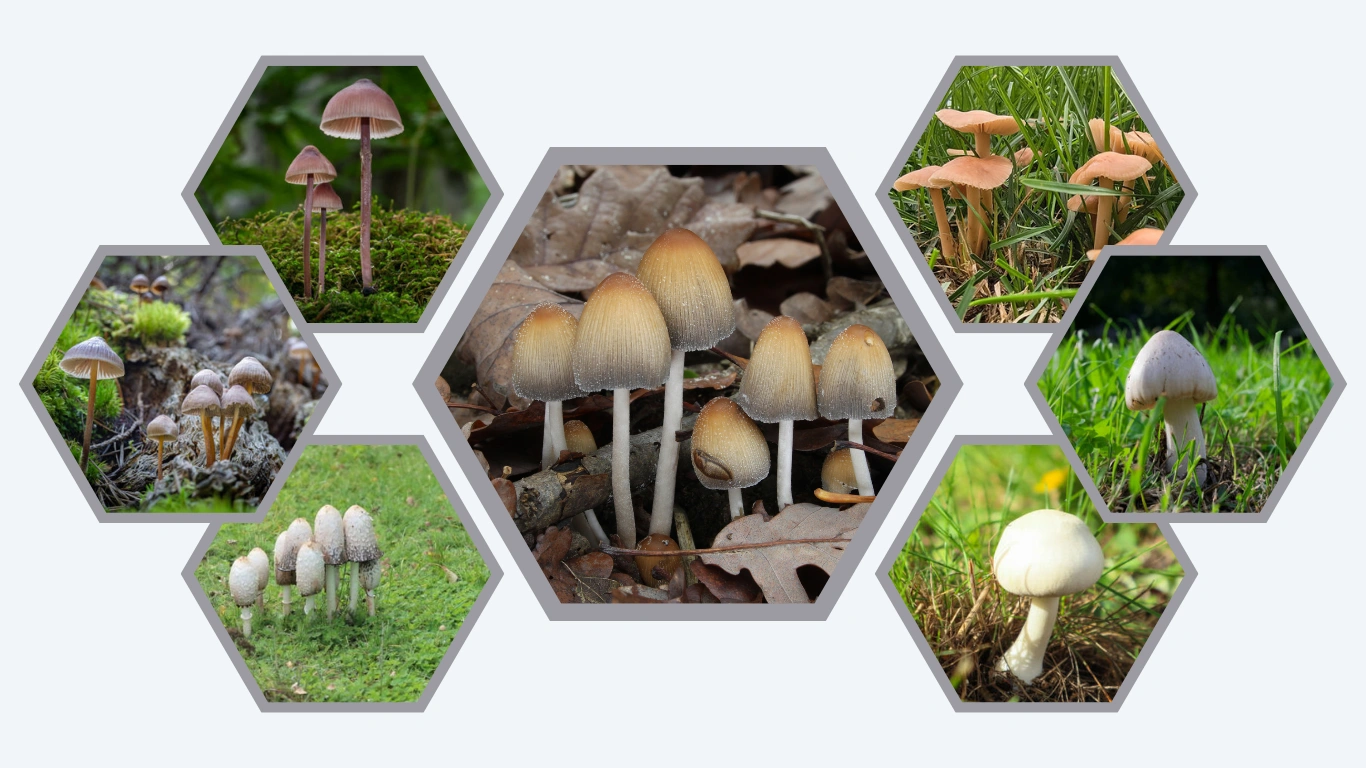
Lawn mushrooms are a common sight in gardens, parks, and grassy yards, especially after rainfall. They often appear suddenly, growing overnight from hidden fungal networks beneath the soil. While many lawn mushrooms are harmless to turf, some can be toxic to humans and pets, making correct awareness important. From tiny conecaps to large puffballs and parasol-shaped species, lawns can host a surprising variety of fungi that play a natural role in breaking down organic matter and recycling nutrients.
1. Common Field Mushroom (Agaricus campestris)

The common field mushroom is one of the most familiar lawn mushrooms, often appearing in grassy areas, parks, and open fields after rain. It is well known for its classic “store-bought mushroom” look and mild scent. This species usually grows in small groups or fairy rings and is widely distributed across temperate regions.
Identification
- Cap: White to slightly off-white, smooth, 5–10 cm wide
- Gills: Pink when young, turning chocolate-brown with age
- Stem: White, firm, with a thin ring
- Spore print: Dark brown
- Smell: Mild, pleasant mushroom scent
Habitat
Common field mushrooms grow mainly in lawns, meadows, pastures, and grassy open spaces. They prefer nutrient-rich soil and often appear after rainfall, especially from late spring through autumn.
Appearance
The cap starts rounded and gradually flattens with age. Gills are free from the stem and darken over time, which is a key feature for identification. The stem is short to medium in length and usually clean white.
Growth Pattern
This mushroom frequently grows in scattered groups, arcs, or full fairy rings. It rarely grows directly on wood and is most often seen in well-maintained lawns and natural grasslands.
2. Fairy Ring Mushroom (Marasmius oreades)

The fairy ring mushroom is a very common lawn species, best known for forming circular or curved growth patterns in grass, often called “fairy rings.” It is a small but tough mushroom that can survive dry conditions better than many others. This species is widespread in lawns, parks, golf courses, and pastures, especially during warm, moist seasons.
Identification
- Cap: Tan to light brown, smooth, 2–5 cm wide, often with a small central bump
- Gills: Widely spaced, pale cream to light tan
- Stem: Thin, tough, fibrous, light brown, usually ringless
- Spore print: White
- Texture: Leathery rather than soft
Habitat
Fairy ring mushrooms grow in grassy areas such as lawns, meadows, and open fields. They feed on organic matter in the soil and often reappear in the same spot year after year. They are most active from late spring through autumn, especially after rain.
Appearance
The cap is usually convex when young and becomes flatter with age, often keeping a slight central knob. The gills are not crowded, which helps distinguish this mushroom from many similar lawn species. The stem is slender and flexible, rarely snapping cleanly when bent.
Growth Pattern
This mushroom is famous for growing in rings, arcs, or long curved lines. The underground mycelium expands outward each year, producing mushrooms at the edge of the ring. Grass inside the ring may appear darker or greener due to changes in soil nutrients.
Lawn Impact
Fairy rings can sometimes cause visible bands of darker grass or, in dry conditions, dead patches of turf. While the mushrooms themselves are not harmful to lawns, the fungal network can affect how water moves through the soil, influencing grass health.
3. Yellow Stainer (Agaricus xanthodermus)

The yellow stainer is a very common lawn mushroom and one that frequently causes confusion with edible field mushrooms. It often appears in gardens, lawns, and grassy parks after rainfall. This species is especially important to recognize because it is poisonous and can cause strong stomach upset if eaten.
Identification
- Cap: White to cream, smooth, 5–12 cm wide, often stains yellow when touched
- Gills: Pale pink when young, turning dark brown
- Stem: White, with a noticeable ring, base often slightly swollen
- Spore print: Dark brown
- Smell: Strong chemical or “inky” odor, especially at the base
Habitat
Yellow stainers grow in lawns, compost-rich soils, garden beds, and along paths. They prefer disturbed ground with plenty of organic matter and often fruit in groups from late spring through autumn.
Appearance
The cap is rounded when young and becomes flatter with age. A key feature is the bright yellow staining that appears when the cap edge or stem base is bruised. The gills darken as the mushroom matures, similar to other Agaricus species.
Growth Pattern
This mushroom usually grows in clusters or scattered groups rather than tight fairy rings. It may appear suddenly after rain and can persist for several days before collapsing.
Safety Note
Although it resembles edible lawn mushrooms, the yellow stainer is toxic. The sharp chemical smell and rapid yellow bruising are the most reliable warning signs.
4. Green-Spored Parasol (Chlorophyllum molybdites)

The green-spored parasol is one of the most common and problematic lawn mushrooms worldwide. It frequently appears in suburban lawns, parks, and grassy playgrounds, often in large numbers after heavy rain. This species is notorious for causing severe gastrointestinal poisoning and is responsible for more mushroom poisonings than any other lawn species.
Identification
- Cap: White with brownish scales, 7–30 cm wide, often very large
- Gills: White when young, turning gray-green to greenish with age
- Stem: Tall, thick, with a prominent ring, often bulbous at the base
- Spore print: Green
- Flesh: White, sometimes reddening slightly when cut
Habitat
Green-spored parasols thrive in well-watered lawns, open grassy fields, sports grounds, and landscaped areas. They prefer warm weather and are most common in summer and early autumn, often appearing overnight after storms.
Appearance
The cap begins egg-shaped, then expands into a broad parasol form with distinctive brown scales. The stem is long and sturdy, making the mushroom stand out above the grass. As the mushroom matures, the gills develop a greenish tint, which is a key identification feature.
Growth Pattern
This species grows singly, in clusters, or in large fairy rings. It often appears in dramatic flushes, with many mushrooms emerging at once across a lawn.
Safety Note
The green-spored parasol is poisonous and should never be eaten. Its large size and parasol shape make it tempting, but the green spore print and lawn habitat are major warning signs.
5. Meadow Mushroom (Agaricus arvensis)

The meadow mushroom is a large, attractive lawn and pasture species often found in open grassy areas. It is closely related to the common field mushroom and is known for its firm texture and pleasant, slightly sweet scent. This mushroom usually appears after rain and can grow either singly or in loose groups.
Identification
- Cap: White to pale cream, smooth to slightly silky, 8–20 cm wide
- Gills: Pale pink at first, becoming chocolate-brown with maturity
- Stem: Thick, white, with a large, double-edged ring
- Spore print: Dark brown
- Smell: Mild, often slightly of almonds or anise
Habitat
Meadow mushrooms grow in lawns, meadows, pastures, and open parklands. They prefer rich, grassy soils and are most commonly seen from late spring through autumn, especially after periods of rainfall.
Appearance
The cap starts out rounded and becomes broadly convex to nearly flat. The surface is usually clean and pale, sometimes yellowing slightly with age or handling. The gills darken steadily as spores develop, which is typical of Agaricus species.
Growth Pattern
This species often appears in arcs, scattered clusters, or partial fairy rings. Individual mushrooms can become quite large and may stand out clearly above the surrounding grass.
Look-alike Note
Meadow mushrooms can be confused with poisonous lawn species such as the yellow stainer. Careful attention to smell, bruising reactions, and gill color changes is important.
6. Mower’s Mushroom (Panaeolina foenisecii)

The mower’s mushroom is one of the most frequently seen lawn mushrooms, especially in regularly cut grass. It is small, delicate, and often overlooked, yet it can appear in huge numbers after rain. This species is well adapted to short turf and is commonly found in home lawns, parks, and sports fields.
Identification
- Cap: Light brown to tan, often darker in the center, 1–3 cm wide
- Gills: Mottled brown, attached to the stem
- Stem: Thin, pale to light brown, fragile, ringless
- Spore print: Dark brown to blackish
- Surface: Smooth, sometimes slightly sticky when moist
Habitat
Mower’s mushrooms thrive in closely mown lawns, grassy yards, and golf courses. They feed on decaying organic matter in soil and are most abundant from late spring through autumn, especially during wet periods.
Appearance
The cap is bell-shaped when young and becomes broadly convex. It often shows subtle color changes as it dries, with the center staying darker. The gills have a speckled look due to uneven spore maturation.
Growth Pattern
This mushroom grows scattered or in loose groups, sometimes forming vague arcs but not true fairy rings. After rainfall, dozens or even hundreds can pop up across a single lawn.
Lawn Relevance
Although harmless to turf, mower’s mushrooms are sometimes mistaken for psychoactive species. They are not considered edible and should not be consumed.
7. Common Inkcap (Coprinopsis atramentaria)

The common inkcap is a fast-growing lawn and garden mushroom known for dissolving into a black, inky liquid as it matures. It often appears suddenly after rain and collapses just as quickly. This species is commonly found in lawns, parks, and along paths, especially where soil is rich in buried wood or organic debris.
Identification
- Cap: Gray to gray-brown, smooth, egg-shaped then bell-shaped, 3–10 cm wide
- Gills: White at first, quickly turning black and inky
- Stem: White, hollow, smooth, with a slight bulb at the base
- Spore print: Black
- Texture: Fragile, dissolves with age
Habitat
Common inkcaps grow in lawns, gardens, roadsides, and disturbed ground. They often appear near old tree roots, buried wood, or compost-rich soil. Fruiting usually occurs from spring through autumn after rainfall.
Appearance
Young mushrooms look neat and upright, with smooth, oval caps. As they mature, the cap edges curl upward and begin to liquefy, turning the gills into a dripping black fluid. This dramatic change is one of the easiest ways to recognize inkcaps.
Growth Pattern
They usually grow in tight clusters or dense groups, sometimes with many mushrooms packed closely together. Entire clusters may appear overnight and vanish within a day or two.
Safety Note
This species can cause illness if consumed with alcohol due to a chemical reaction. It should never be eaten without expert identification.
8. Shaggy Inkcap (Coprinus comatus)

The shaggy inkcap is a striking lawn mushroom, easily recognized by its tall, white, shaggy-scaled cap. It commonly appears along grassy edges, lawns, parks, and roadsides, often pushing up through compacted soil. This species grows quickly after rain and undergoes the same inky self-dissolving process as other inkcaps.
Identification
- Cap: Tall, cylindrical, white with shaggy scales, 5–15 cm tall
- Gills: White when young, turning pink, then black and inky
- Stem: White, hollow, smooth, with a movable ring
- Spore print: Black
- Texture: Soft and delicate, especially when mature
Habitat
Shaggy inkcaps grow in lawns, open grassy areas, along sidewalks, and on disturbed ground. They prefer nutrient-rich soils and are often seen from spring through autumn, particularly after periods of rain.
Appearance
When young, the mushroom looks like a white, shaggy cylinder. As it matures, the cap opens, the gills darken, and the edges dissolve into black liquid. The shaggy scales on the cap surface give it a distinctive “wig-like” appearance.
Growth Pattern
This species grows singly, in lines, or in loose clusters. It often appears in the same grassy spots year after year, sometimes forming long rows along paths or lawn edges.
Visual Impact
Because of its height and bright white color, the shaggy inkcap stands out clearly against green grass, making it one of the most noticeable lawn mushrooms.
9. Haymaker’s Mushroom (Panaeolus foenisecii)

The haymaker’s mushroom is a very common small lawn mushroom, frequently appearing in freshly mowed grass, parks, and open yards. It is sometimes confused with mower’s mushroom because of its similar habitat, but it typically has a slightly darker cap and more pronounced color changes as it dries.
Identification
- Cap: Tan to brown, often darker at the center, 1–3 cm wide
- Gills: Dark brown to blackish, mottled in appearance
- Stem: Thin, fragile, pale brown, ringless
- Spore print: Dark brown to nearly black
- Cap surface: Smooth, often hygrophanous (color-changing)
Habitat
Haymaker’s mushrooms thrive in lawns, meadows, sports fields, and other grassy places with rich organic matter. They are most common from late spring through autumn, especially during warm, wet weather.
Appearance
The cap is bell-shaped to convex and often shows strong color differences between wet and dry states. When moist, it looks darker and richer brown; when dry, it fades to a pale tan. The gills appear speckled because spores mature unevenly.
Growth Pattern
This species grows scattered or in loose groups across lawns rather than in tight clusters. Large numbers may appear overnight after rainfall, covering wide grassy areas.
Common Confusion
Because of its size and habitat, the haymaker’s mushroom is often mistaken for edible or psychoactive species. It is not considered edible and should not be consumed.
10. False Parasol (Chlorophyllum brunneum)

The false parasol is a large, showy lawn mushroom that often appears after heavy rain in gardens, parks, and open grassy areas. It closely resembles parasol-type edible mushrooms, which makes it especially important to recognize. This species is considered poisonous and is known to cause stomach and intestinal distress if eaten.
Identification
- Cap: White to pale cream with thick brown scales, 8–25 cm wide
- Gills: White, crowded, free from the stem
- Stem: Thick, white to brownish, with a prominent ring and swollen base
- Spore print: White
- Flesh: White, may bruise slightly brown or reddish
Habitat
False parasols grow in lawns, landscaped areas, compost-rich soil, and grassy clearings. They prefer warm, moist conditions and are most often seen from late spring through autumn, sometimes appearing in large numbers after storms.
Appearance
The cap begins rounded and expands into a broad parasol shape with coarse, darker scales. The stem is sturdy and often noticeably bulbous at the base. Compared to some true parasols, it looks stockier and heavier.
Growth Pattern
This mushroom grows singly, in clusters, or in partial fairy rings. Large flushes can cover wide sections of lawn, making them very noticeable from a distance.
Safety Note
The false parasol is poisonous. Because it resembles edible parasol mushrooms, lawn specimens should never be eaten without expert identification.
11. Fly Agaric (Amanita muscaria)

The fly agaric is one of the most iconic mushrooms in the world, famous for its bright red cap with white spots. Although it is more commonly associated with woodland edges, it can sometimes appear in lawns, especially where trees such as birch, pine, or oak are nearby. Its striking appearance makes it one of the easiest lawn mushrooms to recognize.
Identification
- Cap: Bright red to orange-red with white warty spots, 8–20 cm wide
- Gills: White, crowded, free from the stem
- Stem: White, with a hanging ring and a bulbous base
- Spore print: White
- Base: Surrounded by white, cottony tissue (volva remnants)
Habitat
Fly agarics grow in lawns, gardens, and grassy areas close to trees, because they form symbiotic relationships with tree roots. They are most common from late summer through autumn, often appearing after periods of rain.
Appearance
Young mushrooms emerge as white “eggs” before the red cap expands and the white patches break through the surface. The cap may fade to orange or yellowish tones with age or strong sunlight.
Growth Pattern
This species grows singly or in small groups rather than dense clusters. It often appears scattered across lawns near trees rather than in open turf.
Toxicity Note
Fly agaric is toxic and psychoactive. It should never be eaten, and contact with children or pets should be avoided.
12. Liberty Cap (Psilocybe semilanceata)

The liberty cap is a small, delicate lawn and grassland mushroom best known for its distinctive pointed cap. It grows in grassy fields, lawns, and pastures, particularly in cool, moist conditions. Although not always present in short-cut lawns, it can appear in natural grass areas, parks, and lightly managed turf.
Identification
- Cap: Conical to bell-shaped with a pointed tip, yellow-brown to olive, 0.5–2.5 cm wide
- Gills: Light brown, becoming dark purplish-brown
- Stem: Thin, pale to yellowish, flexible, ringless
- Spore print: Dark purplish-brown
- Cap surface: Smooth, often slightly sticky when wet
Habitat
Liberty caps grow in lawns, meadows, pastures, and grassy slopes, especially where soil is rich and moisture is consistent. They are most common in autumn and early winter after rainfall.
Appearance
The pointed “nipple” at the top of the cap is the easiest feature to recognize. The cap often changes color as it dries, becoming paler from the edges inward. The slender stem bends easily without snapping.
Growth Pattern
This species grows scattered or in small groups rather than tight clusters. It is rarely found in dense rings and is more common in natural grasslands than heavily maintained lawns.
Legal & Safety Note
Liberty caps contain psychoactive compounds and are illegal or restricted in many regions. They should not be consumed and must be handled responsibly.
13. Common Puffball (Lycoperdon perlatum)

The common puffball is a small, round lawn mushroom often noticed when it releases a little “puff” of brown spores if stepped on. It appears in grassy lawns, parks, and garden edges, as well as near paths and light woodland. When young, it is firm and white inside, but it quickly changes as it matures.
Identification
- Shape: Round to pear-shaped, 2–6 cm tall
- Surface: White with tiny spines or warts that rub off easily
- Interior: Pure white when young, turning yellow-brown and powdery with age
- Base: Narrow, sterile stem-like portion
- Spore mass: Brown when mature
Habitat
Common puffballs grow in lawns, grassy clearings, gardens, and open parkland. They thrive in soil rich in organic matter and often appear after rain from late summer through autumn.
Appearance
Young puffballs look like small white balls or pears attached to the ground. As they age, the surface darkens slightly and a small opening forms at the top. When disturbed, clouds of brown spores are released.
Growth Pattern
They grow singly, scattered, or in small groups rather than dense clusters. Puffballs often appear suddenly across lawns after wet weather.
Distinguishing Note
Only firm, white puffballs inside are immature. Once the interior turns yellow or brown, the mushroom is fully mature and no longer in its early stage.
14. Giant Puffball (Calvatia gigantea)

The giant puffball is one of the largest lawn and meadow mushrooms in the world, sometimes reaching the size of a football or larger. It appears in open grassy areas such as lawns, meadows, and pastures, often after heavy rain. Because of its size and pure white surface when young, it is usually very easy to recognize.
Identification
- Shape: Large, round to oval ball
- Size: Commonly 20–60 cm wide, sometimes larger
- Surface: Smooth to slightly wrinkled, white when young
- Interior: Solid white when young, turning yellow, then brown and powdery
- Stem: Absent (sits directly on the ground)
Habitat
Giant puffballs grow in lawns, meadows, fields, and open parkland. They prefer rich soil and often appear in the same general areas year after year, usually from late summer through autumn.
Appearance
Young specimens are bright white and firm, with a smooth or slightly velvety surface. As they mature, the outer skin becomes thinner and may crack, revealing brown spore powder inside.
Growth Pattern
They usually grow singly or in loose groups, scattered across open grassy areas. Unlike some lawn mushrooms, they do not form rings but may appear suddenly after storms.
Visual Impact
Because of their enormous size, giant puffballs are often spotted from a distance and become temporary lawn landmarks until they collapse.
15. Earthball (Scleroderma citrinum)

The earthball is a common lawn and garden mushroom that resembles a puffball but is darker, tougher, and thicker-skinned. It often appears in lawns, parks, and along grassy edges, especially where soil is sandy or compacted. Unlike true puffballs, earthballs are not edible and can cause poisoning.
Identification
- Shape: Round to irregular, 4–10 cm wide
- Surface: Thick, tough, yellow-brown to brown with cracked, scaly patterns
- Interior: Whitish when very young, quickly turning dark purple-black
- Skin: Hard, leathery outer wall
- Spore mass: Dark, almost black at maturity
Habitat
Earthballs grow in lawns, grassy clearings, woodland edges, and disturbed ground. They tolerate poor or sandy soil and are most often seen from summer through autumn.
Appearance
At first glance, earthballs look like rough, dirty puffballs. Cutting them open reveals a dark interior at an early stage, which distinguishes them from edible puffballs that stay white inside for a long time.
Growth Pattern
They grow singly or in small groups, often partially buried in soil. They do not usually form dense clusters.
Safety Note
Earthballs are poisonous and should never be eaten. Their thick skin and dark interior help separate them from true puffballs.
16. Conocybe Mushroom (Conocybe apala)

The conocybe mushroom is a very small, fragile lawn species often seen growing briefly after rain and disappearing just as quickly. It commonly appears in lawns, parks, and grassy gardens, especially in moist soil. Because of its delicate structure, it is sometimes called a “fragile conecap.”
Identification
- Cap: White to pale cream, conical to bell-shaped, 1–3 cm wide
- Gills: Pale at first, becoming light brown
- Stem: Very thin, white, fragile, ringless
- Spore print: Rusty brown
- Texture: Extremely delicate, easily crushed
Habitat
Conocybe mushrooms grow in lawns, open grass, and cultivated turf. They prefer damp soil and often fruit in warm weather after rain, sometimes lasting only a few hours.
Appearance
The cap is sharply conical when young and may expand slightly but usually keeps a pointed or bell-like form. The entire mushroom is pale, giving it a ghostly or translucent look in early morning lawns.
Growth Pattern
They grow scattered or in small groups, rarely forming rings. Because they dry out rapidly, they may vanish by midday on sunny days.
Lawn Presence
Although harmless to turf, these mushrooms indicate moist, organic-rich soil conditions in lawns.
17. Panaeolus Mushroom (Panaeolus cinctulus)

The panaeolus mushroom is a common small lawn species found in grassy areas, parks, and sometimes fertilized lawns. It is known for its dark, mottled gills and slender form. This species often appears after rain and may be scattered across large areas of turf.
Identification
- Cap: Brown to dark tan, sometimes with a darker band near the edge, 1–4 cm wide
- Gills: Mottled dark brown to black
- Stem: Thin, pale to brownish, smooth, ringless
- Spore print: Black
- Cap surface: Smooth, slightly sticky when moist
Habitat
Panaeolus mushrooms grow in lawns, meadows, grassy fields, and sometimes dung-enriched soil. They prefer moist conditions and often fruit from late spring through autumn.
Appearance
The cap is bell-shaped to convex and may show a darker margin. The gills have a spotted or patchy look because spores mature unevenly, which is typical of this genus.
Growth Pattern
They grow scattered, in loose groups, or sometimes in arcs, but rarely in tight clusters.
General Note
Many Panaeolus species look similar, and accurate identification often requires microscopic features. They are not considered edible.
18. Inky Cap (Coprinellus micaceus)

The inky cap is a delicate lawn and garden mushroom that often grows in dense clusters. It is commonly found in grassy areas, garden beds, and lawns where buried wood or old roots are present. Its cap surface often sparkles when fresh, giving it the nickname “glistening inkcap.”
Identification
- Cap: Honey-brown to amber, bell-shaped, 2–5 cm wide
- Gills: Pale at first, turning dark brown then black
- Stem: Thin, white, hollow, fragile
- Spore print: Black
- Surface: Often covered with tiny glitter-like granules
Habitat
Inky caps grow in lawns, around tree roots, near stumps, and in compost-rich ground. They fruit in clusters from spring through autumn, especially after rain.
Appearance
Young caps are oval and glossy, sometimes with sparkling particles. As they mature, the gills darken and may partially liquefy, though less dramatically than some other inkcaps.
Growth Pattern
They typically grow in tight clumps, with many stems emerging from the same underground source.
Lawn Indicator
Their presence often indicates buried wood or decaying roots beneath the lawn.
19. Lawn Parasol (Lepiota cristata)

The lawn parasol is a small parasol-type mushroom often found in grassy lawns, parks, and gardens. It has a thin stem and a cap with fine scales, giving it a delicate but patterned appearance. Some Lepiota species are poisonous, so lawn parasols should never be eaten.
Identification
- Cap: White to cream with reddish-brown scales, 2–5 cm wide
- Gills: White, free from the stem
- Stem: Thin, white, sometimes slightly bulbous at the base
- Spore print: White
- Smell: Often sharp or unpleasant
Habitat
Lawn parasols grow in lawns, grassy clearings, and garden soils rich in organic matter. They often appear after rain from summer through autumn.
Appearance
The cap is convex when young and flattens with age, showing darker scales concentrated near the center. The slender stem makes the mushroom look delicate compared to larger parasol species.
Growth Pattern
They grow singly or in small groups scattered across lawns rather than in dense clusters.
Safety Note
Many small parasol-type mushrooms in lawns belong to toxic groups. Positive identification is essential, and consumption should be avoided.
FAQs
Are lawn mushrooms dangerous to humans?
Many lawn mushrooms are harmless to look at but some are poisonous if eaten. Species like the green-spored parasol, yellow stainer, and earthball can cause serious stomach problems. Because many edible and toxic mushrooms look similar, it’s safest to treat all lawn mushrooms as potentially dangerous and avoid consumption.
Why do mushrooms suddenly appear on my lawn?
Mushrooms grow from underground fungal networks that are always present in the soil. After rain, warm temperatures, and high humidity, they produce visible mushrooms very quickly. Their sudden appearance usually means your lawn has plenty of moisture and organic matter below the surface.
Do lawn mushrooms harm grass?
Most lawn mushrooms do not damage grass directly. In fact, the fungi are breaking down organic material and recycling nutrients back into the soil. Some species may create fairy rings that change grass color, but the mushrooms themselves rarely kill healthy turf.
How can I get rid of mushrooms in my lawn?
You can reduce mushrooms by improving drainage, removing excess thatch, and watering less frequently. Raking up mushrooms before they release spores can help with appearance, but it won’t eliminate the underground fungus. Long-term control focuses on changing lawn conditions rather than killing the mushrooms.
Is it safe for pets to be around lawn mushrooms?
Some lawn mushrooms are toxic to pets if eaten, and symptoms can include vomiting, drooling, or lethargy. It’s best to remove visible mushrooms promptly and prevent pets from chewing on them. If you suspect a pet has eaten a mushroom, contact a veterinarian immediately.