
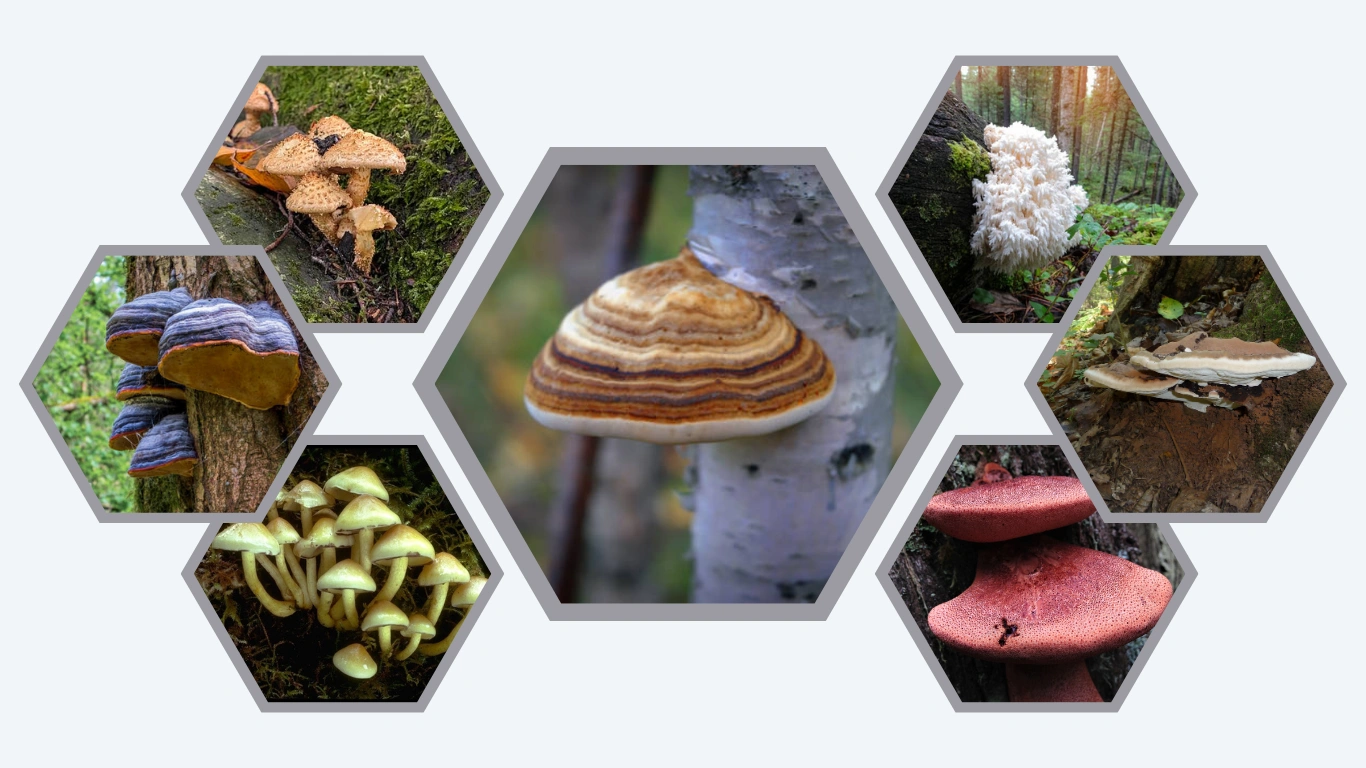
Tree-growing mushrooms are a fascinating group of fungi that develop directly on trunks, logs, and decaying wood. Instead of emerging from soil, they feed on the tough fibers inside trees, helping break down dead timber and recycle nutrients back into forest ecosystems. From soft, edible species like oyster and shiitake to hard, shelf-like bracket fungi, these mushrooms appear in many shapes, colors, and textures. Together, they play a vital role in woodland health and natural decomposition.
1. Oyster Mushroom (Pleurotus ostreatus)

Oyster mushrooms are one of the most common tree-growing fungi in the world. They usually appear in layered, shelf-like clusters on dead or dying hardwood trees. Known for their oyster-shaped caps and mild flavor, these mushrooms are popular in both the wild and commercial cultivation. They play an important ecological role by breaking down wood and recycling nutrients back into forest ecosystems.
Identification
- Fan- or oyster-shaped caps, often overlapping
- Cap color ranges from white and cream to gray or light brown
- Smooth, slightly shiny surface
- Short or absent central stem, usually off-center
- White to pale lilac gills running down the stem
- Soft, fleshy texture with a mild mushroom scent
Habitat
Oyster mushrooms grow mainly on dead or weakened hardwood trees such as oak, beech, and maple. They are commonly found on logs, stumps, and fallen trunks in forests, parks, and even urban areas where old wood is present.
Size and Appearance
Caps usually measure 5 to 20 cm wide, though some clusters can be much larger. The caps are broad and curved, resembling oyster shells. Gills are closely spaced and extend down toward the base, giving the underside a distinctive striped look.
Growth Pattern
This species typically grows in dense clusters, with many caps emerging from a single point on the wood. The layered formation helps distinguish oyster mushrooms from many other tree-growing fungi.
Ecological Role
Oyster mushrooms are powerful decomposers. They break down tough lignin and cellulose in wood, helping dead trees decay faster. This process enriches the soil and supports new plant growth in forest environments.
2. Lion’s Mane (Hericium erinaceus)

Lion’s mane is a striking tree-growing mushroom best known for its white, shaggy appearance that looks like a cascading mane or frozen waterfall. Instead of caps and gills, it forms soft, dangling spines that hang from a central mass. It grows on living or dead hardwood trees and is widely valued for both culinary and traditional uses. In forests, it stands out clearly against dark bark, making it one of the easiest tree mushrooms to recognize.
Identification
- White to creamy-white color when fresh
- Rounded, clump-like body with no cap or gills
- Long, soft spines or “teeth” hanging downward
- Spines usually 1–5 cm long
- Flesh is tender and watery when young
- Turns yellowish or brownish with age
Habitat
Lion’s mane grows on hardwood trees such as oak, beech, maple, and walnut. It is usually found on dead trunks, decaying logs, or wounds on living trees. It appears singly rather than in large clusters and is most common in mature forests and well-wooded parks.
Size and Appearance
A single fruiting body can range from 10 to 30 cm across and may weigh several kilograms in ideal conditions. When young, it is bright white and compact. As it matures, the spines lengthen, giving it a fluffy, pom-pom or beard-like look that clearly separates it from bracket fungi and shelf mushrooms.
Growth Pattern
Lion’s mane typically grows as a solitary mass attached to the side of a tree. It does not form layers like oyster mushrooms. Instead, it develops outward as one rounded clump, with gravity pulling the spines downward as it expands.
Ecological Role
This mushroom is a wood-decomposing fungus that breaks down hardwood, helping recycle nutrients into the forest soil. By colonizing injured or dead trees, it contributes to natural decay processes and supports the wider ecosystem by improving soil quality and habitat conditions.
3. Shiitake (Lentinula edodes)

Shiitake is one of the most well-known tree-growing mushrooms in the world, naturally found on decaying hardwoods. In the wild, it grows on fallen trunks and stumps, especially oak and chestnut. It has a classic mushroom shape with a broad brown cap and pale gills underneath. Beyond forests, shiitake is also widely cultivated on logs, reflecting its natural habit of growing on wood.
Identification
- Medium to large brown caps, often cracked or scaly
- Cap surface dry, smooth to slightly rough
- White to cream gills, closely spaced
- Firm, fibrous stem usually central
- White spore print
- Pleasant, earthy mushroom aroma
Habitat
Shiitake mushrooms naturally grow on dead or dying hardwood trees, especially oak, beech, chestnut, and maple. They are most often seen on logs and stumps in warm, humid forest environments, though cultivated shiitake closely mimics these natural growing conditions.
Size and Appearance
Caps typically measure 5–12 cm across, though some wild specimens can grow larger. The cap is convex when young and flattens with age. The gills are pale and neatly arranged, contrasting with the darker cap. The stem is lighter in color and tougher than the cap.
Growth Pattern
Shiitake usually grow singly or in small scattered groups rather than large overlapping clusters. They emerge directly from cracks or soft spots in the wood, often appearing after rainfall or during humid weather.
Ecological Role
As a saprophytic fungus, shiitake breaks down dead hardwood, returning nutrients to the soil. This decomposition process supports forest regeneration and helps maintain the natural recycling of organic matter within woodland ecosystems.
4. Turkey Tail (Trametes versicolor)

Turkey tail is a thin, colorful bracket mushroom that commonly grows on dead trees and fallen logs. It gets its name from the bold, concentric bands of color that resemble the tail feathers of a wild turkey. Instead of having a soft, fleshy body, this mushroom forms tough, leathery shelves that often cover large sections of wood, making it one of the most visible tree-growing fungi in forests.
Identification
- Thin, fan-shaped brackets growing in overlapping rows
- Concentric rings of brown, gray, blue, reddish, and cream colors
- Velvety or fuzzy upper surface
- White to pale underside with tiny pores instead of gills
- Very tough, leathery texture
- Usually only a few millimeters thick
Habitat
Turkey tail grows on dead hardwood trees such as oak, maple, beech, and birch. It is most often found on fallen logs, decaying trunks, and old stumps. This mushroom is widespread and can appear year-round, especially in moist woodland environments.
Size and Appearance
Individual caps are usually 2–8 cm wide, but they grow in dense, layered colonies that can cover large areas of wood. The thin, multicolored bands are its most distinctive feature, and the underside remains pale with fine pores.
Growth Pattern
This species grows in large, overlapping clusters, forming shelf-like layers along logs and trunks. New brackets often emerge in rows, giving the wood a shingled appearance.
Ecological Role
Turkey tail is a strong decomposer of hardwood. It breaks down lignin and cellulose, speeding up wood decay and helping return nutrients to forest soil. This process supports microorganisms, plants, and insects that depend on decomposing wood.
5. Reishi (Ganoderma lucidum)

Reishi is a glossy, wood-growing mushroom known for its hard, varnished appearance. It forms kidney- or fan-shaped brackets on tree trunks and stumps, often with a reddish-brown surface that looks polished. Unlike soft edible mushrooms, reishi is tough and woody. In forests, it is easily recognized by its shiny cap and distinct color bands, making it one of the most visually striking mushrooms that grow on trees.
Identification
- Shiny, lacquered surface that looks varnished
- Kidney- or fan-shaped cap
- Reddish-brown to dark brown with yellow or white margins
- White to brown pore surface underneath
- Tough, woody texture
- Off-center or lateral stem (sometimes absent)
Habitat
Reishi grows on hardwood trees such as oak, maple, elm, and beech. It is commonly found on dead logs, old stumps, and occasionally at the base of living trees. It prefers warm, humid forests and often appears during late spring through autumn.
Size and Appearance
Caps usually range from 5 to 20 cm wide. The upper surface is smooth and glossy, while the underside has tiny pores instead of gills. Color often changes from bright red near the edge to darker brown toward the center as the mushroom matures.
Growth Pattern
Reishi typically grows singly or in small groups rather than large clusters. The fruiting body emerges from wood and slowly expands outward, forming a firm bracket that can persist for months.
Ecological Role
Reishi is a wood-rotting fungus that causes white rot in hardwoods. By breaking down lignin and cellulose, it accelerates the decay of dead trees and helps recycle nutrients back into forest ecosystems.
6. Chicken of the Woods (Laetiporus sulphureus)

Chicken of the woods is a bright, shelf-like mushroom that grows in large clusters on trees. Its vivid orange and yellow colors make it easy to spot from a distance. The soft, thick brackets often resemble stacked fans. It commonly appears on hardwood trunks and stumps and is one of the most noticeable mushrooms found growing directly from wood.
Identification
- Bright orange caps with yellow edges
- Large, overlapping shelf-like brackets
- Underside with tiny yellow pores instead of gills
- Thick, fleshy texture when young
- Soft and moist surface
- Pale, crumbly flesh inside
Habitat
Chicken of the woods grows mainly on hardwood trees such as oak, chestnut, and beech. It is usually found on dead trunks, old stumps, and sometimes living trees. It appears from late spring through autumn, especially after warm, wet weather.
Size and Appearance
Individual shelves can measure 10–30 cm across, and entire clusters may span over 60 cm. When young, the mushroom is bright and tender. As it ages, the flesh becomes tougher and paler, and the edges may start to dry out.
Growth Pattern
This mushroom forms massive, overlapping clusters that emerge from a single point on the tree. The layered structure often looks like a pile of large, colorful fans.
Ecological Role
Chicken of the woods is a strong wood-decaying fungus that causes brown rot. It breaks down cellulose in wood, contributing to the natural decomposition of trees and recycling nutrients back into the forest environment.
7. Hen of the Woods (Grifola frondosa)

Hen of the woods is a large, clustered mushroom that grows at the base of trees, especially old hardwoods. It forms a dense mass of many thin, leaf-like caps that together resemble the ruffled feathers of a sitting hen. Its earthy colors help it blend into forest floors, but its massive size often gives it away. It is one of the most impressive mushrooms found growing from wood.
Identification
- Large, bushy clusters made of many thin caps
- Gray, brown, or smoky-colored fronds
- White pore surface underneath
- Tough, fibrous central base
- Mild, earthy smell
- White spore print
Habitat
Hen of the woods grows mainly at the base of living or dead hardwood trees, especially oak. It can also appear on buried roots. This mushroom favors mature forests and often returns to the same tree year after year.
Size and Appearance
Clusters commonly range from 15 to 60 cm across, but very large specimens can exceed this. Each individual cap is usually spoon- or fan-shaped. The overall structure looks like a dense bouquet emerging from the ground or trunk base.
Growth Pattern
It grows as a single, massive rosette composed of dozens or even hundreds of small overlapping caps. Unlike shelf fungi, it forms a rounded mound rather than horizontal brackets.
Ecological Role
Hen of the woods is a parasitic and saprophytic fungus. It weakens living trees by breaking down wood tissues and later continues decomposing dead material, helping return nutrients to the forest soil.
8. Artist’s Conk (Ganoderma applanatum)

Artist’s conk is a large, hard bracket fungus that grows on tree trunks and fallen logs. It is famous for its white underside, which bruises brown when scratched, allowing people to “draw” pictures on it. Unlike soft mushrooms, it forms thick, woody shelves that can last for many years, slowly expanding as the tree continues to decay.
Identification
- Large, flat, hoof-shaped or shelf-like brackets
- Upper surface gray to brown, dull and slightly ridged
- White underside that turns brown when scratched
- No gills; underside covered in fine pores
- Very hard, woody texture
- Often extremely thick and heavy
Habitat
Artist’s conk grows mainly on dead or dying hardwood trees such as maple, birch, beech, and elm. It is commonly found on standing trunks, fallen logs, and old stumps in moist forests and shaded woodland areas.
Size and Appearance
This mushroom can reach 30–60 cm across and may weigh several kilograms. The top surface is usually dull brown, while the pore surface underneath is bright white when fresh. Growth rings are often visible, showing its long lifespan.
Growth Pattern
Artist’s conk grows as a perennial bracket, adding a new layer each year. It forms large shelves that project outward from the trunk and often stack on top of older growth.
Ecological Role
This species causes white rot in hardwoods. By breaking down lignin and cellulose, it speeds up the decay of dead trees and plays an important role in nutrient cycling within forest ecosystems.
9. Velvet Shank (Flammulina velutipes)

Velvet shank is a small to medium-sized mushroom that grows in clusters on wood, especially during cold weather. It is well known for fruiting in late autumn and winter, sometimes even pushing up through snow. The caps are smooth and slightly sticky, while the stems are dark and velvety, giving this mushroom its common name.
Identification
- Smooth, rounded caps that are yellowish to orange-brown
- Sticky or shiny surface when moist
- White to pale yellow gills
- Slender stems with dark, velvety bases
- Pale spore print
- Soft, flexible flesh
Habitat
Velvet shank grows on dead hardwood trees such as elm, poplar, willow, and maple. It is commonly found on fallen trunks, decaying logs, and stumps, often in shaded, damp environments.
Size and Appearance
Caps usually measure 2–8 cm across. They are convex when young and flatten with age. The stems can reach 3–10 cm long, becoming darker and more velvety toward the base, which clearly separates this mushroom from many similar-looking species.
Growth Pattern
This mushroom grows in tight clusters, with many slender stems rising from the same piece of wood. It often fruits in cooler seasons when few other mushrooms are present.
Ecological Role
Velvet shank is a saprophytic fungus that decomposes dead wood. By breaking down woody material, it contributes to forest recycling processes and supports soil health.
10. Enoki (Flammulina filiformis)

Enoki is a slender, delicate mushroom that naturally grows on trees, often in cold conditions. In the wild, it looks quite different from the long, pure-white cultivated enoki seen in stores. Wild enoki develops small brownish caps and darker stems and forms tight clusters on wood. It is commonly found on hardwood trunks and stumps, especially during late autumn and winter.
Identification
- Small, rounded caps, yellowish to orange-brown
- Smooth, slightly sticky surface when wet
- White to pale cream gills
- Long, thin stems darker toward the base
- Velvety texture near the stem base
- Pale spore print
Habitat
Enoki grows on dead or dying hardwood trees such as elm, willow, poplar, and mulberry. It is often found on stumps, fallen logs, and standing dead trunks, particularly in cool, shaded forests and riverbank areas.
Size and Appearance
Caps are usually 1–4 cm wide, much smaller than velvet shank’s. Stems are long and thin, sometimes reaching 10 cm or more. Wild forms are darker and tougher than cultivated enoki, with a more noticeable cap and firmer structure.
Growth Pattern
This species grows in dense clumps, with many mushrooms sprouting closely together from the same piece of wood. It frequently fruits in late fall and winter, sometimes surviving light frosts.
Ecological Role
Enoki is a wood-decomposing fungus. It breaks down dead hardwood, helping return nutrients to forest soils and supporting the natural decay cycle of woodland ecosystems.
11. Split Gill (Schizophyllum commune)

Split gill is a small but extremely widespread tree-growing mushroom found on decaying wood across the world. It forms thin, fan-shaped caps that attach directly to logs and branches. Its most unique feature is the “split” gills on the underside, which can close during dry weather and reopen when moisture returns. This ability helps it survive harsh, dry conditions.
Identification
- Small, fan-shaped or shell-like caps
- Whitish to gray, fuzzy upper surface
- Underside with distinctive split gills
- Very thin, tough texture
- Short or absent stem
- Light-colored spore print
Habitat
Split gill grows on dead hardwood and sometimes softwood trees. It is commonly found on fallen branches, rotting logs, fence posts, and decaying stumps. It thrives in warm, humid regions but is also adapted to dry environments.
Size and Appearance
Caps usually measure 1–5 cm across. The surface is often hairy or felt-like, and the margins may curl inward when dry. The split gills underneath look like tiny folded lips rather than true flat gills.
Growth Pattern
This mushroom grows in dense, overlapping groups that cover large areas of wood. Individual caps often attach directly without visible stems, forming layered patches along logs and branches.
Ecological Role
Split gill is a strong decomposer of wood. It breaks down cellulose and lignin, playing an important role in recycling dead plant material and maintaining nutrient flow in forest ecosystems.
12. Tinder Fungus (Fomes fomentarius)

Tinder fungus is a large, hoof-shaped bracket mushroom that grows on tree trunks. For centuries, it was used as natural tinder to start fires, which is how it got its common name. It forms hard, gray to brown growths that can remain attached to trees for many years, slowly expanding as the wood beneath continues to decay.
Identification
- Hoof- or horse’s-hoof-shaped hard brackets
- Gray, silver, or brown upper surface
- Fine pores on the underside instead of gills
- Extremely tough, woody texture
- Distinct growth rings on older specimens
- No visible stem
Habitat
Tinder fungus grows mainly on birch but also occurs on beech, maple, and other hardwood trees. It is found on living trees, standing dead trunks, and fallen logs, especially in cool, moist forest environments.
Size and Appearance
This mushroom commonly measures 10–30 cm across, though very old specimens can be even larger. The upper surface is often smooth and zoned, while the underside is pale gray to whitish with tiny pores.
Growth Pattern
It grows as a perennial bracket, adding new layers each year. The fruiting body becomes thicker and heavier over time, often forming stacked growth rings.
Ecological Role
Tinder fungus causes white rot, breaking down lignin and weakening hardwood trees. It plays a major role in forest decomposition, helping recycle nutrients and create habitats for insects and microorganisms.
13. Birch Polypore (Fomitopsis betulina)

Birch polypore is a smooth, rounded bracket fungus that grows almost exclusively on birch trees. It appears as pale, bun-shaped or shelf-like growths attached to trunks and fallen logs. When fresh, it feels soft and rubbery, but it becomes harder as it ages. Its clean, simple shape makes it one of the easiest tree mushrooms to recognize on birch.
Identification
- Rounded to shelf-like white or pale brown caps
- Smooth, often slightly shiny surface
- White underside with tiny pores
- Soft and rubbery when young, harder with age
- No gills and no true stem
- Mild, mushroom-like smell
Habitat
Birch polypore grows on dead or dying birch trees and rarely on other hardwoods. It is found on standing trunks, fallen logs, and broken branches, especially in cool, damp forests and woodland areas.
Size and Appearance
Fruiting bodies usually range from 5–20 cm across. Young specimens are bright white and swollen, while older ones darken slightly and flatten into shelf-like forms. The underside remains pale with very fine pores.
Growth Pattern
This species usually grows singly or in small groups scattered along birch trunks. It attaches directly to the wood without a stem, forming rounded brackets.
Ecological Role
Birch polypore is a wood-decaying fungus that causes brown rot. It breaks down cellulose in birch wood, helping decompose dead trees and recycle nutrients back into the forest ecosystem.
14. Dryad’s Saddle (Cerioporus squamosus)

Dryad’s saddle is a large, distinctive bracket mushroom that grows on hardwood trees. It is easily recognized by its pale cap covered with dark, scale-like patterns that resemble the markings on a pheasant’s feather. Young specimens have a pleasant, cucumber-like smell. This mushroom often appears in spring and early summer, making it one of the first big tree fungi of the year.
Identification
- Large, fan-shaped or semicircular caps
- Cream to pale brown background with dark brown scales
- Thick, tough flesh
- White pore surface underneath
- Short, off-center stem often present
- Strong, fresh cucumber or melon scent when young
Habitat
Dryad’s saddle grows on dead or dying hardwoods such as elm, ash, maple, and beech. It is commonly found on stumps, fallen logs, and wounded standing trees in parks, forests, and along trails.
Size and Appearance
Caps can range from 10–50 cm across. When young, the flesh is pale and firm, but it quickly becomes tough and leathery with age. The scaly surface pattern is its most striking feature.
Growth Pattern
This mushroom often grows singly or in small overlapping groups. It usually emerges from the sides of logs or trunks, forming large shelves that project outward.
Ecological Role
Dryad’s saddle is a white-rot fungus. It decomposes hardwood by breaking down lignin and cellulose, helping return organic matter to the soil and supporting forest nutrient cycles.
15. Wood Ear (Auricularia auricula-judae)

Wood ear is a jelly-like mushroom that grows on dead trees, especially elder and other hardwoods. It gets its name from its soft, ear-shaped form and rubbery texture. When wet, it is flexible and gelatinous; when dry, it shrivels and hardens, then rehydrates again after rain. This ability allows it to survive long dry periods on exposed wood.
Identification
- Ear-shaped, thin, and wavy fruiting bodies
- Brown to dark reddish-brown color
- Smooth to slightly velvety outer surface
- Jelly-like, rubbery texture when moist
- No gills, pores, or true stem
- Translucent edges when held to light
Habitat
Wood ear grows on dead hardwood trees, especially elder, beech, maple, and elm. It is commonly found on fallen branches, decaying logs, and standing dead wood in damp, shaded forests.
Size and Appearance
Individual fruiting bodies usually measure 3–10 cm across. They are thin and floppy, often forming clusters. The surface may appear slightly hairy on the outside and smoother on the inner side.
Growth Pattern
This species grows in loose clusters along branches and logs. The fruiting bodies often sprout directly from cracks in the bark, forming scattered ear-like shapes.
Ecological Role
Wood ear is a saprophytic fungus that decomposes dead wood. By breaking down woody tissues, it helps recycle nutrients and supports healthy forest soil.
16. Coral Tooth Fungus (Hericium coralloides)

Coral tooth fungus is a beautiful, branching tree mushroom that looks like a mass of white underwater coral. Instead of caps and gills, it forms many delicate branches covered in tiny hanging spines. It grows on dead hardwood and is most often seen on fallen logs and decaying trunks in mature forests.
Identification
- White to creamy branching structure
- Many coral-like arms growing from a central base
- Tiny soft spines hanging from the branches
- No cap or gills
- Flesh soft and brittle when young
- Turns yellowish with age
Habitat
Coral tooth fungus grows on dead hardwood trees such as beech, maple, oak, and birch. It is usually found on fallen logs, decaying trunks, and large wood debris in shaded forest areas.
Size and Appearance
Fruiting bodies commonly range from 10–25 cm across. The branching structure forms dense clusters that can fill cavities in logs. When young, it is bright white and tender, gradually darkening as it matures.
Growth Pattern
This mushroom grows as a single, branched mass rather than in shelves or clusters of caps. It attaches directly to wood and expands outward into a coral-like form.
Ecological Role
Coral tooth fungus is a saprophytic decomposer. It breaks down hardwood, helping recycle nutrients and contributing to the natural decay of forest wood.
17. Bleeding Tooth Fungus (Hydnellum peckii)

Bleeding tooth fungus is one of the most visually striking mushrooms that grow near and on decaying wood. It is famous for the bright red droplets that seep from its white surface when young, giving it a “bleeding” appearance. Although it often grows from soil connected to tree roots, it is closely associated with forest trees and decaying wood.
Identification
- White to pale pink, cushion-shaped cap when young
- Bright red liquid droplets on the surface
- Underside covered with short spines instead of gills
- Tough, fibrous flesh
- Irregular, wavy margins
- Darkens to brown with age
Habitat
Bleeding tooth fungus is found in conifer and mixed forests, growing near decaying wood and tree roots, especially under pine, spruce, and hemlock. It prefers moist, mossy woodland environments.
Size and Appearance
Caps usually measure 4–10 cm across. Young specimens are soft and pale with vivid red droplets. As the mushroom ages, it becomes darker, drier, and harder, often turning brownish-red.
Growth Pattern
This species grows singly or in small scattered groups rather than large clusters. It develops slowly and often blends into forest floors once the bright droplets disappear.
Ecological Role
Bleeding tooth fungus forms a symbiotic relationship with trees while also contributing to wood and organic matter breakdown. It helps with nutrient exchange in forest soils and supports healthy woodland ecosystems.
18. Beefsteak Fungus (Fistulina hepatica)

Beefsteak fungus is a thick, fleshy mushroom that grows directly from tree trunks, especially oak and chestnut. It gets its name from its deep red color and marbled interior, which resemble raw meat. When young, it is soft and juicy, but it becomes firmer and darker with age. It often appears as a tongue- or liver-shaped mass protruding from wood.
Identification
- Thick, tongue- or liver-shaped fruiting body
- Dark red to reddish-brown upper surface
- Moist, slightly sticky texture
- Pale to pinkish pore surface underneath
- No gills and no true stem
- Flesh marbled with red and pale streaks
Habitat
Beefsteak fungus grows mainly on living or dead hardwood trees, especially oak and sweet chestnut. It is commonly found on trunks, stumps, and large exposed roots in mature forests and old parks.
Size and Appearance
Fruiting bodies usually range from 10–30 cm across and can be several centimeters thick. The surface is often glossy and uneven, while the interior is soft and fibrous, with a striking red, flesh-like look.
Growth Pattern
This mushroom typically grows singly rather than in large clusters. It emerges directly from cracks or wounds in the trunk, forming a bold, projecting mass.
Ecological Role
Beefsteak fungus causes brown rot in hardwoods. It breaks down cellulose in wood, weakening trees and later helping decompose fallen timber, returning nutrients to the forest ecosystem.
19. Purple Bracket (Trichaptum biforme)

Purple bracket is a thin, shelf-like mushroom that grows in overlapping rows on dead wood. Its most noticeable feature is the violet to purple tint along the edges and underside, which contrasts with its pale gray or whitish surface. It often forms large colonies that spread across fallen logs and rotting trunks.
Identification
- Thin, fan-shaped bracket caps
- Whitish to pale gray upper surface
- Purple or violet margins and pore surface
- Very small pores underneath
- Tough, leathery texture
- No visible stem
Habitat
Purple bracket grows on dead hardwood trees such as maple, birch, beech, and oak. It is commonly found on fallen logs, stumps, and decaying trunks in moist forests.
Size and Appearance
Individual brackets are usually 2–7 cm wide and very thin. The upper surface may look slightly fuzzy when young, while the underside shows a light purple to violet color, especially near the edges.
Growth Pattern
This mushroom grows in large, overlapping groups, forming layered shelves along logs and trunks. It often spreads in long rows, covering wide sections of wood.
Ecological Role
Purple bracket is a saprophytic fungus that decomposes hardwood. It contributes to the breakdown of dead trees, helping recycle nutrients and supporting forest soil health.
20. Sulphur Tuft (Hypholoma fasciculare)

Sulphur tuft is a bright, clustered mushroom that often grows in dense bunches on rotting stumps and logs. Its vivid yellow caps and greenish-yellow gills make it easy to spot on decaying wood. Large clusters can appear to erupt from the same stump, forming eye-catching masses in forests and woodland edges.
Identification
- Bright yellow caps with darker orange centers
- Small to medium rounded caps
- Greenish-yellow to grayish gills
- Slender pale stems, darker toward the base
- Bitter taste (not for consumption)
- Dark purple-brown spore print
Habitat
Sulphur tuft grows on dead hardwood and sometimes softwood trees. It is commonly found on old stumps, buried roots, and fallen logs in forests, gardens, and parks.
Size and Appearance
Caps usually measure 2–7 cm across. They are convex when young and flatten with age. The stems are thin and often tightly packed together in large clusters.
Growth Pattern
This species grows in dense, tufted clusters, with dozens of mushrooms arising from the same point on the wood. Clumps often appear suddenly after rain.
Ecological Role
Sulphur tuft is a saprophytic fungus that decomposes dead wood. It helps break down stumps and fallen trees, speeding up nutrient recycling in forest ecosystems.
21. Artist’s Bracket (Ganoderma resinaceum)

Artist’s bracket is a large, glossy shelf fungus that grows on hardwood trees. It closely resembles reishi but is usually broader, darker, and often attached directly to the trunk without a long stem. Its hard, varnished surface makes it stand out among duller bracket fungi.
Identification
- Broad, thick, fan-shaped brackets
- Shiny, lacquered surface
- Dark reddish-brown to chestnut color
- White pore surface underneath when young
- Very hard, woody texture
- Usually stemless or with a very short base
Habitat
Artist’s bracket grows on hardwood trees such as oak, beech, maple, and elm. It is commonly found on the lower trunks, stumps, and large roots of living or dead trees.
Size and Appearance
Caps can reach 20–40 cm across. The upper surface is smooth and glossy, often with subtle color zoning. The underside contains tiny pores that darken with age.
Growth Pattern
This mushroom grows singly or in small numbers. It forms large, solid brackets that may persist on trees for a long time.
Ecological Role
Artist’s bracket is a wood-rotting fungus that causes white rot. It breaks down lignin and cellulose, contributing to the decay of hardwood and nutrient recycling in forest environments.
22. Red-Belted Polypore (Fomitopsis pinicola)

Red-belted polypore is a bold, colorful bracket fungus best known for the reddish band that circles its cap. It forms hard, hoof-shaped shelves on dead and dying trees. The glossy surface and striking color zones make it easy to recognize on logs and standing trunks in forests.
Identification
- Thick, hoof-shaped or shelf-like brackets
- Distinct red or reddish-orange band near the edge
- White to cream growing margin
- Dark brown to black upper surface toward the center
- Pale pore surface underneath
- Very hard, woody texture
Habitat
Red-belted polypore grows mainly on conifer trees such as pine, spruce, and fir, but it can also appear on hardwoods. It is found on dead logs, stumps, and standing dead trees in cool, moist forests.
Size and Appearance
Fruiting bodies usually measure 5–25 cm across. The surface is glossy when fresh and becomes duller with age. The color zoning—from white to red to dark brown—is one of its most distinctive features.
Growth Pattern
This species grows singly or in small groups, often stacked along trunks. It persists for years, adding new growth layers annually.
Ecological Role
Red-belted polypore is a brown-rot fungus that decomposes wood, especially conifers. It plays an important role in breaking down dead trees and recycling nutrients back into forest soils.
23. Birch Mazegill (Lenzites betulina)

Birch mazegill is a thin, bracket-like mushroom that grows on dead hardwood, especially birch. Unlike most shelf fungi with round pores, this species has a maze-like pattern underneath that looks like twisted gills. It often forms rows of pale, leathery shelves along fallen logs and rotting trunks.
Identification
- Thin, fan-shaped bracket caps
- Whitish to gray upper surface, sometimes zoned
- Underside with maze-like, gill-shaped pores
- Tough, leathery texture
- No visible stem
- Often grows in overlapping rows
Habitat
Birch mazegill grows mainly on dead hardwood trees, especially birch, oak, and beech. It is commonly found on fallen logs, decaying trunks, and old stumps in moist woodland environments.
Size and Appearance
Individual brackets usually measure 2–10 cm across. The top surface is pale and slightly fuzzy when young, becoming smoother and tougher with age. The underside’s maze-like structure is its most distinctive feature.
Growth Pattern
This mushroom grows in layered groups, forming shelves that spread horizontally along logs and trunks.
Ecological Role
Birch mazegill is a wood-decomposing fungus that causes white rot. It breaks down lignin and cellulose, helping recycle nutrients and speed up the natural decay of trees.
24. Scalycap (Pholiota squarrosa)

Scalycap is a bold, yellow-brown mushroom that grows in dense clusters at the base of trees and on decaying wood. It is easily recognized by the coarse, spiky scales that cover its cap and stem. Large clumps often appear around hardwood trunks, making it one of the more dramatic tree-associated mushrooms in forests.
Identification
- Bright yellow to golden-brown caps
- Thick, dark, pointed scales on cap and stem
- Convex caps that flatten with age
- Pale yellow to brown gills
- Firm, fibrous flesh
- Strong, radish-like or earthy smell
Habitat
Scalycap grows on dead or dying hardwood trees such as oak, maple, and beech. It is commonly found around the base of trunks, on stumps, and on buried roots in forests and parks.
Size and Appearance
Caps usually measure 5–12 cm across. The dense, upturned scales give the mushroom a rough, spiny look. Stems are thick and often crowded together in large clusters.
Growth Pattern
This species grows in tight, clustered groups, often with dozens of mushrooms emerging from the same spot on the wood.
Ecological Role
Scalycap is a wood-rotting fungus that breaks down hardwood. It contributes to the decay of weakened trees and helps recycle nutrients back into the soil.
25. Crowded Parchment (Stereum complicatum)

Crowded parchment is a thin, leathery mushroom that forms large, layered patches on dead wood. It looks more like colorful, ruffled parchment than a typical mushroom. The caps are often wavy and fused together, creating broad, spreading colonies across fallen logs and decaying trunks.
Identification
- Very thin, leathery, fan-shaped growths
- Wavy, curled margins
- Upper surface gray, tan, orange, or brown
- Smooth underside without gills or pores
- Tough, papery texture
- Often fused into crowded layers
Habitat
Crowded parchment grows on dead hardwood trees such as oak, maple, and beech. It is commonly found on fallen logs, stumps, and rotting trunks in moist forests and wooded areas.
Size and Appearance
Individual caps are usually 2–6 cm wide, but they often merge into large sheets covering wide areas of wood. The surface can appear slightly hairy or smooth, and colors often deepen after rain.
Growth Pattern
This species grows in dense, overlapping clusters that spread sideways along wood surfaces, forming broad, ruffled mats rather than thick shelves.
Ecological Role
Crowded parchment is a saprophytic fungus that decomposes dead wood. It plays an important role in breaking down fallen trees and recycling nutrients within forest ecosystems.
Your list of 25 mushrooms that grow on trees is now complete. If you want, I can next prepare the title, intro, and FAQs section for this article.
FAQs
What are mushrooms that grow on trees called?
Mushrooms that grow on trees are usually called wood-growing or lignicolous fungi. They feed on dead or living wood, breaking it down for nutrients. Many are bracket fungi, shelf fungi, or clustered mushrooms that attach directly to trunks, stumps, and fallen logs.
Are tree-growing mushrooms harmful to trees?
Some tree-growing mushrooms appear only after a tree is already dead, while others infect living trees and slowly weaken them. These parasitic species break down wood tissues, which can eventually cause structural damage, though they are also important parts of natural forest ecosystems.
Can edible mushrooms grow on trees?
Yes, many well-known edible mushrooms grow on trees, including oyster mushrooms, shiitake, lion’s mane, and wood ear. They naturally develop on hardwood logs and stumps. However, correct identification is essential, because some tree-growing mushrooms are bitter, inedible, or toxic.
Do mushrooms that grow on trees have roots?
Tree-growing mushrooms do not have roots. Instead, they have thread-like structures called mycelium that spread inside the wood. The visible mushroom is only the fruiting body. The hidden mycelium does most of the feeding and decomposition within the tree.
Why do so many mushrooms grow on dead wood?
Dead wood is rich in cellulose and lignin, which many fungi can break down. Mushrooms specialize in decomposing this tough material, allowing nutrients to return to the soil. This process supports new plant growth and keeps forest ecosystems healthy and balanced.