
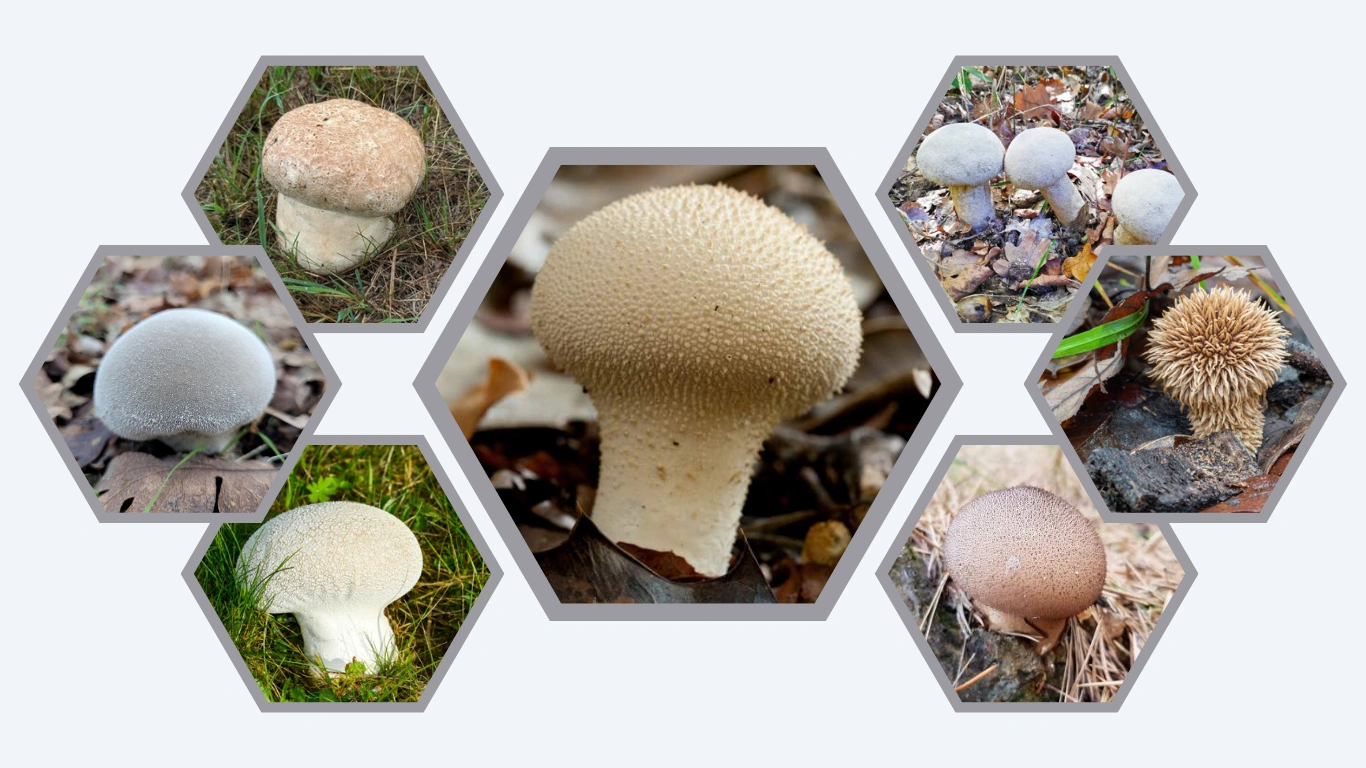
Puffball mushrooms are a fascinating group of fungi best known for their round, ball-like shape and their unique way of releasing spores in dusty “puffs.” They are found in a wide range of habitats, from grassy meadows and lawns to deep forest floors and decaying wood. Some puffballs are edible when young, while others are inedible or toxic, making proper identification extremely important. This guide introduces 17 common types of puffball mushrooms you’re likely to encounter.
1. Giant Puffball (Calvatia gigantea)

The giant puffball is one of the largest and most recognizable puffball mushrooms in the world. It is famous for its massive, round to oval fruiting body and its pure white interior when young. This species commonly appears in meadows, open woodlands, grassy fields, and lawns, often after periods of rain.
Identification
- Large, round to slightly oval fruiting body
- Usually white and smooth when young
- Can reach 10–70 cm in diameter
- No visible stem, cap, or gills
- Interior flesh pure white when edible, turning yellow-brown as it matures
Habitat
Giant puffballs grow on the ground in open, grassy areas such as pastures, fields, parks, forest edges, and sometimes suburban lawns. They are saprobic fungi, meaning they feed on decaying organic matter in the soil. They usually appear singly or in small groups.
Appearance
This mushroom looks like a huge white ball sitting directly on the ground. The outer skin is thin and smooth at first, later becoming cracked or slightly wrinkled with age. As it matures, the inside changes from solid white flesh to powdery brown spores.
Edibility
When young and completely white inside, the giant puffball is considered edible and is widely collected. It is often sliced and cooked like meat or used as a meat substitute. Once the interior begins to yellow or darken, it should not be eaten.
2. Common Puffball (Lycoperdon perlatum)

The common puffball is one of the most widespread and easily recognized puffball mushrooms. It is known for its small to medium size and its surface covered with tiny, pearl-like spines. When mature, it releases clouds of brown spores through a small opening at the top when pressed.
Identification
- Round to pear-shaped fruiting body
- White to cream when young
- Covered with small, soft spines or “pearls”
- Usually 2–7 cm tall
- Interior white when young, turning olive-brown with age
Habitat
Common puffballs grow on soil, leaf litter, decaying wood, and forest floors. They are often found in woodlands, gardens, and along paths, usually appearing in clusters during late summer and autumn.
Appearance
This species has a bulbous base with a narrower top, giving it a pear-shaped look. The outer surface is decorated with short spines that rub off easily, leaving a net-like pattern. As it matures, a pore forms at the top for spore release.
Edibility
When young and the inside is pure white, the common puffball is edible and mildly flavored. It is often sautéed, fried, or added to soups. Once the interior darkens or becomes powdery, it is no longer edible.
3. Pear-Shaped Puffball (Lycoperdon pyriforme)

The pear-shaped puffball is a small, clustered puffball mushroom best known for growing in dense groups on decaying wood. Its pear-like form, pale color, and soft spines make it easy to recognize. Unlike many puffballs that grow on soil, this species almost always appears on rotting logs or stumps.
Identification
- Pear-shaped to top-shaped fruiting body
- White to pale cream when young
- Fine spines or granules on the surface
- Usually 1.5–4 cm tall
- Interior pure white when young, olive-brown when mature
Habitat
Pear-shaped puffballs grow tightly packed on rotting hardwood and conifer wood. They are common on old stumps, fallen logs, and buried wood in forests, parks, and shaded areas. They often appear in large clusters after rainy periods.
Appearance
This puffball has a small rounded top with a narrowed base, giving it a pear-like silhouette. The surface is initially covered in tiny spines that wear off over time. Mature specimens develop a small opening at the top to release spores.
Edibility
When young and firm with a completely white interior, pear-shaped puffballs are edible and mild in taste. They are best cooked fresh. Once the flesh turns yellow or brown and powdery, they should not be eaten.
4. Gem-Studded Puffball (Lycoperdon perlatum var. gemmatum)

The gem-studded puffball is a close relative of the common puffball and is named for its jewel-like white spines that cover the surface when young. These small puffballs are popular with foragers because they are easy to identify and often appear in large numbers on forest floors.
Identification
- Small, round to pear-shaped fruiting body
- White to creamy when young
- Covered with raised, cone-shaped “gem” spines
- Usually 2–6 cm tall
- Interior solid white when young, becoming brown and powdery with age
Habitat
Gem-studded puffballs grow on soil, leaf litter, and decaying organic matter in woodlands. They are common in mixed forests, along trails, and in shaded park areas, especially from late summer through fall.
Appearance
This species has a rounded top and a short, narrowed base. The surface looks decorated with tiny white beads or studs that fall away as the mushroom matures, leaving a patterned skin. A pore develops at the top to release spores.
Edibility
Young gem-studded puffballs with a pure white interior are edible and mild. They are often sliced and sautéed or added to egg dishes and soups. Once the inside darkens, they are no longer suitable for consumption.
5. Meadow Puffball (Vascellum pratense)

The meadow puffball is a small to medium-sized puffball commonly found in grassy, open environments. It is especially frequent in lawns, pastures, and meadows, where it often appears scattered or in loose groups. Its neat shape and soft coloring make it one of the most familiar grassland puffballs.
Identification
- Round to slightly flattened fruiting body
- White to pale buff when young
- Smooth to finely granular surface
- Usually 3–7 cm across
- Interior white when young, turning yellow-brown with age
Habitat
Meadow puffballs grow directly on soil in lawns, fields, roadsides, and open grassy areas. They prefer nutrient-rich ground and often appear after rainfall from late summer into autumn.
Appearance
This puffball is usually squat and rounded, sometimes slightly flattened on top. The outer skin is thin and smooth at first, later developing cracks as it matures. A small pore forms at the top through which spores are released.
Edibility
When young and completely white inside, meadow puffballs are edible and tender. They are often cooked whole or sliced and used in stir-fries and soups. Once the flesh darkens, they should be avoided.
6. Purple-Spored Puffball (Calvatia cyathiformis)

The purple-spored puffball is a medium to large puffball best known for the purplish-brown spores it produces at maturity. It commonly grows in open grassy areas and is often seen alone or scattered rather than in tight clusters. Its size and smooth surface make it fairly easy to recognize.
Identification
- Round to pear-shaped fruiting body
- White to pale cream when young
- Smooth or finely cracked outer skin
- Usually 8–25 cm across
- Interior white when young, later turning purple-brown and powdery
Habitat
Purple-spored puffballs grow on soil in prairies, meadows, lawns, and open fields. They favor sunny, grassy habitats and often appear after rain from late summer into fall.
Appearance
This species is typically globe-shaped with a short, sometimes slightly narrowed base. As it matures, the outer skin may split or peel, and a pore forms at the top to release clouds of dark, purplish spores.
Edibility
When harvested young with a firm, white interior, purple-spored puffballs are edible and mild in flavor. They are often sliced and fried or used as a meat substitute. Mature specimens with dark interiors are not edible.
7. Brain Puffball (Calvatia craniiformis)

The brain puffball gets its name from its irregular, wrinkled surface that often resembles the folds of a human brain. It is a medium to large puffball species and is commonly found in open woods and grassy clearings. Its unusual shape makes it one of the easiest puffballs to recognize.
Identification
- Irregular, brain-like fruiting body
- White to pale cream when young
- Surface deeply wrinkled or lobed
- Usually 6–20 cm wide
- Interior solid white when young, becoming brown and powdery with age
Habitat
Brain puffballs grow on soil in hardwood forests, forest edges, and grassy openings. They are often found in leaf litter or on disturbed ground, appearing from summer through early autumn.
Appearance
This puffball is not perfectly round; instead, it forms a lumpy, folded mass with thick ridges. The outer skin may crack as it matures. A spore opening develops, allowing brown clouds of spores to escape when disturbed.
Edibility
Young brain puffballs with pure white flesh are edible and considered good quality. They are often sliced and cooked like other puffballs. Once the interior darkens, they should not be consumed.
8. Dark Puffball (Lycoperdon nigrescens)

The dark puffball is a small to medium puffball species recognized by its surface that darkens quickly as it matures. When young, it appears pale and soft, but it soon develops a brown to nearly black outer skin. It is commonly found in woodland habitats and often grows scattered on forest floors.
Identification
- Round to slightly pear-shaped fruiting body
- White when very young, turning dark brown to black
- Surface covered with fine spines that wear off
- Usually 2–6 cm wide
- Interior white when young, becoming dark brown and powdery with age
Habitat
Dark puffballs grow on soil and leaf litter in deciduous and mixed forests. They are often found along woodland paths, under trees, and in shaded areas. Fruiting usually occurs from late summer to autumn.
Appearance
This species starts off pale and softly textured, then quickly becomes darker and tougher on the outside. The spines fall away with age, leaving a smoother but darker surface. A small pore opens at the top for spore release.
Edibility
When very young and completely white inside, dark puffballs are edible, though they are not considered among the best-tasting puffballs. Once the interior changes color or becomes powdery, they are no longer suitable for eating.
9. Spiny Puffball (Lycoperdon echinatum)

The spiny puffball is a distinctive small puffball species covered in long, sharp-looking spines that give it a hedgehog-like appearance. These spines darken with age, making the mushroom stand out among leaf litter on forest floors. It is less common than many other puffballs but easy to recognize.
Identification
- Round to slightly pear-shaped fruiting body
- Covered with long, pointed spines
- White when young, becoming brown with age
- Usually 2–5 cm wide
- Interior white when young, later olive-brown and powdery
Habitat
Spiny puffballs grow on soil in deciduous woodlands, especially under beech and oak trees. They prefer rich, undisturbed forest floors and usually appear singly or in small groups in late summer and autumn.
Appearance
This puffball looks bristly and rough due to its tall spines, which may clump together at the tips. As the mushroom matures, the spines fall away or darken, and a pore forms at the top to release spores.
Edibility
When young and the interior is firm and white, spiny puffballs are edible, though they are not widely collected. Once the inside darkens, they should be avoided.
10. Lead-Colored Puffball (Bovista plumbea)

The lead-colored puffball is a small, smooth puffball named for its bluish-gray to lead-like tones as it matures. It is commonly found in short grass and disturbed ground. Despite its small size, it is a very widespread and frequently encountered puffball species.
Identification
- Small, round fruiting body
- White when young, becoming gray to lead-colored
- Smooth to slightly velvety surface
- Usually 1–4 cm across
- Interior white at first, later olive-brown and powdery
Habitat
Lead-colored puffballs grow on soil in lawns, pastures, roadsides, and open grassy places. They prefer compacted or disturbed ground and often appear in scattered groups after rainfall.
Appearance
This species looks like a tiny ball sitting directly on the ground with no visible stem. The outer skin peels away in patches as it ages, revealing a darker inner layer. A small opening forms at the top to release spores.
Edibility
When very young and pure white inside, lead-colored puffballs are edible but too small to be of much culinary value. Once the interior darkens, they are not edible.
11. Mosaic Puffball (Handkea utriformis)

The mosaic puffball is a medium to large puffball species known for the cracked, patchwork pattern that develops on its outer surface as it matures. This mosaic-like skin gives the mushroom a distinctive look. It commonly appears in grassy areas, pastures, and open woodland edges.
Identification
- Round to pear-shaped fruiting body
- White to pale cream when young
- Surface breaks into mosaic-like plates with age
- Usually 6–20 cm tall
- Interior solid white when young, becoming brown and powdery
Habitat
Mosaic puffballs grow on soil in meadows, fields, pastures, dunes, and forest edges. They prefer open or semi-open habitats and are often found alone or in small groups from summer through autumn.
Appearance
This puffball starts smooth and white, then its outer skin cracks into irregular patches separated by darker lines. As it matures, the top opens to allow spores to escape in dusty clouds.
Edibility
When young and completely white inside, mosaic puffballs are edible and mild. They can be sliced and cooked in a variety of dishes. Once the interior darkens, they should not be eaten.
12. Sculpted Puffball (Calvatia sculpta)

The sculpted puffball is a striking large puffball species recognized for its thick, sculpted ridges and geometric surface patterns. When young, it appears bright white and firm, but it becomes yellowish and then brown as it matures. It is mostly found in dry, open regions.
Identification
- Large, round to irregular fruiting body
- White to yellowish when young
- Thick, sculpted ridges on the surface
- Usually 8–30 cm across
- Interior white when young, turning brown and powdery with age
Habitat
Sculpted puffballs grow on sandy or dry soils in grasslands, deserts, and open scrub areas. They are especially associated with arid and semi-arid environments and often appear after seasonal rains.
Appearance
This puffball looks heavily textured, with raised plates and deep grooves over its surface. As it matures, the outer skin darkens and cracks, and spore-release openings develop at the top.
Edibility
Young sculpted puffballs with solid white flesh are edible and have been traditionally used as food in some regions. Once the interior begins to darken, they should not be consumed.
13. Smooth Puffball (Bovista dermoxantha)

The smooth puffball is a small puffball species valued for its nearly hairless, soft outer surface. When young, it looks like a tiny white ball resting on the soil. As it matures, it darkens and develops an opening at the top to release spores.
Identification
- Small, round fruiting body
- Smooth to slightly velvety surface
- White when young, turning gray-brown with age
- Usually 1–3 cm wide
- Interior white at first, later olive-brown and powdery
Habitat
Smooth puffballs grow on soil in grasslands, lawns, open fields, and lightly wooded areas. They prefer open ground and often appear scattered after rainfall.
Appearance
This puffball is almost perfectly spherical with no visible stem. The outer skin is thin and soft when young, later becoming papery and darker. A pore opens at the top to allow spores to escape.
Edibility
When very young and white inside, smooth puffballs are edible but very small and not commonly collected for food. Once the interior darkens, they are not edible.
14. Western Giant Puffball (Calvatia booniana)

The western giant puffball is a massive puffball species native mainly to western North America. It closely resembles the true giant puffball but is considered a separate species. It is known for its impressive size and its preference for open grasslands and woodland edges.
Identification
- Very large, round to slightly irregular fruiting body
- White to pale cream when young
- Smooth outer surface that may crack with age
- Often 15–60 cm across
- Interior solid white when young, later yellow-brown and powdery
Habitat
Western giant puffballs grow on soil in open fields, prairies, forest edges, and grassy clearings. They favor well-drained soils and often appear after periods of rain.
Appearance
This puffball usually looks like a huge white ball resting on the ground. As it matures, the skin becomes dull, may crack, and eventually opens to release large quantities of spores.
Edibility
When young and entirely white inside, western giant puffballs are edible and prepared similarly to giant puffballs. Once the flesh darkens, they should not be eaten.
15. Bowl Puffball (Calvatia cyathiformis var. fragilis)

The bowl puffball is a variation of the purple-spored puffball and is named for the shallow, bowl-like shape it sometimes develops as it matures. It is commonly found in grassy habitats and open landscapes. When fully mature, it often breaks open irregularly, giving it a cup-like appearance.
Identification
- Round to slightly flattened fruiting body
- White to pale buff when young
- Surface smooth to slightly cracked
- Usually 6–18 cm wide
- Interior white when young, later purple-brown and powdery
Habitat
Bowl puffballs grow on soil in meadows, lawns, prairies, and open fields. They prefer sunny, grassy environments and typically appear from late summer through autumn, often after rain.
Appearance
When young, this puffball is firm and rounded. With age, the outer skin may split unevenly, sometimes forming a shallow bowl shape. Mature specimens release dark spores through breaks in the surface.
Edibility
Young bowl puffballs with a completely white interior are edible and mild in flavor. They are usually sliced and cooked. Once the interior darkens or becomes powdery, they are no longer edible.
16. Purple Puffball (Lycoperdon atropurpureum)

The purple puffball is a small, distinctive puffball species named for the deep purplish-brown tones it develops as it matures. When young, it is pale and soft, but it soon darkens, making it easy to separate from lighter-colored puffballs. It is most often found in forested habitats.
Identification
- Small, round to pear-shaped fruiting body
- Pale when young, becoming dark purple-brown
- Surface finely granular or slightly spiny
- Usually 1.5–4 cm across
- Interior white at first, later dark brown to purple and powdery
Habitat
Purple puffballs grow on soil and leaf litter in deciduous and mixed forests. They prefer shaded woodland floors and often appear singly or scattered in late summer and autumn.
Appearance
This puffball starts off whitish, then quickly becomes darker and richer in color. The outer skin may crack slightly with age, and a small opening forms at the top to release spores.
Edibility
When very young and still white inside, purple puffballs are technically edible, but they are small and not widely collected. Once the interior darkens, they should not be eaten.
17. Pigskin Puffball (Scleroderma citrinum)

The pigskin puffball, also known as the common earthball, is a thick-skinned puffball-like mushroom often mistaken for true puffballs. It is called “pigskin” because of its tough, leathery outer surface. Unlike edible puffballs, its interior turns dark quickly and is not safe to eat.
Identification
- Round to irregular fruiting body
- Thick, tough, yellow-brown outer skin
- Surface often cracked or warty
- Usually 4–10 cm across
- Interior white briefly, then rapidly turning dark purple-black
Habitat
Pigskin puffballs grow on soil in woodlands, sandy ground, heathlands, and along forest paths. They often appear partially buried and are common in both deciduous and coniferous forests.
Appearance
This species looks heavier and rougher than true puffballs, with a thick rind and irregular shape. As it matures, it splits open to release dark, dusty spores.
Edibility
Pigskin puffballs are not edible and can cause gastrointestinal upset if eaten. They are important to mention because they are frequently confused with edible puffballs when young.
FAQs
Are all puffball mushrooms edible?
No, not all puffball mushrooms are edible. Only true puffballs with a completely white, solid interior are considered safe to eat. Puffball look-alikes, such as earthballs, quickly develop dark interiors and can be toxic. Always cut a puffball open before using it.
How can you tell if a puffball mushroom is fresh?
A fresh puffball is firm and pure white inside, with no yellow, brown, or purple coloring. If the interior is spongy, discolored, or powdery, the mushroom is mature and should not be eaten. Fresh puffballs also feel heavy for their size.
Where do puffball mushrooms usually grow?
Puffballs grow in many habitats, including meadows, lawns, open fields, forest floors, and rotting wood. Some species prefer grasslands, while others are more common in wooded areas. They often appear after rain, especially from late summer through autumn.
When is the best time to find puffball mushrooms?
The best time to find puffballs is usually from late summer to early fall, depending on climate and rainfall. They often emerge a few days after heavy rain when temperatures are mild and the soil remains moist.
What happens when a puffball matures?
As a puffball matures, the solid white interior turns yellow, brown, or purple and becomes a mass of powdery spores. A hole forms at the top, and when the mushroom is pressed by rain or animals, clouds of spores puff out into the air.