
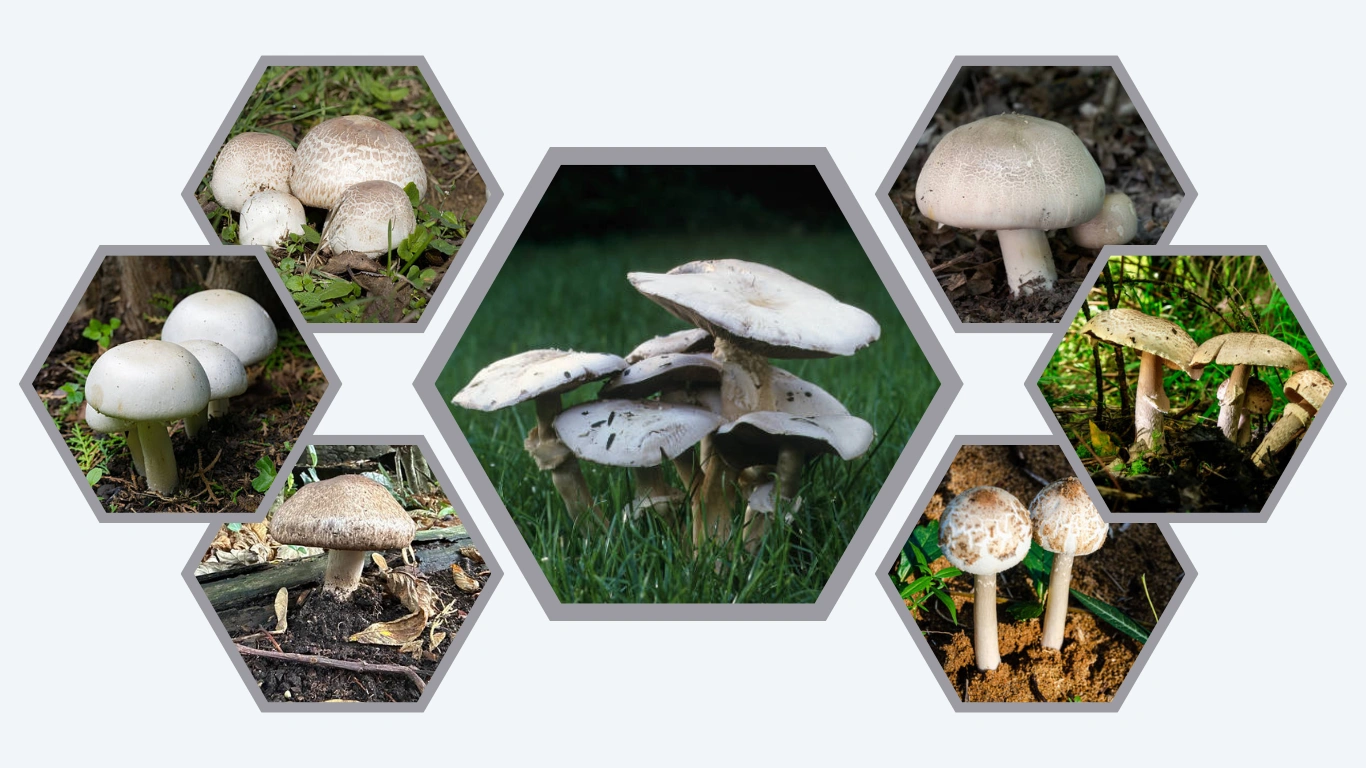
Button mushrooms belong to the genus Agaricus, one of the most well-known and widely distributed groups of mushrooms in the world. This genus includes the familiar white button, cremini, and portobello mushrooms, along with many wild relatives found in fields, forests, and gardens. Some Agaricus species are prized edibles, while others are toxic and require careful identification. Understanding the different types of button mushrooms helps foragers, growers, and food lovers recognize their diversity, uses, and important safety differences.
1. Agaricus bisporus (White Button Mushroom)

The white button mushroom is the most widely cultivated and consumed mushroom in the world. It belongs to the genus Agaricus and is the same species as cremini and portobello mushrooms, differing only by maturity. Young specimens are small, firm, and mild in flavor, making them extremely popular in everyday cooking, salads, soups, and commercial food production.
Identification
- Cap: Smooth, round, and white to off-white, usually 2–8 cm wide
- Gills: Pink when young, turning chocolate-brown with age
- Stem: Short, thick, and white with a small ring
- Flesh: Firm, white, and does not change color quickly when cut
- Spore print: Dark brown
Habitat
White button mushrooms are not commonly found growing wild in large numbers because they are mainly cultivated. In nature, wild relatives grow in grasslands, fields, compost-rich soils, and manured areas, especially in temperate regions.
Edibility & Uses
Agaricus bisporus is completely edible and valued for its mild taste and versatile texture. It is used raw in salads, sautéed, grilled, stuffed, or added to soups, sauces, pizzas, and stir-fries.
Growth & Cultivation
This mushroom is commercially grown on composted agricultural waste under controlled temperature, humidity, and light conditions. It matures quickly, making it one of the most economically important edible mushrooms worldwide.
2. Agaricus bisporus (Cremini Mushroom)

Cremini mushrooms, also called baby bella mushrooms, are simply a more mature form of the white button mushroom. They have a light to dark brown cap, a firmer texture, and a deeper, earthier flavor. Cremini mushrooms are very popular in cooking because they hold their shape well and add richer taste to soups, sauces, pasta dishes, and sautéed recipes.
Identification
- Cap: Smooth, light to dark brown, 3–10 cm wide
- Gills: Pale pink when young, turning dark brown with maturity
- Stem: Short, thick, off-white to light brown with a small ring
- Flesh: Firm, pale, may slightly brown when cut
- Spore print: Dark brown
Habitat
Like white button mushrooms, cremini mushrooms are primarily cultivated. Their wild forms naturally grow in grasslands, meadows, compost-rich soils, and manured fields, especially in mild and temperate climates.
Edibility & Uses
Cremini mushrooms are fully edible and prized for their stronger flavor compared to white buttons. They are commonly sautéed, roasted, grilled, or added to risottos, stews, omelets, pizzas, and meat dishes.
Growth & Cultivation
They are grown commercially on composted organic material in climate-controlled rooms. Cremini mushrooms are harvested after the white button stage, just before they develop into full portobello mushrooms.
3. Agaricus bisporus (Portobello Mushroom)

Portobello mushrooms are the fully mature form of Agaricus bisporus. They are large, flat, and dark brown, with a dense, meaty texture and rich, savory flavor. Because of their size and firmness, portobellos are often used as a meat substitute in burgers, sandwiches, and grilled dishes.
Identification
- Cap: Broad, flat to slightly domed, dark brown, 8–15 cm or wider
- Gills: Dark chocolate-brown, very crowded
- Stem: Short, thick, often removed before cooking
- Flesh: Dense, firm, and white to pale brown
- Spore print: Dark brown
Habitat
Portobello mushrooms are mainly cultivated, but wild relatives grow in grasslands, open woodlands, and compost-rich soils, especially in warm, temperate regions.
Edibility & Uses
Portobellos are completely edible and valued for their strong umami flavor. They are commonly grilled, roasted, stuffed, baked, or used as vegetarian steaks, burger patties, and pizza toppings.
Growth & Cultivation
They are grown the same way as white button and cremini mushrooms but are left to mature longer. This extended growth allows the caps to expand and the gills to fully develop.
4. Agaricus campestris (Field Mushroom)

The field mushroom is a classic wild Agaricus species commonly found in natural grasslands and pastures. It closely resembles the cultivated button mushroom but often has a richer aroma and flavor. For centuries, it has been collected as an edible wild mushroom and is one of the best-known species in the genus.
Identification
- Cap: White to slightly creamy, smooth, 5–10 cm wide
- Gills: Pink when young, turning dark brown as spores mature
- Stem: White, slender, with a thin ring
- Flesh: White, may slowly pink when cut
- Spore print: Chocolate-brown
Habitat
Agaricus campestris grows naturally in meadows, lawns, pastures, and grassy fields, often appearing in fairy rings after rainfall. It prefers rich soil and is widespread in temperate regions.
Edibility & Uses
The field mushroom is edible and highly regarded for its pleasant taste. It is commonly fried, added to soups, sauces, omelets, and traditional countryside dishes.
Growth & Season
It usually fruits from late spring through autumn, especially after rain. Unlike cultivated button mushrooms, it grows freely in the wild and is gathered seasonally by foragers.
5. Agaricus arvensis (Horse Mushroom)

The horse mushroom is a large, robust Agaricus species known for its impressive size and pleasant anise-like scent. It is often found in grassy habitats and is closely related to the field mushroom, though generally much bigger. Because of its mild taste and firm flesh, it is widely collected as an edible wild mushroom.
Identification
- Cap: White to cream, smooth, 8–20 cm wide
- Gills: Pale pink at first, becoming dark chocolate-brown
- Stem: Thick, tall, white, with a large, double ring
- Flesh: White, slowly yellowing when bruised
- Spore print: Dark brown
Habitat
Agaricus arvensis commonly grows in meadows, pastures, parks, and field edges, often in nutrient-rich soils. It appears in summer and autumn, sometimes forming large rings.
Edibility & Uses
This mushroom is edible and valued for its mild, slightly sweet flavor. It is often sliced and fried, added to soups, stews, and sauces, or used as a substantial meat substitute.
Growth & Season
Horse mushrooms fruit mainly from mid-summer to late autumn, especially after rainfall. They grow naturally in open grasslands rather than dense forests.
6. Agaricus augustus (The Prince)

Agaricus augustus, commonly called “the prince,” is one of the largest and most admired members of the Agaricus genus. It is known for its impressive size, brown-scaled cap, and strong almond-like aroma. This mushroom is highly valued by foragers and is often considered one of the finest-tasting wild Agaricus species.
Identification
- Cap: Large, brown to golden-brown with darker scales, 10–25 cm wide
- Gills: Pale pink when young, turning dark chocolate-brown
- Stem: Thick, white to brownish, with a large, hanging ring
- Flesh: White, may slightly yellow when cut
- Spore print: Dark brown
Habitat
The prince mushroom grows in woodlands, forest edges, parks, and along paths, especially near conifer and hardwood trees. It prefers rich soil and often appears singly or in small groups.
Edibility & Uses
This species is edible and famous for its rich, sweet, almond-like flavor. It is excellent sautéed, grilled, or added to creamy sauces, soups, and gourmet dishes.
Growth & Season
Agaricus augustus usually fruits from late summer through autumn. It often appears after warm rains and can persist for several weeks in favorable conditions.
7. Agaricus blazei (Almond Mushroom)

Agaricus blazei is a well-known Agaricus species famous for its strong almond-like aroma and its use both as an edible and medicinal mushroom. It is sometimes called the almond mushroom or Brazilian mushroom and is widely cultivated for food and health products. It has a firm texture and a pleasant, sweet flavor.
Identification
- Cap: White to light brown, smooth to slightly scaly, 6–12 cm wide
- Gills: Pale pink when young, becoming dark brown
- Stem: Thick, white, with a persistent ring
- Flesh: White, may yellow slightly when bruised
- Spore print: Dark brown
Habitat
In the wild, Agaricus blazei grows in grassy areas and forest edges in warm regions, especially in South America. Today, it is mostly cultivated under controlled conditions for commercial and medicinal use.
Edibility & Uses
This mushroom is edible and commonly used in stir-fries, soups, and teas. It is also widely dried and powdered for supplements due to its popularity in traditional and modern wellness products.
Growth & Cultivation
Agaricus blazei is grown commercially on composted substrates in warm, humid environments. It matures relatively quickly and is harvested when the caps are still firm.
8. Agaricus bitorquis (Pavement Mushroom)

Agaricus bitorquis, commonly known as the pavement mushroom, is a tough, urban-adapted species that often pushes up through compacted soil, asphalt edges, and sidewalk cracks. It is notable for its thick flesh, short stem, and double ring, and is one of the few Agaricus species frequently found in cities.
Identification
- Cap: White to off-white, smooth, firm, 5–12 cm wide
- Gills: Pink when young, becoming dark brown
- Stem: Short, very thick, with a distinct double ring
- Flesh: Dense, white, slowly staining pinkish
- Spore print: Dark brown
Habitat
This mushroom commonly grows in urban environments, along roadsides, gardens, parks, and compacted soils. It can emerge from beneath pavement, giving it its common name.
Edibility & Uses
Agaricus bitorquis is edible and has a mild, pleasant flavor. It is often sautéed, added to soups, pasta, and mixed vegetable dishes.
Growth & Season
It fruits from late spring through autumn and tolerates cooler and drier conditions better than many other Agaricus species.
9. Agaricus subrufescens (Sun Mushroom)

Agaricus subrufescens, often called the sun mushroom, is a widely cultivated Agaricus species valued for both culinary and medicinal purposes. It is known for its sweet, almond-like aroma, brownish cap, and firm texture. This mushroom is especially popular in Brazil and parts of Asia.
Identification
- Cap: Light brown to reddish-brown, smooth to slightly scaly, 5–12 cm wide
- Gills: Pale pink when young, turning dark chocolate-brown
- Stem: Thick, white to pale brown, with a strong ring
- Flesh: White, slowly yellowing when cut
- Spore print: Dark brown
Habitat
In nature, this species grows in grassy areas, forest edges, and rich soils in warm climates. Today, it is widely cultivated and rarely collected from the wild.
Edibility & Uses
The sun mushroom is edible and commonly cooked in soups, stir-fries, and teas. It is also dried and used in extracts and powders because of its popularity in traditional wellness practices.
Growth & Cultivation
It is grown on composted organic matter under warm, humid conditions and harvested while young for the best flavor and texture.
10. Agaricus silvicola (Wood Mushroom)

Agaricus silvicola, commonly known as the wood mushroom, is a pale, graceful Agaricus species often found in woodland habitats. It is recognized by its slender stem, soft white cap, and mild anise-like scent. This mushroom is frequently encountered by foragers in forested areas during warm and wet seasons.
Identification
- Cap: White to creamy, smooth, sometimes slightly yellowing, 5–10 cm wide
- Gills: Light pink when young, turning dark brown
- Stem: Slender, white, with a thin ring
- Flesh: White, slowly yellowing when cut
- Spore print: Dark brown
Habitat
This species grows in woodlands, forest edges, parks, and near leaf litter, often under both hardwood and conifer trees. It prefers rich, well-drained soils.
Edibility & Uses
Agaricus silvicola is considered edible and has a mild, pleasant flavor. It is commonly sautéed, added to soups, omelets, and light mushroom dishes.
Growth & Season
The wood mushroom fruits from late summer through autumn, especially after rainfall, and often appears singly or in small scattered groups.
11. Agaricus xanthodermus (Yellow Stainer)

Agaricus xanthodermus, known as the yellow stainer, is a common Agaricus species often confused with edible button mushrooms. It is best known for its bright yellow staining when bruised and its strong chemical or ink-like odor. This species is considered toxic and should not be eaten.
Identification
- Cap: White, smooth, sometimes with small scales, 5–12 cm wide
- Gills: Pink at first, turning dark brown
- Stem: White, with a noticeable ring, base often bulbous
- Flesh: Turns bright yellow rapidly when cut or bruised
- Spore print: Dark brown
Habitat
This mushroom grows in gardens, parks, lawns, compost piles, and forest edges. It is widespread in urban and suburban environments.
Toxicity & Effects
Agaricus xanthodermus is poisonous and can cause gastrointestinal distress such as nausea, vomiting, stomach cramps, and diarrhea. Its unpleasant chemical smell becomes stronger when cooked.
Growth & Season
It typically appears from late spring to autumn, often in groups, especially in disturbed or nutrient-rich soils.
12. Agaricus macrosporus

Agaricus macrosporus is a large, attractive Agaricus species known for its strong almond or anise-like fragrance and broad white cap. It is less common than many other button-type mushrooms but is well regarded where it occurs. Its pleasant aroma and firm flesh make it notable among European Agaricus species.
Identification
- Cap: White to creamy, smooth, broad, 8–20 cm wide
- Gills: Pale pink when young, becoming dark brown
- Stem: Thick, white, with a well-developed ring
- Flesh: White, slowly yellowing when cut
- Spore print: Dark brown
Habitat
This species typically grows in grasslands, pastures, open woodlands, and field edges. It prefers undisturbed soils and is most often recorded in temperate regions.
Edibility & Uses
Agaricus macrosporus is considered edible and valued for its pleasant taste and almond-like scent. It is usually cooked by frying, grilling, or adding to sauces and traditional mushroom dishes.
Growth & Season
It fruits mainly in summer and early autumn, often appearing singly or in small groups after periods of rain.
13. Agaricus impudicus

Agaricus impudicus is a lesser-known member of the Agaricus genus, notable for its white cap, dark gills at maturity, and distinctive odor that can range from almond-like to somewhat unpleasant, depending on age. It is an uncommon species and is mainly recorded in natural grassland habitats.
Identification
- Cap: White to cream, smooth, 5–10 cm wide
- Gills: Pink when young, becoming dark chocolate-brown
- Stem: White, slender to moderately thick, with a ring
- Flesh: White, may slowly discolor when cut
- Spore print: Dark brown
Habitat
This species is usually found in meadows, grassy clearings, and lightly wooded areas with rich soil. It appears singly or in small scattered groups.
Edibility & Notes
Agaricus impudicus is sometimes reported as edible, but it is not widely consumed due to its rarity and inconsistent odor. Accurate identification is important because of confusion with toxic Agaricus species.
Growth & Season
It typically fruits in summer and early autumn, especially after rainfall, in temperate regions.
14. Agaricus langei

Agaricus langei is a medium to large Agaricus species closely related to the field mushroom complex. It is recognized for its smooth white cap, sturdy stem, and mild mushroom aroma. Although not as famous as cultivated button mushrooms, it is a well-documented wild species in Europe and parts of Asia.
Identification
- Cap: White to off-white, smooth, 5–12 cm wide
- Gills: Pale pink when young, turning dark brown
- Stem: White, fairly thick, with a persistent ring
- Flesh: White, sometimes slightly yellowing when cut
- Spore print: Dark brown
Habitat
This species grows in grasslands, meadows, parks, and open woodland edges. It prefers nutrient-rich soils and often appears after summer rains.
Edibility & Uses
Agaricus langei is generally considered edible and has a mild, pleasant flavor. It is usually cooked before eating and used in similar ways to field mushrooms.
Growth & Season
It fruits from summer through autumn, often singly or in small groups in open habitats.
15. Agaricus moelleri

Agaricus moelleri is a white, smooth-capped Agaricus species that is often confused with edible button mushrooms. However, it belongs to the yellow-staining group and is known for its unpleasant chemical odor. Because of this and its toxic effects, it is not considered safe to eat.
Identification
- Cap: White to grayish-white, smooth, 5–12 cm wide
- Gills: Pink at first, turning dark brown with age
- Stem: White, with a noticeable ring and slightly swollen base
- Flesh: Quickly turns yellow, especially at the base when cut
- Spore print: Dark brown
Habitat
This species grows in parks, gardens, woodland edges, and grassy areas, often in nutrient-rich or disturbed soils.
Toxicity & Effects
Agaricus moelleri is poisonous and can cause stomach pain, nausea, vomiting, and diarrhea. The strong ink- or phenol-like smell is an important warning sign.
Growth & Season
It usually fruits from late spring to autumn, appearing singly or in groups, particularly after rain.
16. Agaricus placomyces

Agaricus placomyces is a distinctive white Agaricus species marked by grayish-brown scales on its cap and a strong chemical or inky odor. It belongs to the yellow-staining group and is commonly mistaken for edible button mushrooms. Due to its toxic properties, it should not be consumed.
Identification
- Cap: White with gray to brown scales, 5–12 cm wide
- Gills: Pink when young, becoming dark brown
- Stem: White, with a ring, base often bulbous
- Flesh: Quickly stains yellow when bruised or cut
- Spore print: Dark brown
Habitat
This mushroom grows in woodlands, forest edges, parks, and gardens, often under hardwood trees and in rich soils.
Toxicity & Effects
Agaricus placomyces is poisonous and can cause gastrointestinal upset, including nausea, vomiting, and abdominal cramps. Its chemical smell becomes stronger when cooked.
Growth & Season
It typically fruits from summer through autumn and is often found singly or scattered in mixed habitats.
17. Agaricus sylvaticus (Blushing Wood Mushroom)

Agaricus sylvaticus, commonly known as the blushing wood mushroom, is a woodland Agaricus species recognized for its brown-scaled cap and its tendency to slowly redden or blush when bruised. It is fairly common in forested areas and is often encountered by mushroom hunters in temperate regions.
Identification
- Cap: Brown with darker scales, 5–12 cm wide
- Gills: Pale pink at first, becoming dark chocolate-brown
- Stem: White to pale brown, slender, with a ring
- Flesh: Whitish, slowly turning pink to reddish when cut
- Spore print: Dark brown
Habitat
This species grows in coniferous and mixed woodlands, forest paths, and among leaf litter. It prefers well-drained forest soils and often appears after rainfall.
Edibility & Uses
Agaricus sylvaticus is generally considered edible when properly identified and cooked. It has a mild flavor and is commonly sautéed or added to forest mushroom dishes.
Growth & Season
It fruits from summer to autumn, often singly or in small groups in wooded habitats.
FAQs
Are button mushrooms and Agaricus mushrooms the same?
Button mushrooms belong to the genus Agaricus. The common white button, cremini, and portobello mushrooms are all the same species (Agaricus bisporus), just harvested at different stages of maturity. However, many other wild Agaricus species also exist, some edible and some poisonous.
How can you tell edible Agaricus from poisonous ones?
Edible Agaricus species usually smell pleasant (almond or mushroom-like) and may slowly yellow or not change much when cut. Poisonous types often stain bright yellow quickly and give off an inky, phenol, or chemical odor, especially near the stem base.
Where do Agaricus mushrooms commonly grow?
Agaricus mushrooms are most often found in grasslands, meadows, parks, gardens, forest edges, and compost-rich soils. Many species prefer open areas rather than deep forests and usually appear after rainfall during warm months.
Are all Agaricus mushrooms safe to eat?
No. While many Agaricus mushrooms are edible, several species are toxic and can cause serious stomach problems. Because edible and poisonous species can look very similar, wild mushrooms should never be eaten unless identified with complete certainty by an expert.
Can button mushrooms be grown at home?
Yes. Button mushrooms (Agaricus bisporus) are one of the easiest mushrooms to grow at home. They are cultivated on composted organic material in dark, humid environments and are widely available as beginner mushroom-growing kits.