
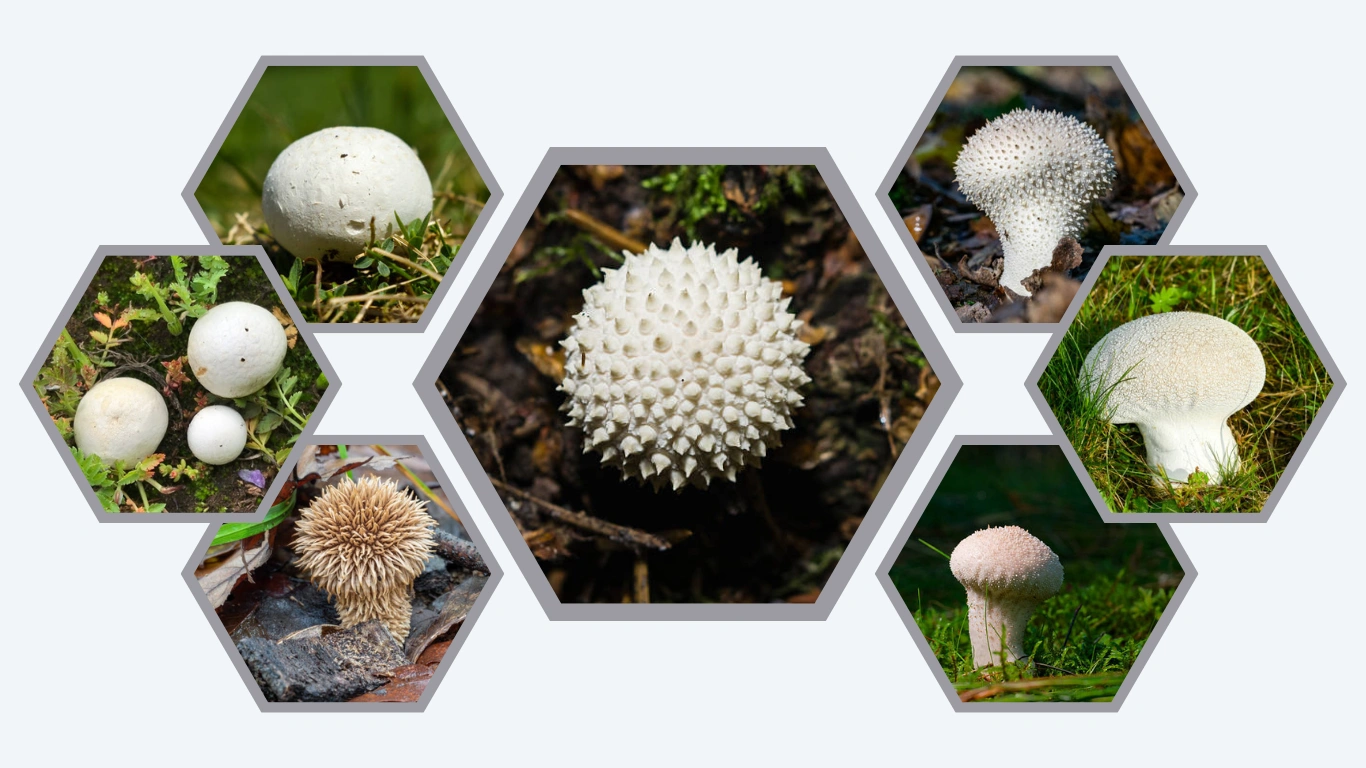
Puffball mushrooms are a unique group of fungi known for their round or pear-shaped bodies and their dramatic way of releasing spores in smoky “puffs.” Unlike typical mushrooms, they do not have visible gills or caps. Instead, their spores develop inside a soft interior that changes color as the mushroom matures. Found in forests, grasslands, and even lawns, puffballs range from tiny marble-sized species to massive giants larger than a football.
1. Giant Puffball (Calvatia gigantea)

The giant puffball is one of the most famous and easily recognized puffball mushrooms in the world. Known for its enormous size and smooth white surface, this species often appears in meadows, lawns, and open woodlands. When young, it looks like a large white ball resting on the ground. As it matures, it can grow to impressive dimensions and release clouds of brown spores when disturbed.
Identification
- Large, round to slightly oval shape, often resembling a white ball
- Size commonly 10–50 cm across, sometimes even larger
- Pure white, smooth outer surface when young
- Interior flesh solid, white, and marshmallow-like when edible
- Turns yellowish to brown inside as it matures
- Lacks a visible stem, cap, or gills
Habitat
Giant puffballs grow on the ground in grassy areas such as meadows, pastures, lawns, and open forest edges. They often appear singly or in small groups, especially after periods of rain. This species is widely distributed across North America, Europe, and parts of Asia, favoring nutrient-rich soils.
Edibility
When young and completely white inside, the giant puffball is considered an excellent edible mushroom. It has a mild flavor and a soft, bread-like texture that absorbs seasonings well. Once the interior begins turning yellow or brown, it is no longer suitable for eating.
Interesting Facts
The giant puffball holds records as one of the largest fruiting bodies in the fungal world. Some specimens have weighed over 20 kilograms. Historically, dried giant puffball flesh was used as a natural bandage to help stop bleeding.
2. Common Puffball (Lycoperdon perlatum)

The common puffball is one of the most widespread and easily identified puffball mushrooms, often recognized by its small size and pearl-like spines. It typically grows in forests, gardens, and along woodland paths. When young, it appears bright white and firm, but as it matures, the surface darkens and releases a cloud of brown spores when pressed.
Identification
- Small to medium-sized, pear-shaped or round fruiting body
- Usually 2–6 cm wide and 3–8 cm tall
- White surface covered with tiny, cone-shaped spines or “pearls”
- Spines rub off easily, leaving a net-like pattern
- Interior pure white and firm when young
- Turns olive-brown inside as it matures and becomes inedible
- Short, sterile base instead of a true stem
Habitat
Common puffballs grow on soil, decaying wood, and forest debris in both coniferous and deciduous forests. They are often found in clusters along trails, on rotting logs, or in shaded woodland areas. This species is widely distributed across North America, Europe, and Asia.
Edibility
When the inside is completely white and solid, the common puffball is edible and considered fairly good. It has a mild, slightly earthy flavor and is often sliced and sautéed. Any yellowing or browning inside means it should not be eaten.
Interesting Facts
The name Lycoperdon means “wolf’s fart,” referring to the way mature puffballs release spores in smoky puffs. This species was once used in folk medicine, where the dried spore mass was applied to minor cuts to help stop bleeding.
3. Pear-Shaped Puffball (Apioperdon pyriforme)

The pear-shaped puffball is a small but very common puffball mushroom, especially noticeable because it often grows in dense clusters on decaying wood. Its soft, pear-like shape and pale coloring make it easy to spot on rotting logs and stumps. When young, it is firm and white inside, later turning brown as it fills with spores.
Identification
- Small, pear-shaped to club-shaped fruiting body
- Usually 2–5 cm tall and 1.5–4 cm wide
- Pale white to creamy surface, sometimes yellowish with age
- Fine granules or tiny spines on the outer skin
- Narrow sterile base instead of a true stem
- Interior pure white and firm when young
- Becomes olive-brown and powdery inside at maturity
Habitat
Pear-shaped puffballs grow mainly on rotting wood, including old logs, stumps, and buried roots. They are commonly found in large, tight clusters in forests, parks, and even landscaped areas. This species is widespread across temperate regions of North America, Europe, and Asia.
Edibility
This puffball is edible only when young and completely white inside. It has a mild flavor and soft texture, making it suitable for frying or adding to soups. Once the interior begins to yellow or brown, it should not be consumed.
Interesting Facts
Unlike many puffballs that grow on soil, the pear-shaped puffball prefers decaying wood, which helps distinguish it from similar species. When fully mature, a small opening forms at the top, allowing clouds of spores to puff out when raindrops hit it.
4. Meadow Puffball (Vascellum pratense)

The meadow puffball is a small, round puffball commonly found in open grassy areas such as lawns, fields, and pastures. It is often overlooked because of its size, but it is one of the most familiar puffballs in human-managed landscapes. When young, it is bright white and firm, later turning yellowish to brown as it matures and releases spores.
Identification
- Small, round to slightly flattened shape
- Usually 1.5–5 cm wide
- Smooth to finely granular white surface when young
- Often has a slightly wrinkled or cracked outer skin with age
- Clear separation inside between spore mass and sterile base
- Interior solid white when young, later yellow-brown
- Lacks a true stem and visible gills
Habitat
Meadow puffballs grow on soil in lawns, meadows, pastures, golf courses, and open grassy areas. They often appear after rain, scattered or in small groups. This species is widely distributed in North America, Europe, and other temperate regions.
Edibility
When young and completely white inside, the meadow puffball is edible and mild in flavor. It is usually sliced and pan-fried or added to mixed mushroom dishes. Any discoloration inside means it is no longer suitable for eating.
Interesting Facts
Unlike many other puffballs, the meadow puffball has a thin internal membrane that separates the spore mass from the sterile base. This feature helps mycologists distinguish it from similar lawn-dwelling puffball species.
5. Mosaic Puffball (Handkea utriformis)

The mosaic puffball is a medium to large puffball mushroom recognized by its thick outer skin that cracks into irregular, mosaic-like patches as it matures. It often looks like a weathered, tan ball sitting on the ground. When young, the inside is firm and white, but it gradually darkens and fills with spores.
Identification
- Round to slightly pear-shaped fruiting body
- Commonly 6–15 cm wide
- Thick outer skin that breaks into mosaic or plate-like patches
- White to pale cream when young, turning tan or brown with age
- Base often slightly narrowed but without a true stem
- Interior pure white and solid when young
- Becomes dark brown and powdery inside at maturity
Habitat
Mosaic puffballs grow on soil in grasslands, meadows, forest edges, and open woodland areas. They are often found singly or scattered rather than in dense clusters. This species is common across Europe, North America, and parts of Asia, especially in undisturbed grassy habitats.
Edibility
Young mosaic puffballs are edible when the flesh is completely white and firm. They have a mild, slightly nutty flavor and are best sliced and cooked thoroughly. Once the interior starts turning yellow or brown, they should be avoided.
Interesting Facts
The scientific name utriformis refers to its “wineskin-like” shape. The cracked, tile-like surface pattern is one of the easiest ways to distinguish this puffball from smoother species.
6. Skull-Shaped Puffball (Calvatia craniiformis)

The skull-shaped puffball is a striking puffball species named for its irregular, brain- or skull-like form. Instead of being perfectly round, it often develops folds and lobes, giving it a sculpted appearance. When young, it is bright white and firm inside, later becoming yellowish to brown as it matures and fills with spores.
Identification
- Irregular, lobed, or skull-like shape rather than perfectly round
- Usually 8–20 cm across
- White to creamy outer surface when young, often slightly wrinkled
- Surface may crack or discolor with age
- No true stem, but sometimes a narrowed base
- Interior solid white when young
- Turns yellow, then brown and powdery at maturity
Habitat
Skull-shaped puffballs grow on soil in open woods, forest edges, old fields, and grassy clearings. They may appear singly or in scattered groups, often after warm rains. This species is most common in North America, especially in hardwood forest regions.
Edibility
This puffball is edible only in the young stage, when the inside is completely white and firm. It has a mild flavor and is usually sliced and cooked. Any sign of yellowing or browning inside means it should not be eaten.
Interesting Facts
Because of its unusual shape, this puffball is sometimes mistaken for a decaying object rather than a mushroom. Mature specimens release enormous clouds of spores when struck by raindrops or stepped on, creating a dramatic “smoke puff” effect.
7. Purple-Spored Puffball (Calvatia cyathiformis)

The purple-spored puffball is a medium-sized puffball notable for the distinctive purplish-brown color of its mature spores. When young, it is smooth, round, and white, blending easily into grassy environments. As it ages, the outer surface darkens and cracks, and the inside gradually turns from white to deep purple-brown.
Identification
- Round to slightly flattened fruiting body
- Typically 5–15 cm wide
- Smooth white surface when young, becoming tan to brown
- Outer skin often cracks into irregular patches
- No true stem, but a slightly narrowed base may be present
- Interior pure white and firm when young
- Becomes purple-brown and powdery inside at maturity
Habitat
Purple-spored puffballs grow on soil in open grasslands, prairies, lawns, and light woodland edges. They are commonly found singly or scattered rather than in clusters. This species is widespread in North America and parts of Central America.
Edibility
When young and completely white inside, this puffball is edible and mild in taste. It can be sliced and fried or used in mixed mushroom dishes. Once the interior begins turning yellow, brown, or purple, it is no longer edible.
Interesting Facts
This species is especially valued by mycologists because its spore mass turns a deep purplish shade instead of the usual brown. In some regions, it is one of the most common large puffballs found in open prairie habitats.
8. Lead-Gray Puffball (Bovista plumbea)

The lead-gray puffball is a small, smooth puffball that often appears in lawns and open grassy places. It gets its name from the grayish tone it develops as it matures. When young, it is white and firm inside, but with age the outer surface darkens and the interior fills with fine brown spores.
Identification
- Small, round to slightly flattened fruiting body
- Usually 1–4 cm wide
- Smooth outer surface, white when young
- Turns grayish, bluish-gray, or lead-colored with age
- Lacks a true stem and often sits directly on the ground
- Interior solid white when young
- Becomes brown and powdery inside at maturity
Habitat
Lead-gray puffballs grow on soil in lawns, meadows, fields, roadsides, and grassy clearings. They often appear after rain, scattered or in small groups. This species is widespread across North America, Europe, and many other temperate regions.
Edibility
This puffball is edible only when very young and completely white inside. Because of its small size, it is usually collected only in quantity. Any discoloration of the interior indicates it should not be eaten.
Interesting Facts
Unlike many puffballs, mature lead-gray puffballs often detach easily from the ground and can roll in the wind, helping to spread their spores over a wider area.
9. Spiny Puffball (Lycoperdon echinatum)

The spiny puffball is a distinctive small puffball mushroom known for its long, soft spines that cover the outer surface when young. These spines give it a shaggy, almost hedgehog-like appearance. Over time, the spines fall away, leaving a darker, net-like pattern as the mushroom matures.
Identification
- Small to medium-sized, round to pear-shaped fruiting body
- Usually 2–6 cm wide
- Covered in long, pale spines when young
- Spines rub off with age, exposing a darker surface
- Short sterile base instead of a true stem
- Interior pure white and firm when young
- Turns olive-brown and powdery inside at maturity
Habitat
Spiny puffballs grow on soil in deciduous forests, woodland edges, and shaded clearings. They are often found singly or in small groups, especially in leaf litter-rich areas. This species is distributed across Europe, North America, and parts of Asia.
Edibility
This puffball is edible only in the young stage when the interior is completely white. It has a mild flavor and tender texture but is less commonly collected than smoother puffball species.
Interesting Facts
The long spines of Lycoperdon echinatum help distinguish it from the gem-studded puffball, which has much shorter, pearl-like bumps instead of soft spines.
10. Smooth Puffball (Bovista nigrescens)

The smooth puffball is a small, round puffball mushroom with a clean, nearly featureless surface compared to many spiny puffballs. When young, it is white and firm, blending easily into grassy environments. As it matures, the outer skin darkens and the inside transforms into a fine brown spore mass.
Identification
- Small, round fruiting body
- Usually 2–5 cm wide
- Smooth or very finely textured outer surface
- White when young, becoming gray-brown to dark brown
- Lacks a true stem and often sits loosely on the ground
- Interior solid white when young
- Turns dark brown and powdery inside at maturity
Habitat
Smooth puffballs grow on soil in meadows, lawns, open fields, and grassy woodland edges. They are often found scattered or in small groups, especially after rainfall. This species occurs in many temperate regions worldwide.
Edibility
This puffball is edible only when very young and completely white inside. Due to its small size and thin flesh, it is not considered a prime edible species, but it can be used mixed with other young puffballs.
Interesting Facts
Mature smooth puffballs frequently break free from the soil and act like tiny “tumbleweeds,” rolling in the wind and releasing spores through small openings as they move.
11. Warty Puffball (Lycoperdon mammiforme)

The warty puffball is a medium-sized puffball mushroom recognized by its thick skin and large, plate-like warts that often peel away in patches. When young, it appears white and firm, but as it matures the surface breaks up and the interior gradually turns brown and powdery.
Identification
- Round to pear-shaped fruiting body
- Commonly 4–10 cm wide
- Thick outer skin with large, soft warts or patches
- White to cream when young, later tan to brown
- Often with a short sterile base instead of a true stem
- Interior pure white and solid when young
- Becomes olive-brown and powdery inside at maturity
Habitat
Warty puffballs grow on soil in deciduous forests, woodland edges, and shaded grassy areas. They are often found singly or scattered rather than in dense clusters. This species is distributed across Europe, North America, and parts of Asia.
Edibility
This puffball is edible when young and completely white inside. It has a mild taste and soft texture and is best cooked before eating. Any yellowing or browning of the interior means it should be discarded.
Interesting Facts
As the warty puffball ages, its outer skin often flakes off in large pieces, giving it a rough, cracked appearance that helps distinguish it from smoother puffball species.
12. Brown Puffball (Bovista dermoxantha)

The brown puffball is a small to medium-sized puffball that quickly develops darker tones compared to many other puffball species. When young, it is pale and firm, but it soon turns brown on the outside as the inner spore mass matures. Its simple, rounded form allows it to blend easily into dry grass and soil.
Identification
- Small to medium, round fruiting body
- Usually 2–6 cm wide
- Smooth to finely textured outer surface
- Pale cream when young, becoming yellow-brown to dark brown
- Lacks a true stem and sits directly on the ground
- Interior solid white when young
- Turns brown and powdery inside at maturity
Habitat
Brown puffballs grow on soil in dry meadows, grasslands, open fields, and sandy or disturbed areas. They may appear singly or scattered in small groups. This species is found in various temperate and subtropical regions.
Edibility
This puffball is edible only when young and completely white inside. Because it darkens relatively quickly, careful checking is needed before consumption. Once the interior discolors, it should not be eaten.
Interesting Facts
Many Bovista species, including this one, often detach from the ground when mature and roll with the wind, helping spread their spores over wide open habitats.
13. Desert Puffball (Battarrea phalloides)

The desert puffball is an unusual puffball species adapted to dry, sandy environments. Unlike round ground-hugging puffballs, it develops a tall, woody stalk that lifts the spore case above the soil. When young, the spore sac is firm and pale, but it later dries out and releases clouds of brown spores through openings in the top.
Identification
- Tall, stalked puffball with a round spore case on top
- Total height usually 10–30 cm
- Spore sac pale to light brown, becoming papery with age
- Stalk tough, fibrous, and woody
- Base often rooted in sandy soil
- Interior white when very young
- Becomes brown and powdery inside at maturity
Habitat
Desert puffballs grow in arid and semi-arid regions, including deserts, dry scrublands, and sandy plains. They are often found in nutrient-poor soils and open, sunny locations. This species occurs in parts of Africa, southern Europe, Asia, and the Americas.
Edibility
This puffball is generally not considered edible. The flesh becomes tough very quickly, and by the time it is noticeable, it is usually already dry and filled with spores.
Interesting Facts
The tall stalk helps elevate the spore mass so wind can carry spores long distances. This adaptation makes Battarrea phalloides one of the most distinctive puffballs in the world.
14. Long-Spined Puffball (Lycoperdon pulcherrimum)

The long-spined puffball is a striking small puffball species covered with conspicuously long, white spines when young. These spines give it a shaggy, decorative appearance. As it ages, the spines fall away, revealing a darker surface beneath and allowing spores to escape from an opening at the top.
Identification
- Small, round to pear-shaped fruiting body
- Usually 2–6 cm wide
- Densely covered with long, soft white spines when young
- Spines shed with age, leaving a patterned surface
- Short sterile base instead of a true stem
- Interior pure white and firm when young
- Turns brown and powdery inside at maturity
Habitat
Long-spined puffballs grow on soil in forests, woodland edges, and shaded clearings. They are often found singly or in small groups, especially in warm, humid environments. This species is most common in North and Central America.
Edibility
This puffball is edible only when very young and completely white inside. It has a mild flavor but is not widely harvested due to its small size.
Interesting Facts
Because of its ornate spines, this species is sometimes called one of the most beautiful puffballs. The spines help protect the young fruiting body before falling off as it matures.
15. Steppe Puffball (Calvatia candida)

The steppe puffball is a medium to large puffball species commonly associated with dry grasslands and open steppe environments. It usually appears as a pale, rounded mass sitting directly on the soil. When young, the inside is firm and white, but with maturity it darkens and fills with powdery spores.
Identification
- Round to slightly flattened fruiting body
- Commonly 6–18 cm wide
- Smooth to finely cracked outer surface
- White to creamy when young, later yellowish to light brown
- Base often slightly narrowed but without a true stem
- Interior pure white and solid when young
- Turns brown and powdery inside at maturity
Habitat
Steppe puffballs grow on soil in open grasslands, dry meadows, plains, and steppe regions. They favor sunny, well-drained areas and often appear after seasonal rains. This species is found across parts of Europe and Central Asia.
Edibility
This puffball is edible only when young and the interior is completely white. It has a mild flavor and can be sliced and cooked like other edible puffballs. Any yellowing or browning inside indicates it is no longer suitable for eating.
Interesting Facts
The species name candida refers to its bright white color when young. It is well adapted to dry, windy habitats where its mature spores can be easily dispersed.
16. Brain Puffball (Calvatia rubroflava)

The brain puffball is a rare and unusual puffball species named for its convoluted, brain-like surface. Instead of being smooth and round, it develops folds and lobes that give it a wrinkled appearance. When young, it is pale and firm, but as it matures the outer skin darkens and the inside turns into a brown, powdery spore mass.
Identification
- Irregular, lobed, brain-like fruiting body
- Usually 6–15 cm across
- Pale cream to light yellow surface when young
- Surface becomes wrinkled and darker with age
- No true stem, sometimes a slightly narrowed base
- Interior solid white when young
- Turns brown and powdery inside at maturity
Habitat
Brain puffballs grow on soil in grasslands, forest edges, and open woodlands. They are uncommon and usually found singly rather than in groups. This species has been reported from parts of North America and Asia.
Edibility
This puffball is considered inedible due to its rarity and uncertain edibility status. It should be admired and left in place rather than collected.
Interesting Facts
Because of its folded surface, this puffball is sometimes mistaken for a piece of coral or a brain-like fungus. Its unusual form makes it one of the most visually distinctive members of the Calvatia genus.
17. Giant Brain Puffball (Calvatia craniiformis var. lobata)

The giant brain puffball is a rare puffball form known for its strongly folded, brain-like surface. Instead of being smooth and round, it develops deep lobes and ridges that make it look sculpted. When young, it is pale and firm inside, but as it matures, the interior darkens and becomes filled with powdery spores.
Identification
- Large, irregular, deeply lobed fruiting body
- Often 10–25 cm across
- Surface strongly wrinkled or brain-like
- White to creamy when young, later yellowish to brown
- No true stem, sometimes with a narrowed base
- Interior solid white when young
- Turns brown and powdery inside at maturity
Habitat
Giant brain puffballs grow on soil in open woods, forest edges, grassy clearings, and old fields. They are usually found singly and are much less common than smooth giant puffballs. This form is mainly reported from North America.
Edibility
Like other large puffballs, it is edible only when very young and completely white inside. Because of its rarity and odd form, many foragers prefer not to collect it.
Interesting Facts
Its dramatic folds increase the surface area of the outer skin, giving it a unique look among puffballs. Many people mistake it for a coral fungus or a deformed giant puffball when first encountered.
FAQs
What is a puffball mushroom?
A puffball mushroom is a type of fungus that produces spores inside a round or pear-shaped body instead of on gills. When mature, the outer skin opens and releases a cloud of spores if pressed or struck. Puffballs commonly grow on soil, grasslands, or decaying wood.
How can you tell if a puffball mushroom is edible?
A puffball is edible only when the inside is completely white, firm, and uniform, like fresh cheese or a marshmallow. If the interior shows any yellow, brown, or purple coloration, or a developing mushroom shape, it should not be eaten.
Where do puffball mushrooms usually grow?
Puffball mushrooms grow in a wide range of habitats, including lawns, meadows, forests, woodland edges, and rotting logs. Some species prefer open grassy areas, while others are found mainly on decaying wood. They often appear after rainfall in warm seasons.
Are there poisonous puffballs?
True puffballs are not poisonous, but dangerous lookalikes exist, especially young poisonous Amanita mushrooms that resemble small white balls. Cutting a puffball in half is essential. A true puffball is solid white inside, while a toxic lookalike shows a developing cap and stem.
When is the best time to find puffball mushrooms?
Puffball mushrooms are most commonly found from late summer through autumn, depending on climate. They often appear after heavy rain followed by warm weather. Open fields, lawns, and forest edges are especially productive places to search during peak season.